Taiwan's AI Basic Act Is Quietly Challenging Brussels on How to Govern Intelligent Systems
Taiwan's principles-based AI Basic Act is drawing serious attention from European regulators and policymakers who are wrestling with the implementation headaches of the EU AI Act. As Brussels grapples with compliance complexity, Taipei's lighter, sector-led framework raises an uncomfortable question: did Europe over-engineer its landmark legislation from the start?
Europe built an encyclopaedia. Taiwan wrote a constitution. As the EU AI Act moves from political triumph to operational nightmare, a small democracy with an outsized semiconductor industry is demonstrating that you can govern transformative technology without burying it under conformity assessments and risk pyramids. The lessons are directly relevant to every public-sector AI programme running from Lisbon to Warsaw.
[[KEY-TAKEAWAYS:Taiwan's AI Basic Act uses broad principles rather than prescriptive risk categories, keeping rule-making with sector experts.|The EU AI Act's compliance burden is already drawing criticism from startups and member-state regulators alike.|A sandbox clause separates research freedom from real-world deployment accountability, a model Brussels has not fully adopted.|Two contrasting governance philosophies are now competing for global influence, with smaller economies watching closely.|European policymakers could adopt sector-led flexibility without scrapping the AI Act's rights-based foundations.]]
Advertisement
The Regulation That Bit Back
When OpenAI's Sam Altman hinted the company might exit Europe over the EU AI Act, the message landed hard in Brussels and Berlin alike: regulation has teeth, and they bite. The EU's landmark legislation is built around a risk pyramid. Every AI system gets sorted into one of four boxes: banned outright, high-risk with a heavy compliance load, limited risk with transparency obligations, or minimal risk with virtually no restrictions. On paper, it is a rational architecture. In practice, it is generating exactly the friction that innovation-focused policymakers feared.
Consider a medical AI startup operating out of, say, Amsterdam or Zurich. Under EU rules, the founding team must first determine which risk category their diagnostic tool falls into, then work through conformity assessments, technical documentation packages, quality management systems, and post-market monitoring obligations, all before a single patient benefits. Margrethe Vestager, former European Commission Executive Vice-President responsible for digital policy, acknowledged in 2023 that implementation timelines would be challenging for smaller operators, though she maintained the framework was necessary to build public trust. That trust argument is sound; the compliance mechanics, less so.
What Taiwan Is Actually Doing Differently
Taiwan's draft AI Basic Act, advanced by the Ministry of Digital Affairs and the National Science and Technology Council in 2024, sets broad principles rather than detailed prescriptions: fairness, transparency, accountability, and meaningful human oversight. It then delegates the specifics to sector regulators who actually understand the domain risks involved. Financial regulators write the fintech rules. Health authorities set the medical AI standards. Generalist lawmakers do not try to anticipate every edge case in every vertical.
This is not regulatory laziness. It is a deliberate acknowledgement that one rulebook cannot sensibly govern a hospital triage algorithm and a credit-scoring engine with equal precision. The approach shares something with the thinking of Yoshua Bengio, the Turing Award-winning AI safety researcher who has consistently argued that governance frameworks must be adaptive rather than static, and that prescriptive rules crystallised at a single point in time will be outpaced by the technology they seek to govern.
The most practically significant element is the sandbox clause. Research and development activity receives explicit regulatory breathing room. The accountability obligations kick in at the moment of real-world deployment, when the system begins affecting actual people and environments. Experiment freely; deploy responsibly. It is a cleaner line than the EU AI Act currently draws for research exemptions.
How the Frameworks Compare
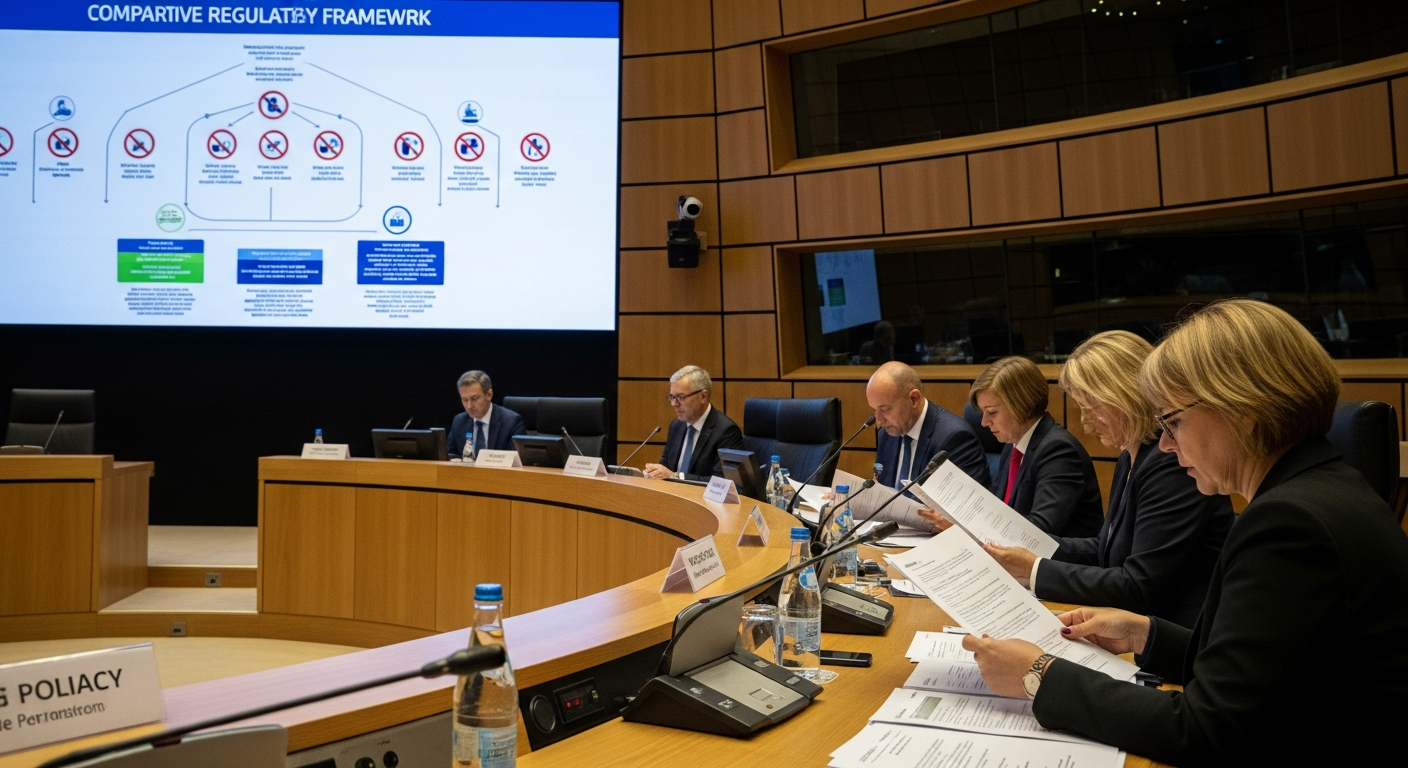
The contrasts between major approaches are stark enough to be worth laying out directly:
EU AI Act: risk-based categories with mandatory pre-market compliance, extensive technical documentation, and significant barriers for high-risk deployments, particularly in public-sector contexts such as law enforcement, benefits administration, and education.
Taiwan AI Basic Act: principles plus sector-specific rules, flexible implementation timelines, and an explicit research sandbox that separates experimentation from deployment accountability.
Singapore's Model AI Governance Framework: voluntary guidelines and industry adoption, explicitly market-friendly and non-binding, with limited enforcement teeth.
China's approach: state-security orientation with broad administrative discretion, giving authorities wide powers to restrict applications deemed threatening to social stability.
Europe sits at the most prescriptive end of this spectrum. That is partly intentional: the EU AI Act was designed to be the global benchmark, to export the Brussels Effect to AI governance the way GDPR exported it to data protection. That ambition is legitimate. The question is whether the implementation mechanics support or undermine it.
The European Implementation Problem
The EU AI Act entered into force on 01/08/2024, with a phased implementation schedule running through to 2027. Member states are already flagging resource constraints in standing up national competent authorities. The European AI Office, established within the Commission to oversee the most powerful general-purpose AI models, is operational but stretched. And the technical standards that underpin conformity assessments are still being finalised by CEN-CENELEC, the European standardisation bodies tasked with producing them.
Sandra Wachter, Professor of Technology and Regulation at the Oxford Internet Institute and one of Europe's most cited AI governance academics, has argued publicly that the Act's risk categorisation relies on assumptions about AI system boundaries that may not hold as models become more general-purpose. Her concern is that the static risk boxes will require constant amendment as capabilities evolve, creating regulatory churn that disadvantages European operators relative to competitors in jurisdictions with more adaptive frameworks.
That is precisely where Taiwan's principles-based model has an edge. If the principles are durable, the sector-specific rules can be updated without reopening primary legislation. The EU's approach bakes assumptions into statute; Taiwan's bakes them into guidance, which is far easier to revise.
What European Public Sector AI Buyers Should Take From This
For procurement officials, technology ministers, and agency heads across the EU and UK, the Taiwan framework raises several concrete questions worth asking of your own governance structures:
Are your sector regulators, the bodies that understand healthcare data, welfare algorithms, and border management systems, actually writing the detailed AI rules, or are generalist compliance teams doing it?
Do your internal AI governance frameworks distinguish clearly between research pilots and live deployments, with different accountability obligations for each?
Is your organisation prepared for the EU AI Act's high-risk compliance requirements in areas such as biometric identification, education, and employment screening, where public bodies are frequently the deploying entity?
Are you monitoring adaptive governance models internationally, rather than treating the EU AI Act as the settled final word on responsible AI deployment?
The UK's approach post-Brexit is worth noting here. The Government's AI regulation white paper, published in 2023 and refreshed in 2024, deliberately adopted a principles-based, sector-led model closer in spirit to Taiwan than to Brussels. The Department for Science, Innovation and Technology has explicitly framed this as a competitive differentiator, arguing that flexible frameworks attract investment and allow faster iteration. Whether that proves correct over a five-year horizon remains to be seen, but the strategic logic mirrors what Taipei is attempting.
Key principles emerging from Taiwan's governance experiment include:
Sector-specific expertise produces better rules than one-size-fits-all legislation.
Research freedom and deployment accountability can be separated cleanly with a sandbox clause.
International credibility does not require adopting the most prescriptive available framework.
Adaptive governance outperforms static categorisation as AI capabilities evolve rapidly.
Human oversight requirements should scale proportionally with the risk level of real-world impact.
Taiwan's regulatory experiment matters beyond the island's own borders. As economies worldwide grapple with governing transformative technology, the evidence from Taipei is that you do not have to choose between innovation paralysis and a regulatory vacuum. The smartest frameworks leave room to learn. Whether the EU AI Act, for all its ambition, leaves enough of that room is now the central question for European AI governance.
Updates
published_at reshuffled 2026-04-29 to spread distribution per editorial directive
AI Terms in This Article6 terms
benchmark
A standardized test used to compare AI model performance.
transformative
Causing a major change in form, nature, or function.
responsible AI
Developing and deploying AI with consideration for ethics, fairness, and safety.
AI governance
The policies, standards, and oversight structures for managing AI systems.
AI safety
Research focused on ensuring AI systems behave as intended without causing harm.
sandbox
A controlled testing environment for trying out new technologies or regulations.
Advertisement
Comments
Sign in to join the conversation. Be civil, be specific, link your sources.





Comments
Sign in to join the conversation. Be civil, be specific, link your sources.