

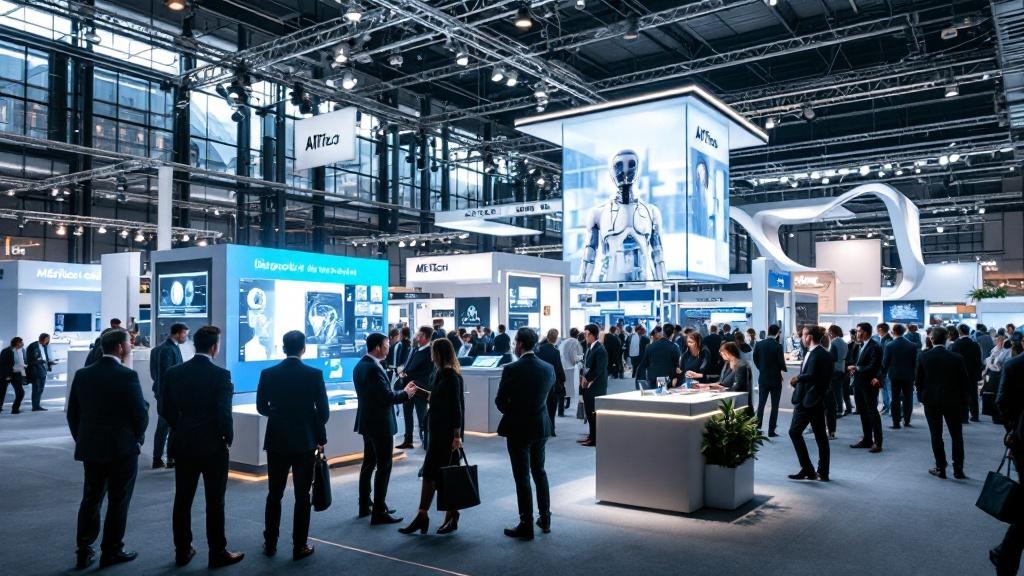
Belgium is stepping decisively onto the global AI stage. The country debuted a dedicated national pavilion at one of the world's largest technology and artificial intelligence summits, held on 9 and 10 April 2026, signalling that European ambitions in healthcare AI, semiconductor research, and enterprise deployment are no longer content to stay in the background. The two-day event brought together over 23,000 attendees, more than 600 enterprises and startups, and 250 investors managing a combined US$350 billion in capital, with speakers and delegations representing over 110 countries.
For the European healthcare sector in particular, the summit's co-located Digi Health and Biotech conference carried the most weight. Hospital administrators, medtech companies, and pharmaceutical R&D teams gathered to assess how agentic AI systems are moving beyond controlled pilots into live clinical environments, a transition that has significant implications for EU-regulated health systems operating under the AI Act.
Belgium's Pavilion: Semiconductors, Medtech, and Serious Intent
Belgium's participation was not merely symbolic. The country brought a delegation anchored in its two most credible technology assets: semiconductor research, led by the internationally recognised work of imec, the Leuven-based nanoelectronics research centre, and a medtech and pharmaceutical cluster centred around the Brussels and Ghent ecosystems. imec's chip design and process research underpins a significant share of Europe's AI hardware ambitions, and its presence at a summit dominated by compute infrastructure discussions was well timed.
The European angle on healthcare AI is increasingly shaped by regulatory obligations that do not apply to many of the summit's other delegations. The EU AI Act classifies AI systems used in medical diagnostics and treatment planning as high-risk, requiring conformity assessments, transparency obligations, and human oversight. Belgian companies operating in this space are already navigating this compliance landscape, giving them both a credibility advantage and a cost burden that peers in less-regulated markets do not face.
Healthcare AI: From Diagnostics to Agentic Systems
The Digi Health and Biotech stream addressed AI adoption across hospitals, pharmaceutical development, and medical diagnostics. Agentic AI systems, which can plan and execute multi-step clinical workflows without constant human prompting, drew the most attention. Early evidence from hospital deployments in the Netherlands and Germany suggests these systems can reduce diagnostic turnaround times and flag anomalies that rule-based software misses. However, European clinicians and regulators remain cautious about the accountability gap that emerges when an autonomous agent makes a recommendation that influences patient care.
Francesca Bosco, Chief Strategy Officer at the Cybersecurity and AI Safety think tank ITU and a recognised voice in European AI governance, has argued that healthcare is precisely the domain where the AI Act's high-risk classification earns its keep. The obligation to document training data provenance and maintain human oversight is not bureaucratic friction; it is the mechanism that makes liability traceable when something goes wrong in a clinical setting.
At the academic level, ETH Zurich's AI Centre has published work on uncertainty quantification in medical imaging models, a direct response to the problem of AI systems that produce confident-sounding outputs even when their confidence is not warranted. That research is informing how European medtech companies are architecting their compliance documentation under the AI Act's requirements for robustness and accuracy.
Enterprise AI: Moving from Pilot to Production
Across all sectors represented at the summit, the dominant theme was the transition from proof-of-concept to production deployment. Enterprises are integrating AI into supply chains, customer service operations, and financial systems at a pace that was considered aspirational two years ago. The conversation has shifted from whether AI delivers value to how organisations manage the operational, legal, and cultural complexity of running AI at scale.
For European enterprises, this transition carries a layer of complexity absent in less-regulated markets. GDPR obligations interact with AI Act requirements in ways that legal teams are still untangling. Data localisation preferences, particularly in healthcare, mean that the hyperscaler architectures favoured elsewhere cannot always be replicated without modification. Several Belgian and broader EU delegations at the summit were specifically exploring sovereign cloud options that satisfy both data residency requirements and the compute demands of large-scale AI inference.
Six Conference Streams: Infrastructure, Security, Quantum, and Health
Six parallel conferences ran alongside the main programme, each addressing a distinct layer of the AI stack:
- AI Everything: large language models, agentic systems, and generative applications for enterprise technology buyers and AI developers.
- Startups North Star: fundraising, investor matching, and pitch competitions for founders and early-stage companies.
- Digi Health and Biotech: healthcare AI, diagnostics automation, and pharmaceutical R&D for hospital administrators and medtech companies.
- Global Data Centres: cloud infrastructure, AI compute capacity, and data sovereignty for operators and hyperscalers.
- Cybersecurity and Compliance: governance frameworks, threat detection, and regulatory alignment for CISOs and security teams.
- Quantum Expo: quantum hardware, software, and finance applications for researchers and enterprise innovation teams.
Infrastructure projections presented at the data centres stream pointed to a rapid expansion of global AI compute capacity over the next five years. For European operators, this raises an immediate question about whether the continent's data centre buildout, concentrated in markets including Ireland, the Netherlands, and Germany, can keep pace with demand without compromising energy sustainability commitments under the European Green Deal.
Governance, Skills, and the Regulatory Backdrop
The ministerial and policy roundtables convened government leaders and enterprise executives to align on skills development, regulatory frameworks, and governance blueprints for responsible AI deployment. The EU AI Act, which came into force in August 2024, provided the dominant regulatory reference point for European delegates. Its tiered risk classification, prohibited uses list, and conformity assessment requirements are now shaping procurement decisions, vendor contracts, and internal AI governance structures across the bloc.
Skills shortages remain acute. European universities are expanding AI curricula, but the pipeline between graduate education and enterprise-ready AI deployment skills is still thin. Belgium's higher education institutions, including KU Leuven and Ghent University, have AI research programmes of genuine international standing, but translating research excellence into a broader workforce capable of implementing, auditing, and governing AI systems in regulated industries remains an unresolved challenge.
Investment appetite for European healthcare AI is nonetheless strong. Venture capital activity in EU medtech and health AI has grown consistently over the past three years, and the presence of Belgian and broader European delegations at a summit attended by 250 investors managing significant capital suggests that cross-continental deal flow is accelerating. The question for European founders is whether they can attract that capital while maintaining compliance with a regulatory framework that adds time and cost to the development cycle, but also, arguably, adds credibility in risk-averse healthcare procurement contexts.
What Belgium Takes Home
Belgium's debut pavilion was a statement of positioning rather than a closing of deals. The country is not the loudest voice in the European AI conversation, but imec's hardware research, the Brussels medtech cluster, and a regulatory environment that forces rigorous AI development practices give it a defensible niche. In healthcare AI specifically, where trust, traceability, and clinical validation matter more than raw performance benchmarks, that niche may prove more durable than it first appears.
European enterprises evaluating AI vendor solutions, seeking investment, or exploring partnerships in cloud infrastructure and healthcare technology will find that the conversations begun at summits of this scale take months to resolve into signed agreements. Belgium's task now is to ensure the relationships opened in April translate into concrete collaboration by the end of the year.

Comments
Sign in to join the conversation. Be civil, be specific, link your sources.