"We're never going to lose the importance of being able to think, to reason, to question critically, so I think those skills will be incredibly important for our young people to develop," Sunak said, citing data from Stanford economists and LinkedIn workforce research.
This framing aligns with what researchers at the Alan Turing Institute in London have been arguing for some time: that human-AI collaboration requires a fundamentally different educational model, one focused on partnership rather than replacement. The concept of "AI agents", autonomous software programmes designed to handle specific tasks, is rapidly moving from research labs into everyday workplace tools. Sunak predicts that managing these agents will become a standard expectation for new graduates within years, not decades.
Where European Education Currently Stands
The urgency behind Sunak's message maps directly onto a documented gap in UK and European classrooms. Across EU member states and in the UK, AI literacy provision remains uneven, patchy at primary level and only marginally better by secondary school. Research from Digital Promise highlights the structural problem: the gap between the proportion of secondary students receiving AI literacy lessons and the proportion of primary students receiving them points to the absence of coherent AI literacy learning pathways from early years through to sixth form.
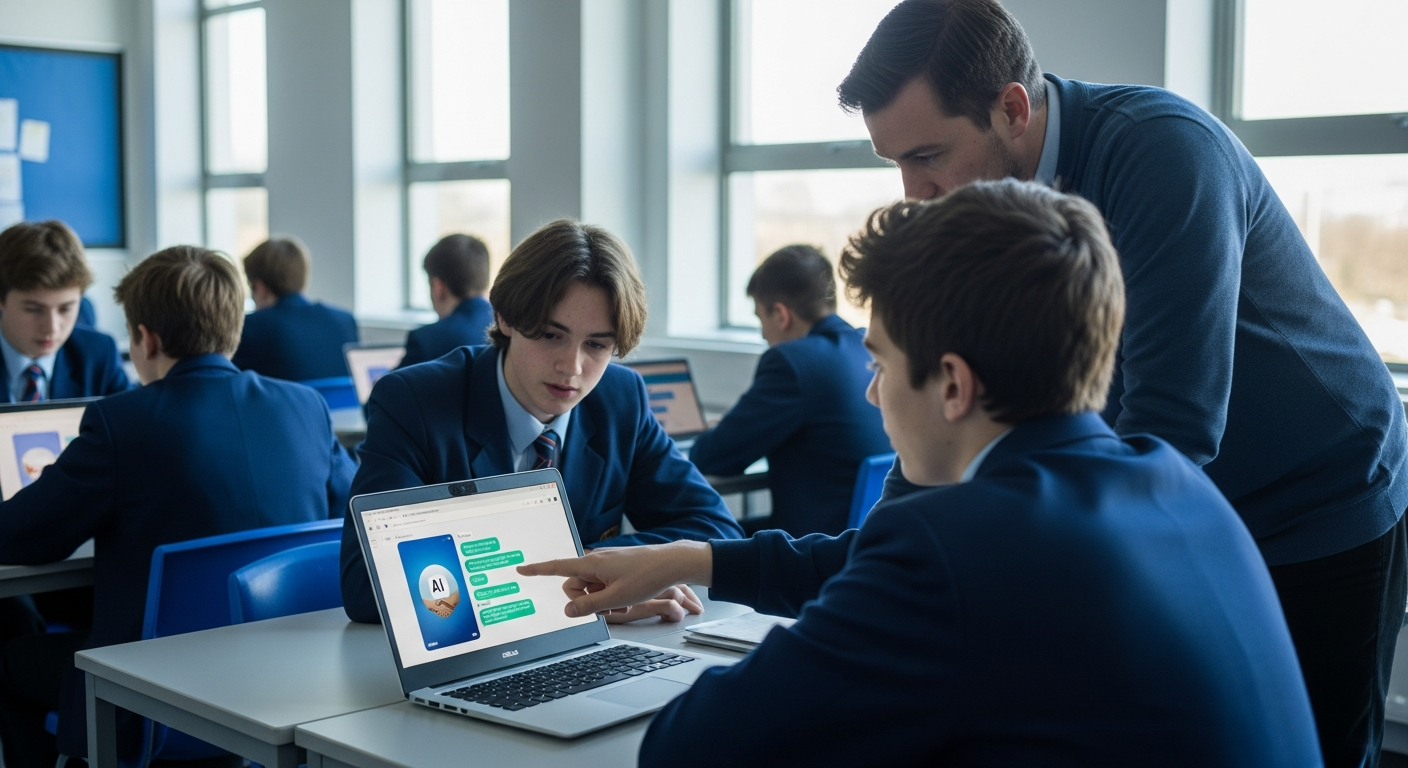
The integration required goes well beyond basic computing. Students must learn to delegate tasks to AI tools effectively whilst maintaining the critical ability to verify output accuracy. That demands intellectual curiosity, a habit of questioning, and a continuous learning mindset. These are precisely the qualities that risk being crowded out if schools treat AI as a purely technical subject rather than a cross-curricular thinking discipline.
Ivana Bartoletti, Chief Privacy and AI Governance Officer at Wipro and a prominent European voice on responsible AI, has consistently argued that AI education must embed ethical reasoning from the outset, not bolt it on as an afterthought. Her position is that schools which teach students to use AI tools without teaching them to interrogate those tools are producing workers who are useful to AI systems rather than masters of them.
At the policy level, the European Commission's AI Act, which came into force in 2024, explicitly references AI literacy as a requirement for certain categories of AI deployment. Article 4 of the Act places obligations on providers and deployers to ensure staff possess sufficient AI literacy, a provision that feeds directly into questions about what schools and universities should be delivering years before students enter the workforce.
The Skills That Will Define Career Success
The skills Sunak emphasises for his daughters mirror what workforce analysts across Europe identify as the most durable, recession-resistant capabilities for an AI-integrated economy:
- Critical evaluation of AI-generated content and recommendations
- Emotional intelligence and interpersonal communication skills
- Creative problem-solving that combines human insight with AI capability
- Ethical reasoning to navigate AI's societal implications
- Adaptability to rapidly evolving technological landscapes
None of these capabilities are developed by using AI tools passively. They require active, questioning engagement with technology, precisely the kind of pedagogy that many UK schools have yet to fully embed.
The Empathy Imperative
Perhaps the most significant aspect of Sunak's framing is his insistence on empathy. This is not soft thinking; it is a direct response to data showing that as routine cognitive tasks become automated, the professional premium on emotional intelligence rises. Roles that require genuine human connection, nuanced judgement, and ethical navigation are the ones most resistant to displacement.
Sunak has also acknowledged warnings from Anthropic's CEO Dario Amodei about AI's potential to disrupt entry-level white-collar employment. Rather than treating this as cause for alarm, he frames it as an opportunity for individuals who can blend human judgement with AI capability. That framing is optimistic, but it carries a hard condition: the blend only works if the human half of the equation is genuinely developed.
Professor Rose Luckin of University College London's Knowledge Lab, one of the UK's foremost researchers on AI in education, has long argued that the educational system must prioritise what she calls "intelligence unleashed": equipping students with the metacognitive skills to understand their own thinking well enough to work with, and critically assess, AI systems. Her research supports the conclusion that schools focusing narrowly on prompt engineering and tool use, without building underlying reasoning skills, are setting students up for fragility rather than resilience.
What Schools and Parents Should Do Now
The practical implications of this debate are concrete. For schools, the priority list looks like this:
- Integrate AI literacy across subjects rather than siloing it within computing or technology classes.
- Build critical evaluation of AI outputs into existing curricula in English, science, and humanities.
- Develop progression pathways from primary through to post-16, so that AI literacy is cumulative rather than episodic.
- Train teachers to model questioning behaviour with AI tools, not just proficient use of them.
For parents, Sunak's advice is essentially a call to treat AI tools at home as a site of active discussion rather than passive consumption. Encouraging children to ask why an AI produced a particular output, where it might be wrong, and what assumptions it reflects is more valuable than any specific technical skill.
The conversation around AI literacy and human skills development is far from settled. As AI systems continue to evolve, so must the educational frameworks designed to prepare young people for working alongside them. Sunak's parenting advice, stripped of its political context, amounts to a coherent and evidence-grounded position: the future belongs to people who can think alongside AI, not simply think like it.




Comments
Sign in to join the conversation. Be civil, be specific, link your sources.