The UK's AI sector, for example, benefits from a concentration of talent around the so-called "Golden Triangle" of London, Oxford, and Cambridge, where spinouts from academic computer science departments routinely attract Series A rounds from Tier 1 venture funds. France has structured its national AI strategy around a handful of flagship research institutes, with Inria and the Paris Institute for Advanced Study anchoring a pipeline that feeds directly into commercial ventures. Germany's Fraunhofer Society, with its applied research mandate and 76 institutes, provides a translational layer between academic discovery and industrial deployment that most other economies lack entirely.
Margrethe Vestager, Executive Vice President of the European Commission responsible for competition and digital policy, has consistently argued that Europe's industrial base is itself a competitive advantage in applied AI: sectors such as precision manufacturing, pharmaceuticals, and financial services generate the rich, domain-specific datasets on which production-grade AI systems depend. That argument is borne out by the investment data. According to PitchBook, European AI startups raised over 14 billion euros in venture capital during 2023, with manufacturing-adjacent applications including supply chain optimisation, predictive maintenance, and computer vision quality control accounting for a growing share of that total.
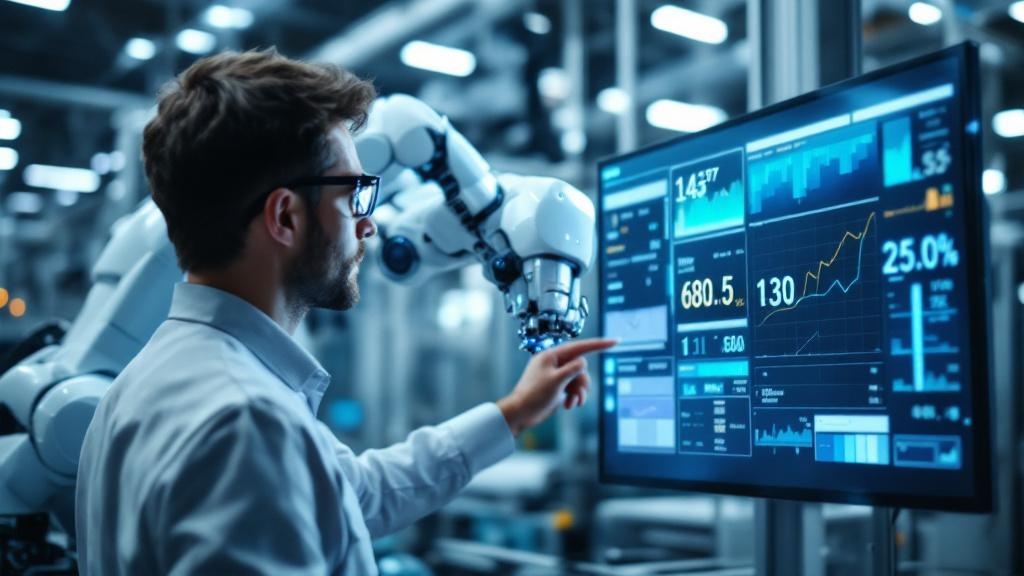
The manufacturing sector is where European AI startups are arguably making their deepest mark. Computer vision systems trained on defect images from automotive production lines are reducing scrappage rates at facilities across the Ruhr Valley and the West Midlands. Predictive maintenance platforms, feeding on sensor data from CNC machines and injection moulding equipment, are extending asset lifetimes and reducing unplanned downtime in ways that directly affect unit economics.
ASML, the Dutch semiconductor equipment manufacturer whose extreme ultraviolet lithography machines underpin the global chip supply chain, has become one of the most prominent examples of AI integration in high-precision manufacturing. The company has deployed machine learning models to optimise the calibration cycles of its lithography systems, reducing the time between wafer exposures and improving yield rates. ASML's approach, embedding AI within the operational feedback loops of extraordinarily complex physical equipment, is precisely the model that smaller European manufacturers are now trying to replicate at their own scale.
Beyond the headline names, a layer of specialist AI startups is building sector-specific tooling. Companies focused on process manufacturing use reinforcement learning to optimise chemical reactor conditions in real time, reducing energy consumption per unit of output. Others apply natural language processing to maintenance logs, extracting failure patterns that human engineers would take weeks to identify manually. The common thread is that these are not general-purpose AI tools bolted onto legacy processes; they are purpose-built systems trained on industrial data that European manufacturers have spent decades accumulating.
Fintech, Healthcare, and the Cross-Sector Reach of AI Startups
European AI startups are not confined to the factory floor. Financial technology is a parallel area of strength, particularly in the UK, where the Financial Conduct Authority's regulatory sandbox has allowed machine learning-powered credit assessment, fraud detection, and robo-advisory platforms to test innovations in a controlled environment before seeking full authorisation. London-based fintech companies use alternative data sources, from open banking transaction histories to utility payment records, to extend credit to small businesses and individuals whose profiles would confuse traditional scoring models.
Healthcare AI is advancing with equal urgency. Diagnostic support systems that assist radiologists in interpreting CT and MRI scans are now CE-marked and deployed in NHS trusts and hospital networks across the EU. Philips, headquartered in Amsterdam, has built a substantial AI diagnostics business on the back of its imaging hardware installed base, training models on millions of anonymised scans. Patient scheduling and capacity management platforms, using probabilistic models to predict no-show rates and optimise theatre utilisation, are generating measurable cost savings at a time when every European health system is under severe budget pressure.
Professor Yoshua Bengio, whose work on deep learning underpins much of modern AI, has noted that European health systems, with their combination of large longitudinal patient datasets and genuine willingness to engage with academic AI researchers, represent one of the most promising environments globally for responsible medical AI development. That structural advantage will matter more as AI capabilities continue to compound.
Venture Capital and the Patience Question
One persistent criticism of European AI venture capital has been its relative impatience compared with US counterparts, a tendency to push portfolio companies toward early revenue at the expense of the longer development cycles that genuine deep technology requires. That criticism is becoming less valid with each passing year.
Dedicated deep-tech funds, including those backed by the European Investment Fund and national development banks such as the British Business Bank, are extending typical fund horizons. Sovereign-adjacent capital is supplementing purely commercial venture investment, providing the patient runway that AI companies working on complex physical systems genuinely need. Accelerators and incubators attached to institutions such as ETH Zurich and the Technical University of Munich are providing early-stage funding and mentorship that improves survival rates for technically ambitious founding teams.
The diversity of funding routes available to European AI startups is now comparable with what was previously a uniquely American advantage. Angel networks, corporate venture arms from industrial giants such as Siemens and Bosch, Horizon Europe research grants, and an increasingly active secondary market for growth-stage stakes are creating a multi-layered capital ecosystem that can support companies across the full journey from laboratory to listed entity.
Regulatory Environment: Friction and Opportunity
The EU AI Act, which entered into force in August 2024, is the most consequential AI regulatory development anywhere in the world. Opinions within the European startup community are genuinely divided. Critics argue that compliance costs and liability provisions for high-risk AI systems, which include most manufacturing quality control and medical diagnostic applications, will disadvantage European startups relative to competitors operating under lighter regulatory regimes. Proponents counter that clear rules create procurement confidence, particularly for enterprise and public-sector clients who would otherwise hesitate to commit to AI deployments carrying undefined legal risk.
The honest assessment is that both positions contain merit. Regulatory clarity does accelerate enterprise sales cycles for well-capitalised companies with dedicated compliance functions. It does, however, create meaningful overhead for early-stage startups that have not yet reached the scale to absorb that cost efficiently. The European Commission's decision to create a dedicated AI Office to support SME compliance is a recognition of that tension, though whether the practical support on offer will be sufficient remains to be seen.
Data governance remains the most operationally complex aspect of the regulatory landscape. GDPR constraints on cross-border data flows and restrictions on training AI models on personal data without explicit consent create genuine engineering challenges for companies building AI systems that depend on large, diverse datasets. European AI startups have responded with a variety of technical approaches, including federated learning architectures that train models without centralising sensitive data, and synthetic data generation pipelines that augment real datasets whilst avoiding privacy risk. These constraints are driving genuine innovation in privacy-preserving AI techniques, which may prove to be a durable competitive advantage as global regulatory convergence continues.
Talent, Education, and the Long Game
Europe's technical talent pipeline is extensive but unevenly distributed. Leading universities including ETH Zurich, the Technical University of Delft, Imperial College London, and Ecole Polytechnique produce graduates who are globally competitive in machine learning, robotics, and systems engineering. The challenge is retaining that talent within the European ecosystem rather than losing it to higher compensation packages in the United States or to the research divisions of US-headquartered technology companies operating in Europe.
Retention is improving as European AI companies scale and compensation benchmarks rise. The founding and early-team equity culture, long more prevalent in the US, is now sufficiently established in London, Berlin, Paris, and Stockholm to make early-stage equity packages genuinely competitive for technically excellent candidates who understand the upside. Remote and hybrid working norms, accelerated by the pandemic, have also extended the effective recruitment radius of European AI companies, allowing them to hire across the continent without requiring physical relocation.
Government scholarship and reskilling programmes are broadening the talent base beyond elite research universities. Industry-led coding bootcamps and AI apprenticeship schemes, several of which operate under the UK's Institute for Apprenticeships and Technical Education framework, are creating alternative pathways into the sector for people from non-traditional backgrounds, which is both a social good and a practical response to a genuine skills shortage that would otherwise constrain ecosystem growth.
Scaling Beyond Domestic Markets
The most successful European AI startups are not building for domestic markets alone. The EU single market, with its 450 million consumers and deep industrial base, provides a home territory large enough to achieve genuine scale before internationalising. UK companies, operating outside the single market post-Brexit, have compensated through aggressive expansion into North American and Commonwealth markets, often leveraging the English-language advantage and the reputational weight of UK regulatory endorsement.
Cross-border expansion within Europe is more straightforward for AI software companies than the regulatory complexity sometimes suggests, particularly where the AI Act's harmonised requirements reduce the need for country-by-country regulatory navigation. Manufacturing AI platforms that prove themselves in German automotive or French aerospace supply chains carry a credibility signal that travels well to industrial clients in South Korea, Canada, and Japan. European provenance, with its association with engineering rigour and regulatory trustworthiness, is becoming a genuine commercial asset in enterprise AI sales conversations globally.
Challenges That Remain Real
Honest accounting requires acknowledging the challenges that have not yet been resolved. Compute access remains a constraint for European AI startups that lack the balance sheet to purchase or lease the GPU clusters that frontier model training requires. The concentration of high-performance compute infrastructure in US hyperscaler data centres creates a dependency that European industrial policy is only beginning to address through initiatives such as the EuroHPC Joint Undertaking.
Fragmentation across national markets, in regulatory interpretation, procurement processes, and language, continues to impose friction that US competitors operating in a single large domestic market do not face. The absence of a genuinely pan-European pension fund investment culture, of the kind that channels long-duration capital into venture and growth equity in the United States and Canada, means that later-stage growth rounds for European AI companies frequently require participation from US investors, which introduces its own set of governance and strategic tensions.
None of these are insurmountable. Several are being addressed directly by current policy. But they are real, and the European AI ecosystem will be stronger for confronting them plainly rather than papering over them with optimistic framing.
The Outlook: Cautiously Confident
Europe's AI startup ecosystem has built the foundational elements that sustained technology leadership requires: deep engineering talent, patient capital that is growing more abundant, anchor industrial clients that generate valuable domain-specific data, and a regulatory environment that, whatever its costs, is establishing the trust infrastructure on which enterprise AI adoption depends. The manufacturing sector, in particular, is producing proof points at a rate that is beginning to shift the global narrative about where serious industrial AI work is actually being done.
The acceleration of AI adoption globally will amplify both the opportunities and the risks for European players. Those that move quickly to embed themselves in the operational fabric of European industrial clients, and that use their regulatory credibility as a differentiator in international markets, are well placed to establish durable competitive positions. The ecosystem has earned its confidence. The task now is to convert that confidence into market leadership before the window is smaller than it looks.




Comments
Sign in to join the conversation. Be civil, be specific, link your sources.