Free Chinese AI Takes Aim at GPT-5: What European Industry Must Reckon With
A Chinese research lab has released an open-source large language model it claims matches or beats GPT-5 on key benchmarks, at a fraction of the development cost. For European enterprises, regulators, and AI labs, the implications stretch well beyond a benchmark table. Frontier AI just got cheaper, and the competitive map is being redrawn.
A Chinese research lab has released a large language model it claims matches or surpasses OpenAI's GPT-5 across multiple standard benchmarks. The model is open-source, free to use, and reportedly cost a fraction of what Western frontier labs spend on comparable systems. If the claims survive independent scrutiny, this is not merely a technical milestone. It is a fundamental challenge to the assumptions underpinning the global AI power structure, and European industry cannot afford to treat it as somebody else's problem.
[[KEY-TAKEAWAYS:Independent benchmark verification is still ongoing; early results are mixed but credible|Reported development cost of under $10 million challenges the economics of frontier AI|Open-source release makes any export-control-style restriction essentially unenforceable|European enterprises should audit AI procurement strategies now, before the market reprices|EU AI Act compliance requirements apply regardless of a model's country of origin]]
Advertisement
What the Benchmarks Actually Show
Benchmark claims in AI deserve careful scrutiny, and this case is no exception. The lab published results across a range of standard evaluations, including MMLU, HumanEval, GSM8K, and several reasoning tasks. On mathematical reasoning and code generation, the model posted numbers that appear genuinely competitive with the best models currently available from any geography.
Independent researchers have raised important caveats, however. Benchmark performance does not always translate to real-world capability. Models can be specifically optimised to perform well on known evaluation tasks without demonstrating the same level of general competence in deployment. This practice, sometimes called benchmark gaming, has been a persistent and frustrating problem across the industry.
Early independent testing by academic groups has produced mixed results. The model appears genuinely strong on structured reasoning tasks but shows weaker performance on open-ended conversation and nuanced language understanding when compared directly with GPT-5. That is a meaningful distinction for European enterprise users whose use cases extend well beyond benchmark conditions. Researchers at ETH Zurich, which has been tracking open-source model performance systematically, have noted that structured-reasoning gains frequently fail to replicate in production environments at scale.
Built for a Fraction of the Cost
Perhaps more consequential than the benchmark claims is the reported development cost. While OpenAI, Google, and Anthropic have collectively spent hundreds of millions of dollars training their latest models, this Chinese lab claims to have achieved comparable results for under US$10 million. That figure, if accurate, rewrites the economics of frontier AI development entirely.
The lab attributes its efficiency to several specific factors:
Aggressive training data curation, prioritising quality over raw volume accumulation
Novel architectural optimisations that reduce compute requirements substantially
A lean team structure that avoided the coordination overhead common to larger organisations
Targeted use of available hardware, despite export restrictions on advanced chips
The approach echoes the efficiency-focused philosophy behind DeepSeek's earlier breakthrough, which similarly rattled Western observers with its cost-to-performance ratio. If the cost figures hold up, they challenge the prevailing assumption that frontier AI is an activity reserved for the wealthiest technology companies. The implication is stark: clever engineering can substitute for brute-force spending, at least up to a point, and that point may be considerably higher than the industry previously imagined.
For European AI labs such as Paris-based Mistral AI, which has itself built a competitive position on relative efficiency and open-weight releases, this dynamic is both familiar and intensifying. Mistral's own approach to lean, high-quality training has been held up as a European model for sustainable AI development. A Chinese lab now claiming to operate at similar or lower cost per capability unit places additional pressure on every incumbent in the space.
The Open-Source Strategy and Its Implications
Releasing the model as open-source is a deliberate and sophisticated strategic choice. By making it freely available, the lab simultaneously:
Builds credibility through transparency and invites global verification
Creates an ecosystem of developers building directly on its technology
Places direct competitive pressure on proprietary Western models that charge for API access
Makes any future export-control-style restriction on distribution essentially unenforceable
The move mirrors the strategy that made Meta's LLaMA series so influential. By releasing capable models for free, Meta reshaped the competitive landscape and forced other companies to justify their pricing. A Chinese open-source model that credibly rivals GPT-5 would amplify this dynamic considerably. For European software vendors and system integrators, a high-performing free model changes the build-versus-buy calculation at every tier of the market.
The open-source release also carries a pointed geopolitical message. Once model weights are publicly available, no export control regime, whether administered in Washington or Brussels, can meaningfully restrict their spread. This is a strategic reality that European policymakers will need to confront directly, and soon.
The European Regulatory Dimension
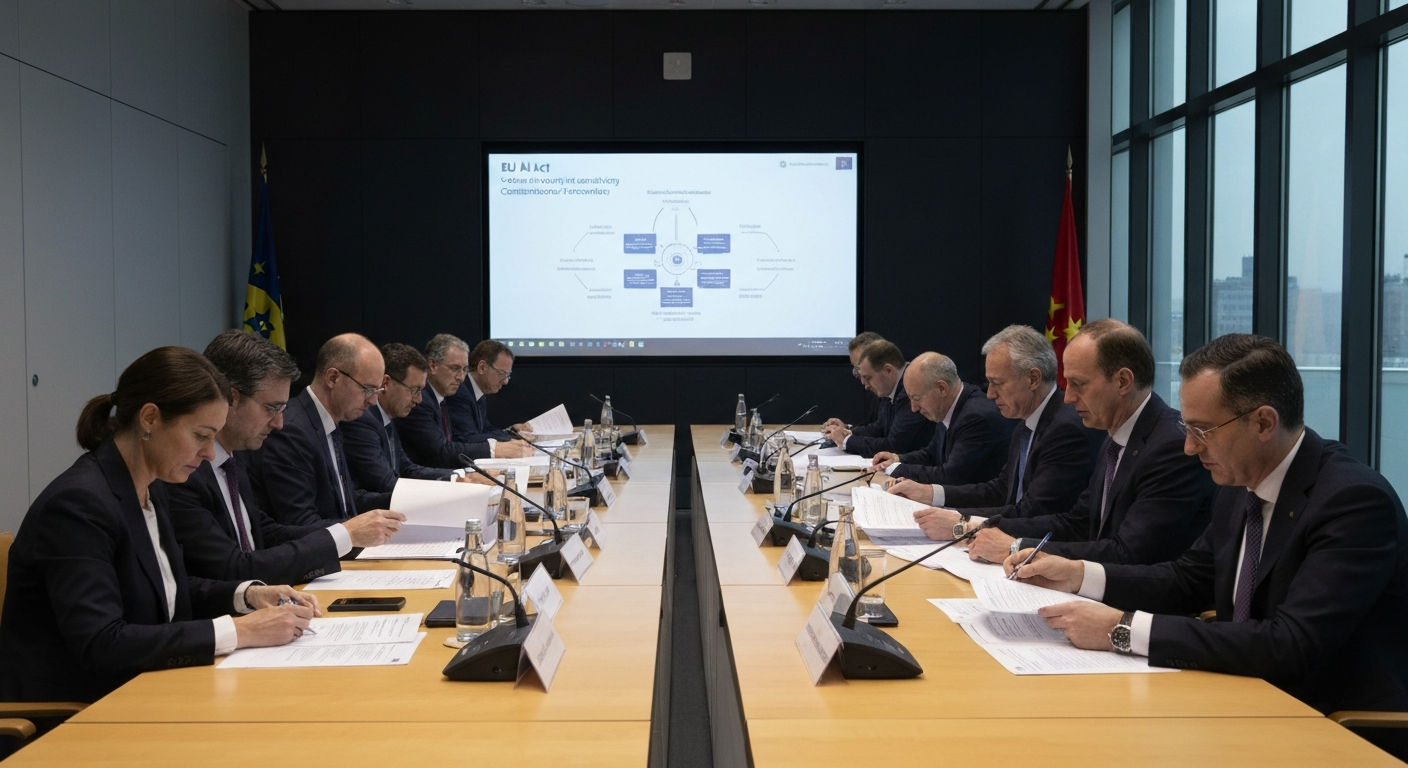
The arrival of a free, frontier-capable model from outside the EU creates immediate and concrete questions under the EU AI Act. The Act classifies general-purpose AI models above certain compute thresholds as GPAI models subject to transparency and safety obligations. Margrethe Vestager, the former Executive Vice-President of the European Commission who shaped much of the EU's digital regulatory agenda, has previously argued that origin-neutral enforcement is essential to the Act's credibility. A Chinese open-source model used by European businesses does not escape those obligations simply because it was developed elsewhere.
For European enterprises considering deployment, the compliance checklist includes:
Assessing whether the model qualifies as a GPAI model with systemic risk under the AI Act
Conducting due diligence on training data provenance and potential GDPR implications
Evaluating supply chain risk, particularly for sectors covered by NIS2 and the Critical Entities Resilience Directive
Documenting the decision-making rationale for procurement records
The AI Office, established within the European Commission to oversee GPAI enforcement, will face an early test of its practical authority as models like this enter wide European deployment. Whether it has the resources and the political backing to act decisively remains an open question, but the regulatory exposure for enterprises that skip due diligence is real.
What This Means for European Business
For businesses across the EU and UK, a free, high-performing model with strong multilingual support could be genuinely transformative in cost terms. Companies that currently rely on expensive API access to proprietary Western models could switch to a free alternative, dramatically reducing their AI infrastructure costs. That calculation will be particularly attractive for mid-market businesses and startups, where AI API spend represents a meaningful line in the budget.
Adoption patterns will almost certainly vary by sector and by country. Markets with deep integration into the US technology ecosystem, including the UK and the Netherlands, are likely to approach Chinese AI models cautiously, weighing performance benefits against supply chain and regulatory risks. Germany's industrial sector, with its established sensitivity to technology sovereignty questions, will scrutinise provenance carefully.
Others, particularly earlier-stage technology businesses in Southern and Eastern Europe where AI adoption is accelerating but costs remain a genuine barrier, may be considerably more pragmatic. A capable free model accelerates deployment timelines for any business that was previously priced out of frontier-level AI performance.
The model's multilingual capabilities are also relevant in a specifically European context. With reported strong performance across more than 15 languages, it addresses a genuine gap that English-first Western models have been slow to fill. Multilingualism is not a nice-to-have in European enterprise deployments. It is a core operational requirement across most large organisations on this continent.
The Broader Industry Shift
Whether or not this specific model lives up to every benchmark claim, the broader trend it represents is undeniable. Open-source models are closing the gap with proprietary ones. The cost of developing competitive AI systems is falling faster than most industry observers projected. And the assumption that a small club of well-funded Western labs holds an unassailable lead in frontier AI is looking increasingly fragile.
For the global AI industry, this trajectory points toward more competition, lower prices, and faster diffusion of capable AI technology. For geopolitical strategists in European capitals, it complicates every assumption about technology control and competitive advantage that has guided policy over the past three years. Export controls on advanced semiconductors, long treated as a meaningful lever for slowing non-Western AI development, are now facing serious questions about their actual efficacy. EU policymakers will need to decide whether their own approach to technology sovereignty is built on durable foundations, or whether it requires urgent revision.
It also raises a sharper question about the sustainability of current business models. If a genuinely frontier-capable AI can be released for free, what does that mean for companies that charge for API access? The answer will shape investment decisions, startup strategies, and enterprise procurement across the European AI industry for years to come.
Updates
published_at reshuffled 2026-04-29 to spread distribution per editorial directive
AI Terms in This Article6 terms
API
Application Programming Interface, a way for software to talk to other software.
benchmark
A standardized test used to compare AI model performance.
at scale
Applied broadly, to a large number of users or use cases.
transformative
Causing a major change in form, nature, or function.
ecosystem
A network of interconnected products, services, and stakeholders.
compute
The processing power needed to train and run AI models.
Advertisement
Comments
Sign in to join the conversation. Be civil, be specific, link your sources.





Comments
Sign in to join the conversation. Be civil, be specific, link your sources.