How a Floating Data Centre Actually Works
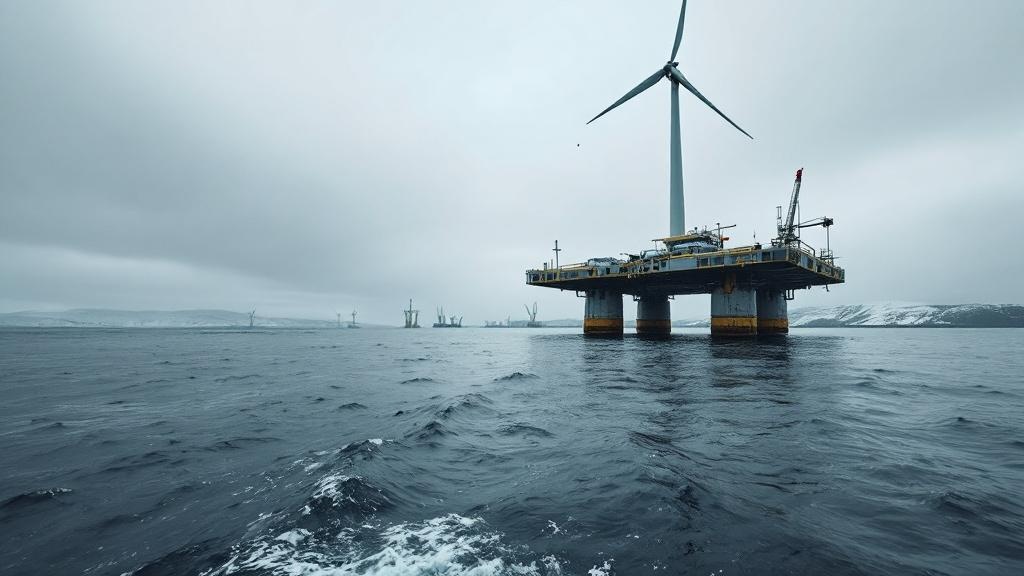
Aikido's platform uses semisubmersible technology borrowed from the oil and gas sector. A single wind turbine sits at the centre of a structure roughly the size of a football pitch, supported by three legs that extend outward into ballast tanks. Those tanks, traditionally filled with freshwater for buoyancy, double as server halls in Aikido's design.
Each ballast tank can house a 3 to 4 megawatt data hall, giving a single platform a combined 10 to 12 MW of compute capacity. The freshwater inside the tanks is chilled naturally by the surrounding ocean and circulated through the servers as liquid coolant. Warmed water cycles back into the ballast for re-cooling, creating a closed loop that eliminates the need for massive external cooling infrastructure.
Sam Kanner, CEO of Aikido Technologies, frames the value proposition simply: the platform has power from the wind, free cooling from the sea, and a modular, what he calls an "IKEA-like" assembly approach that allows platforms to be manufactured onshore and towed into position. Onboard batteries and a grid connection provide backup for periods when wind drops.
Why Europe Should Be Paying Close Attention
The floating data centre concept is being piloted in the North Sea, and Europe is precisely where the pressure points are sharpest. The UK alone saw data centre energy consumption rise to approximately 6% of national electricity demand by 2023, according to analysis cited by the Department for Energy Security and Net Zero. Planning approvals for new onshore facilities in England have slowed considerably, with local authorities pushing back on large-scale developments in the Home Counties and the Midlands. In Ireland, where much of hyperscale European compute is concentrated around Dublin, EirGrid has warned that data centre load could account for 32% of national electricity demand by 2031, a figure that has already prompted moratoriums on new grid connections in certain areas.
The EU is no less exposed. The European Commission's AI Continent Action Plan, published in April 2025, explicitly identifies energy infrastructure as a binding constraint on European AI competitiveness. Commissioner Henna Virkkunen, responsible for the Tech Sovereignty portfolio, has stated publicly that Europe cannot build sovereign AI capacity without confronting the energy co-location problem head on. Offshore floating platforms, co-located with their own renewable generation, represent one credible response to that challenge.
For latency-tolerant workloads, model training and batch inference chief among them, proximity to a city centre is not a requirement. A fleet of floating platforms in the southern North Sea or the Celtic Sea could serve Amsterdam, London, Hamburg, and Copenhagen with acceptable latency whilst consuming zero onshore land and drawing no freshwater from already-stressed catchments.
| Factor | Onshore Data Centre | Floating Offshore Data Centre |
|---|
| Power source | Grid (often fossil-heavy) | Integrated wind turbine plus grid backup |
| Cooling | Chillers, evaporative (high water use) | Ocean-cooled closed loop (zero freshwater draw) |
| Land required | Significant (industrial zoning) | None (offshore lease) |
| NIMBY risk | High (noise, traffic, visual) | Low (out of sight) |
| Construction time | 18 to 36 months typically | Modular, potentially faster at scale |
| Security risk | Physical access, cyberattack | Subsea cable sabotage, maritime threats |
| Regulatory maturity | Well established | Largely uncharted |
The Engineering Risks Nobody Is Glossing Over
Putting servers in the ocean introduces problems that onshore facilities never face. Saltwater corrosion, marine debris, and the constant mechanical stress of wave motion are all genuine threats to uptime. Aikido's closed-loop freshwater system isolates the servers from direct seawater contact, but the approach still requires long-term validation in real operational conditions.
Dr. Luca Bertolini, a researcher in distributed computing infrastructure at ETH Zurich, has noted that while liquid immersion and closed-loop cooling in marine environments is technically sound in principle, the sector lacks multi-year reliability data on GPU-dense deployments exposed to continuous wave-induced vibration. That is not a reason to dismiss the concept; it is a reason to run the pilots rigorously and publish the results openly.
Liquid cooling handles GPUs and CPUs, but not every component plays along. Ethernet switches and other networking gear still require traditional air conditioning, which adds complexity inside a sealed marine environment. The mixed cooling architecture is one of the harder engineering challenges Aikido faces, and it is one the industry will need to solve at component level rather than at platform level.
Then there is security. Offshore infrastructure in the North Sea has come under increased scrutiny following well-documented incidents involving vessels interfering with subsea cables and wind farm assets. The Swedish Civil Contingencies Agency and NATO's maritime command have both flagged the vulnerability of offshore energy and communications infrastructure in the Baltic and North Sea corridors. Extending that threat surface to include compute infrastructure raises the stakes considerably. Kanner has pointed to national coast guards as a first line of defence, but protecting remote, critical computing infrastructure in open water is a fundamentally different problem from securing a fenced facility in an industrial park.
Regulation is the wildcard. Offshore data centres do not fit neatly into existing permitting frameworks in any EU member state or in the UK. Environmental reviews covering heat discharge, electromagnetic interference, and marine ecosystem impact could prove more onerous than standard onshore approvals. The EU's forthcoming Data Act and the evolving Network and Information Security 2 Directive both touch on critical infrastructure resilience, but neither was drafted with floating compute platforms in mind. Clarity from regulators, ideally coordinated at EU level rather than handled jurisdiction by jurisdiction, would significantly de-risk investment in the concept.
From Crypto Rigs to AI Racks
Aikido's origin story predates the generative AI wave. Kanner originally explored powering cryptocurrency mining rigs with offshore wind, a concept that gained little traction when crypto prices were low. The arrival of large language models in late 2022, and the subsequent explosion in demand for GPU compute, gave the idea a far more compelling economic case.
The timing aligns with a broader European infrastructure shift. Conventional data centre capacity in key European markets is being absorbed faster than it can be built. London, Frankfurt, Amsterdam, and Paris, the so-called FLAP-D markets, are all reporting record-low vacancy rates and lengthening lead times for new capacity. Co-locating compute with its own power source rather than competing for grid connections is precisely the kind of lateral thinking that European AI infrastructure needs.
Aikido's 100-kilowatt prototype, targeting Norwegian waters by the end of 2026, is a proof of concept rather than a commercial deployment. The economics of a single platform are unfavourable compared with an onshore hyperscale campus. But the economics of a fleet, sharing manufacturing, logistics, and operational infrastructure, could shift the equation materially. European offshore wind developers, several of whom have already explored co-location of hydrogen electrolysers on floating platforms, are watching closely.
Professor Johanna Myrzik, chair of the Energy Systems Integration group at TU Dortmund and a member of the European Commission's Scientific Advisory Mechanism, has argued that co-locating energy-intensive computation with variable renewable generation assets is one of the most underexplored options for decarbonising digital infrastructure. The floating data centre model is a direct expression of that principle, applied at the hardware level rather than through grid-scale power purchase agreements.
What It Would Take to Scale in European Waters
Scaling Aikido's concept in European waters would require coordination across at least three policy domains. Offshore leasing frameworks, currently administered by bodies such as The Crown Estate in the UK and national maritime authorities in EU member states, would need to accommodate hybrid wind-plus-compute platforms. Environmental permitting, particularly around thermal discharge and electromagnetic emissions, would need standardised EU-level guidance to avoid a patchwork of incompatible national rules. And critical infrastructure designation, with the security obligations that come with it, would need to be extended to floating data centres explicitly.
None of those hurdles is insurmountable. The North Sea, with its established offshore wind regulatory regimes, deep experience in platform-based operations, and proximity to major European population centres, is the obvious proving ground. If Aikido's Norwegian prototype demonstrates sustained uptime, acceptable operational costs, and manageable environmental impact, the case for a European commercial deployment becomes considerably stronger.
Offshore wind has already proved it can power millions of homes across the UK, Denmark, the Netherlands, and Germany. The question now is whether it can simultaneously power the AI models reshaping those same homes, workplaces, and economies. The answer is not yet proven. But the question is worth asking seriously, and Europe's energy and technology policymakers should be asking it now rather than after the capacity crisis deepens further.




Comments
Sign in to join the conversation. Be civil, be specific, link your sources.