Understanding the Building Blocks of European AI
Artificial General Intelligence (AGI) remains the theoretical horizon: machines capable of matching human cognitive ability across every domain. Unlike narrow AI that excels at specific tasks, AGI would understand, learn, and adapt to any intellectual challenge. No credible European lab claims to have achieved it, but the debate shapes research funding priorities from ETH Zurich to the Alan Turing Institute.
Large Language Models (LLMs) underpin today's most commercially significant AI applications. These systems, trained on datasets measured in trillions of tokens, power everything from customer-service chatbots to the translation services accelerating cross-border commerce inside the single market. Mistral AI, headquartered in Paris, has become the continent's most prominent LLM developer, releasing open-weight models that European enterprises can deploy on their own infrastructure without routing data through American hyperscalers.
Fine-tuning allows developers to customise powerful foundation models for specific regional needs. In Europe, this means building AI systems that handle German compound nouns, French administrative language, Polish legal terminology, and the cultural nuances that generic English-first models routinely miss. For regulated industries such as finance and healthcare, fine-tuning on domain-specific European datasets is not optional; it is a compliance requirement.
Regional Powerhouses Driving Innovation
Europe's AI landscape is far from monolithic. Each major market brings distinct structural advantages to the continental ecosystem.
- Germany anchors industrial AI adoption, with manufacturers integrating predictive maintenance and computer vision across automotive and chemicals supply chains. ASML in Eindhoven, while primarily a semiconductor equipment maker, exemplifies the deep-tech infrastructure that makes European AI hardware credible.
- France has invested heavily in sovereign AI capability. Mistral AI's open-weight models and the government's EUR 109 million commitment to AI compute under the France 2030 plan signal top-level political commitment.
- The Netherlands and Belgium serve as data centre hubs, with Amsterdam and Brussels hosting significant cloud infrastructure that underpins AI workloads across the continent.
- Switzerland, outside the EU but deeply integrated, contributes through ETH Zurich's research output and a cluster of applied AI start-ups in Zurich and Basel.
- The UK, post-Brexit, pursues its own AI strategy via the AI Safety Institute and a lighter-touch regulatory stance than Brussels, creating a dual-track dynamic that European multinationals must navigate carefully.
Dragos Tudorache, who co-led the European Parliament's work on the EU AI Act, has argued consistently that Europe's regulatory clarity is a competitive asset rather than a handicap. Speaking during the Act's final trilogue negotiations, he framed binding rules as a foundation for trustworthy AI that global markets would eventually adopt as a baseline, a view that has gained traction as US federal AI legislation stalls.
Technical Innovations Reshaping European Industries
Reinforcement Learning from Human Feedback (RLHF) has become critical for developing AI systems that communicate effectively with European audiences. This technique helps models understand cultural context, appropriate communication registers, and regulatory language requirements, making AI interactions feel professional rather than generic.
Diffusion models have transformed image generation across European creative industries. From advertising agencies in London to design studios in Milan, these AI systems generate culturally relevant visuals at scale. The challenge, as the EU AI Act's transparency provisions make clear, is ensuring that AI-generated content is properly labelled, a requirement that is already changing production workflows at major European publishers and broadcasters.
The phenomenon of AI hallucination presents a particularly acute problem in regulated European sectors. A hallucinating AI providing incorrect legal citations or fabricated drug interaction data is not merely embarrassing; under emerging EU liability frameworks, it could be actionable. European AI developers have consequently prioritised retrieval-augmented generation and grounding techniques to reduce hallucination rates in enterprise deployments.
Localisation as Competitive Advantage
Generic AI solutions built primarily on English-language training data routinely fail to capture Europe's linguistic diversity and cultural complexity. Successful AI implementations across the continent require localisation that goes well beyond translation.
- Supporting the EU's 24 official languages and dozens of regional languages including Catalan, Welsh, and Basque
- Understanding cultural context that shapes communication styles, humour, and professional norms across very different national markets
- Adapting to regulatory requirements that vary significantly between EU member states, and between the EU and the UK post-Brexit
- Integrating with existing enterprise resource planning systems, many of which are German-built SAP installations with decades of legacy data
- Training models on locally relevant datasets that reflect European legal, financial, and social patterns rather than American ones
Arthur Mensch, chief executive of Mistral AI, has spoken directly to this imperative. In interviews following Mistral's series B funding round, he emphasised that the company's open-weight approach was specifically designed to allow European enterprises to adapt models to their own data environments without surrendering control to a foreign cloud provider, a concern he described as both commercial and geopolitical.
Investment Patterns Signal Long-term Commitment
European firms are increasing AI investment at a pace that challenges the conventional narrative of a continent perpetually behind its American and East Asian counterparts. Research indicates that a growing share of European companies now spend EUR 350,000 to EUR 450,000 annually on generative AI tooling and integration, with CEO-level strategy ownership rising sharply, particularly in Germany, France, and the Netherlands.
The focus on enterprise AI adoption reveals both opportunity and persistent friction. Pilot programmes proliferate across sectors from energy to logistics, but scaling successful implementations remains complex given Europe's fragmented regulatory landscape and the uneven distribution of AI talent across member states.
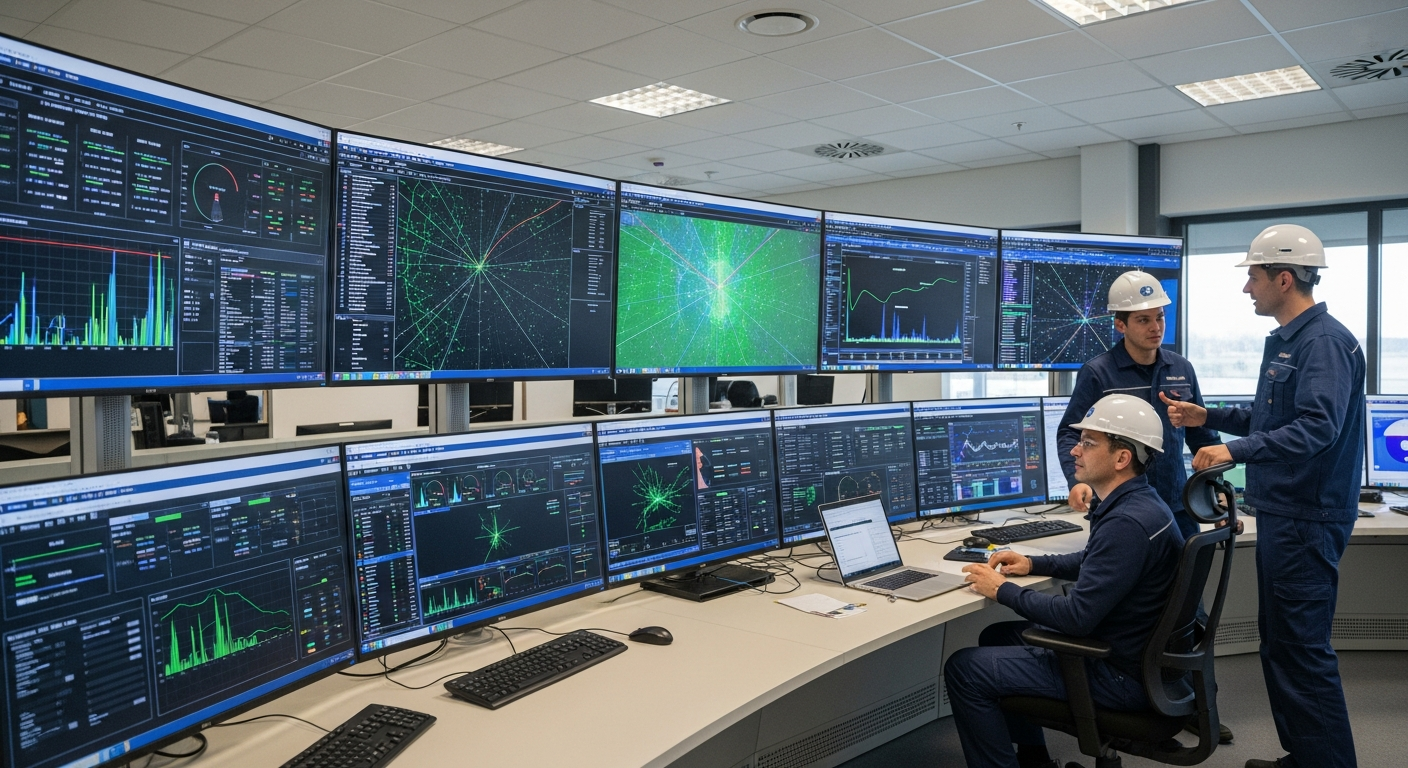
The energy sector presents one of the clearest cases for AI-driven value creation. Grid operators across Germany, France, and the Nordic countries are deploying predictive analytics to optimise renewable energy dispatch, reduce curtailment, and integrate distributed generation assets. The computational demands are substantial, and the accuracy requirements are unforgiving, making European energy one of the most demanding proving grounds for enterprise AI anywhere in the world.
What Makes European AI Development Distinctive?
European AI development is shaped by several structural factors that have no direct equivalent elsewhere:
- Regulatory primacy: The EU AI Act assigns risk categories to AI applications and imposes conformity assessment obligations that are already influencing product roadmaps at US and Asian AI companies serving European clients.
- Data sovereignty: GDPR and its sectoral equivalents mean that European AI deployments are built around data minimisation and purpose limitation from the outset, not retrofitted for compliance.
- Multilingual by default: European AI teams treat multilingual capability as a first-class engineering requirement, not an afterthought.
- Public-sector anchoring: European governments are significant AI customers, from national health services to defence ministries, providing stable demand that shapes research and commercial priorities.
The continent's AI sector is not converging towards a single global standard. It is diverging towards regionally optimised solutions that reflect European values around privacy, transparency, and accountability. Companies that ignore these structural realities risk building products that cannot clear EU compliance hurdles, or that simply fail to resonate with European enterprise buyers who have learned, often painfully, that American-first AI tools need significant reworking before they are fit for purpose on this side of the Atlantic.





Comments
Sign in to join the conversation. Be civil, be specific, link your sources.