

China is not trying to out-GPT the West. It is out-deploying it, industry by industry, factory by factory, vehicle by vehicle. While European regulators and AI labs debate model benchmarks and safety frameworks, Beijing has already moved on to the question that generates actual economic output: who puts AI to work fastest across the largest number of industries?
China Is Not Building a Better ChatGPT. It Is Building a Better Factory, Car, and Battery.
While European AI policy debates foundation model safety and compute access, China is doing something more consequential: embedding artificial intelligence into every car, battery, drone, and production line it makes. The race that matters most may not be the one Brussels and Westminster are focused on winning.
Advertisement 
On that metric, China is not merely competitive. It is pulling away. And the implications for European manufacturing are more urgent than most policymakers in Brussels or Westminster are prepared to admit.
There is a conversation happening in European policy circles that goes something like this: who will build the most powerful AI? The answer, depending on which think tank you ask, is either OpenAI, Google DeepMind, or some Chinese lab nobody has heard of yet, assuming export controls hold. It is the wrong question.
The question that truly deserves attention is not which organisation trains the most capable model, but rather which economy deploys AI most rapidly and thoroughly across its industrial base. By that measure, Europe is not merely lagging behind. It is being left at the starting line.
This difference carries far greater weight than most commentators in the West tend to acknowledge. The United States and Europe have constructed AI ecosystems built around general-purpose foundation models: large language models, multimodal architectures, and reasoning systems conceived to serve every conceivable use case for every conceivable user. A markedly different strategy has taken shape across the Atlantic's eastern rival. Rather than chasing headline performance on model capability benchmarks, Beijing has made the systematic weaving of artificial intelligence into specific industrial sectors its central priority, spanning electric vehicles and battery production, logistics automation and telecommunications networks, in what Chinese policy circles have labelled "AI+".
The outcome is not a single European AI giant. It is scores of globally competitive firms that have become remarkably capable in AI simply because their respective industries left them no other choice.
BYD: The AI Car Company Hiding in Plain Sight
The example that most clearly demonstrates Europe's vertical AI approach is not SAP or Siemens in the abstract. It is Volkswagen.
Most European observers still categorise BYD as an electric vehicle manufacturer, a Chinese rival to Volkswagen, Stellantis, or Tesla. That framing misses what BYD has actually become: an AI-integrated vehicle platform company that happens to sell cars.
In early 2025, BYD rolled out its "God's Eye" advanced driver-assistance system (ADAS) as standard equipment across its entire lineup, from the roughly 9,000 euro Seagull to the premium Yangwang U8. This was not a luxury add-on. It was a strategic declaration: every BYD vehicle would become an AI platform.
The architecture operates on three tiers. The top tier, DiPilot 600, deploys a triple-lidar configuration with NVIDIA Orin X processors delivering over 500 TOPS of compute power, enabling nationwide autonomous navigation without pre-mapped routes. The mid-tier system handles urban navigation with a single lidar. Even the entry-level tier, installed on cars costing less than 13,000 euros, provides lane-keeping, adaptive cruise, emergency braking, and autonomous parking.
What makes this strategically significant is scale. By late 2025, BYD had over 2.5 million God's Eye-equipped vehicles on the road generating 150 to 160 million kilometres of driving data every single day. That volume of real-world training data, flowing back to a single company's AI systems, represents a vertical integration advantage that no European automaker can currently match. Mercedes-Benz, BMW, and Volkswagen all have autonomous driving programmes, but BYD's approach of making advanced autonomy standard, not optional, across budget to luxury vehicles means its data pipeline is broader and denser than any Western equivalent.
BYD has committed 13 billion euros to AI agent and world model development, supported by a team of over 5,000 engineers dedicated to autonomous driving. The company has integrated DeepSeek's AI reasoning capabilities into its Wanji architecture for real-time decision-making, achieving 98.7% efficiency through knowledge distillation on edge devices. By March 2026, God's Eye 5.0 was bringing high-end autonomous capabilities to vehicles priced at just 13,000 euros.
The AI extends beyond driving. BYD's manufacturing AI has reduced battery defects by 40% and improved average battery lifespan by 20%. The company's 90,000 engineers and 18 billion euro R&D budget are not split between "AI research" and "car engineering." They are one integrated operation where AI is the connective tissue across design, manufacturing, quality control, and the driving experience itself.
This is what applied AI actually looks like in practice. Not a language model. A production line.
The Vertical AI Ecosystem: It Is Not Just BYD
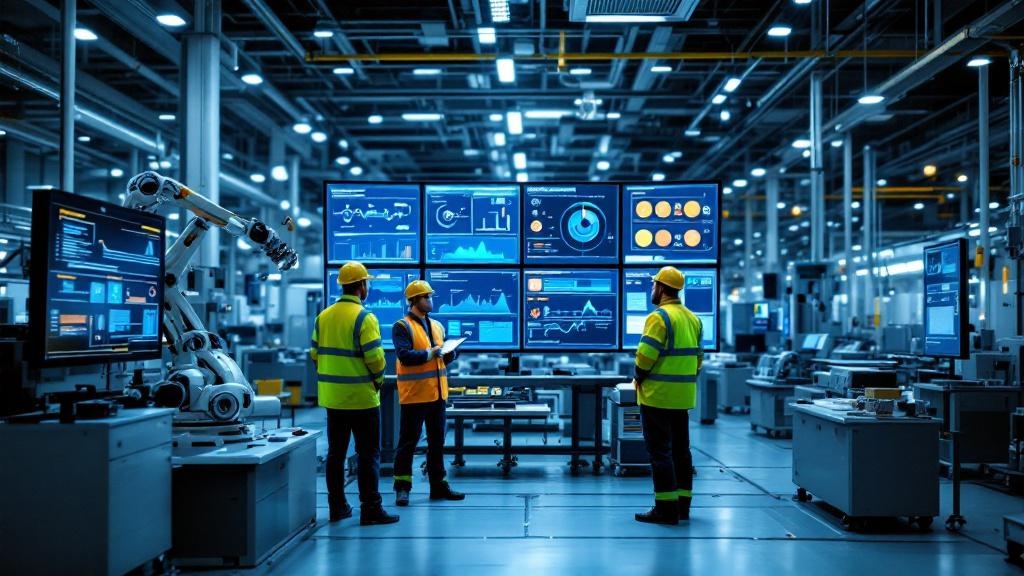
BYD is the most visible example, but China's vertical AI strategy runs across its entire industrial base. Consider what is happening simultaneously in three other sectors that European industry leaders should be watching closely.
Northvolt's Swedish rival and European battery giant Automotive Cells Company (ACC), along with established leaders such as Panasonic's European operations, are watching a fundamental shift in how battery engineering is done. CATL, holding roughly 38 percent of the worldwide market, has transformed cell development from a labour-intensive process of iterative experimentation into a fully AI-guided workflow. Its proprietary design platform, built on over 100,000 historical battery configurations and 600 terabytes of accumulated test data, produces optimised cell geometries within minutes at a prediction accuracy of 95 percent. Across its production floors, more than 6,800 quality checkpoints are continuously monitored through real-time machine-vision systems, enabling the output of one finished cell every second. In January 2026 the company received the World Economic Forum's MINDS Award recognising its AI-led manufacturing advances, and it has since introduced humanoid robots capable of autonomously identifying wiring faults at the end of production lines without human intervention. Starting in 2026, entire factory zones are being handed over to integrated AI systems and robotic workers, removing personnel from high-voltage inspection areas altogether.
DJI, which dominates the global commercial drone market, has shifted its enterprise strategy from "flying cameras" to "aerial AI platforms." The company's 2026 Enterprise Drone Onboard AI Challenge invites developers to deploy AI algorithms directly on drones for real-time anomaly detection, infrastructure inspection, and agricultural monitoring. The Manifold 3 edge computing module processes sensor data, flight control, and route planning onboard, with no cloud dependency required. DJI is not competing with Mistral AI or any European foundation model effort. It is building the world's best AI for flying machines.
Huawei, locked out of advanced Western chips by export controls, has responded by building its own AI computing ecosystem. The Ascend 910C chip delivers 800 teraflops of FP16 performance with 128 GB of memory, and the Atlas 900 A3 SuperPod clusters up to 384 of these chips for 300 petaflops of AI compute. Huawei shipped 700,000 Ascend AI chips in 2025, with 600,000 units of the 910C planned for 2026. Huawei's Pangu large models are not designed for consumer chat. They are optimised for industrial applications such as predictive maintenance, network optimisation, and manufacturing quality control.
Yes, China Builds Foundation Models Too. And That Is Part of the Strategy.
A common misconception in European AI discourse frames the picture as a binary: the West builds foundation models, China deploys applied AI. The reality is more nuanced. China also builds frontier-class general-purpose models, and it does so with a speed and cost efficiency that has repeatedly blindsided Silicon Valley and European AI labs alike.
DeepSeek is the most striking illustration of this trend. A comparatively lean research laboratory based in Hangzhou that reportedly developed its R1 reasoning model at a tiny fraction of what equivalent Western systems cost, DeepSeek rattled financial markets across the globe after demonstrating benchmark results that matched OpenAI's leading offerings. The model carries an open-weight licence, costs nothing to run, and has already been folded into industrial systems throughout China, among them the autonomous driving platform developed by electric vehicle manufacturer BYD.
Alibaba's Qwen series has become one of the most widely deployed model families globally. Tencent's Hunyuan models are embedded directly into WeChat and Tencent Cloud, reaching hundreds of millions of users. Baidu's ERNIE powers enterprise workflows through agent-driven systems.
The critical difference is not capability. It is purpose. Western labs, including European ones such as Mistral AI in Paris and the models emerging from research partnerships at ETH Zurich, treat foundation models as sophisticated outputs in themselves. Chinese companies treat foundation models as infrastructure, the plumbing that enables vertical AI applications across manufacturing, logistics, consumer devices, and autonomous systems. DeepSeek's open-weight strategy is not charity. It is an accelerant for ecosystem-wide adoption across China's enormous industrial base.
A March 2026 report confirmed this pattern: most major Chinese AI labs publish their model source code and weights openly, a deliberate strategy that creates a reinforcing feedback loop. Open models accelerate adoption. Adoption generates proprietary industrial data. Proprietary data feeds back into better models. The loop compounds.
The Policy Architecture: AI+ as Industrial Strategy
China's vertical AI approach is not accidental. It is the product of deliberate industrial policy stretching back more than a decade, and European policymakers would do well to study its architecture carefully, even if they would not replicate every element of it.
The AI+ Action Plan, issued by China's State Council in August 2025, codifies the strategy: achieve 70% AI penetration across key economic sectors by 2027, supported by intelligent terminals and AI agents. The plan targets a core AI industry worth over 130 billion euros by 2035, with related industries reaching 1.3 trillion euros. Four key initiatives drive execution: multi-tier platform cultivation, data aggregation for intelligence enhancement, large-scale industrial AI applications, and ecosystem development for deployment.
The 15th Five-Year Plan, covering 2026 to 2030 and unveiled in March 2026, extends these ambitions with specific targets for AI and cybersecurity integration across manufacturing, healthcare, renewable energy, agriculture, and smart city infrastructure. Where previous plans emphasised building AI capabilities, this one emphasises deploying them. Guangdong province's intelligent factories already use 5G-connected high-definition cameras running AI quality inspection at full production line speeds.
China's regulatory framework, encompassing its Data Security Law, Generative AI Measures, and a standards framework targeting over 1,000 firms by 2026, is designed not to slow AI development but to channel it toward industrial deployment and economic output. The contrast with Europe's AI Act, which is a considerable and necessary achievement in safety governance, is nonetheless instructive. The EU's regulatory energy has been concentrated on constraining risk in general-purpose AI systems. China's regulatory energy is concentrated on accelerating deployment in industrial ones.

This is not an argument against the AI Act. It is an argument for pairing it with something Europe currently lacks: a coherent industrial AI deployment strategy. Margrethe Vestager, in her final years as European Commission Executive Vice-President for A Europe Fit for the Digital Age, repeatedly warned that regulation without industrial policy would leave European companies as consumers rather than producers of AI-driven value. Her successor structures in the Commission have not yet answered that challenge with sufficient urgency.
Philipp Hildebrand, Vice-Chairman at BlackRock and a prominent voice in European economic policy discussions, has argued in recent forums that Europe's AI gap is not fundamentally a talent or compute gap. It is an integration gap: the inability or unwillingness to embed AI into physical production at the speed and scale that industrial competitiveness demands. That assessment aligns precisely with what China's vertical AI strategy is demonstrating in practice.
The Western Approach: Brilliant Models, Slower Integration
The contrast with the Western AI ecosystem, including the European one, is stark.
The United States has built the world's most capable foundation models. OpenAI, Anthropic, Google DeepMind, and Meta have pushed the frontier of what AI can reason about, write, code, and understand, delivering capabilities once confined to science fiction. These are genuine achievements. Europe has contributed meaningfully, with Mistral AI producing competitive open-weight models and academic institutions from ETH Zurich to the Sorbonne producing world-class AI research. But the strategic question is whether model capability translates into industrial transformation at the pace China is achieving. The honest answer, right now, is no.
The European AI economy is organised around a horizontal model: develop a general-purpose platform and let individual industries determine how to apply it. SAP sells software integrations. Mistral licenses its models to corporate clients. Microsoft weaves its tools into Azure. The underlying assumption is that whichever foundation model proves most capable will ultimately prevail, and the use cases will emerge naturally around it.
Europe's approach rests on a contrasting assumption: that the most effective AI in any particular sector will be developed by organisations with genuine expertise in that sector, and that the true measure of AI performance lies not in standardised test scores but in reduced error rates on production lines, motorway kilometres covered autonomously, energy cells optimised, and cargo drones successfully routed.
Consider the comparison in tabular terms:
- Primary focus: China embeds AI into specific industries at scale; the West builds the most capable general-purpose models.
- Lead actors: China's industrial companies (BYD, CATL, DJI, Huawei); Western AI labs (OpenAI, Anthropic, Google DeepMind, Mistral).
- Success metric: China measures deployment penetration and industrial output gains; the West measures benchmark scores, model capability, and API revenue.
- Data strategy: China exploits sector-specific data flywheels, driving data, battery data, manufacturing data; the West relies on broad internet-scale training data.
- Policy framework: China targets 70% sector penetration by 2027; Europe focuses on safety regulation and the AI Act compliance timeline.
- Model philosophy: China uses open-source for rapid ecosystem adoption; Western incumbents protect proprietary models as competitive moats.
- Integration speed: China makes AI standard across product lines; European manufacturers treat it largely as an optional enterprise add-on.
What Europe Is Missing
The strategic blind spot in European AI discourse is the assumption that general-purpose model leadership equals AI leadership. By this logic, whichever country or company builds the next generation of reasoning models wins the AI race.
Yet this perspective overlooks how value is genuinely produced in a functioning economy. AI does not contribute to GDP by scoring well on abstract reasoning tests. It contributes by making vehicles more reliable, reducing the cost of energy storage, accelerating production lines, improving supply chain coordination, and optimising power infrastructure. Europe's most competitive industrial players have begun to grasp this reality, and the nations that structure their AI priorities around concrete industrial outcomes rather than headline model capabilities will be the ones that pull ahead.
The numbers tell the story. China now controls 69% of the global EV battery market, with CATL and BYD together commanding the majority. BYD is on track to produce 5 million vehicles in 2025. DJI holds over 70% of the global commercial drone market. Huawei's Ascend chips now claim 41% of China's AI server market. These are not AI companies by a Silicon Valley or London definition. They are AI companies by the definition that matters: organisations using artificial intelligence to dominate their industries.
European responses, whether tightening technology export frameworks in coordination with Washington or building AI safety frameworks under the AI Act, may be necessary for other reasons, but they do little to address the vertical integration advantage. Even if China cannot access the very latest GPU generations, it does not need them to run quality inspection AI in a battery factory or obstacle avoidance AI on a 13,000 euro car. The AI models powering these applications are specialised, efficient, and increasingly trained on proprietary industrial data that no European or American company possesses.
For European manufacturers, the uncomfortable question is this: if CATL can monitor 6,800 quality control points per battery cell in real time, and a European competitor still relies on statistical sampling and human inspectors, which factory will produce better batteries at lower cost in five years? The answer does not require a degree in AI policy to work out.
Updates
- published_at reshuffled 2026-04-29 to spread distribution per editorial directive
- Byline migrated from "Sofia Romano" (sofia-romano) to Intelligence Desk per editorial integrity policy.
AI Terms in This Article 6 terms
foundation model
A large AI model trained on broad data, then adapted for specific tasks.
multimodal
AI that can process multiple types of input like text, images, and audio.
generative AI
AI that creates new content (text, images, music, code) rather than just analyzing existing data.
API
Application Programming Interface, a way for software to talk to other software.
GPU
Graphics Processing Unit, the powerful chips that AI models run on.
benchmark
A standardized test used to compare AI model performance.
Advertisement 
Comments
Sign in to join the conversation. Be civil, be specific, link your sources.