From Aspiration to Benchmark
China's "AI+" integration framework has featured in government work reports for three consecutive years, but this forum introduced sharper language around what officials are now calling a "new form of intelligent economy." The goal is to move AI from a national aspiration to a measurable economic output with policy teeth behind it.
The most concrete signal came from Liu Liehong, head of China's National Data Administration, who told delegates that AI-related industries in China are officially targeted to exceed 10 trillion yuan, approximately 1.45 trillion US dollars, by the end of the 15th Five-Year Plan period in 2030. This is not an investment bank projection. It is a planning benchmark from the body overseeing China's national data strategy, and it carries the weight of state resource allocation behind it.
Liu also outlined a structural shift in how AI models are evolving. As foundation models mature, the emphasis is moving towards domain-specific models trained on high-quality industry datasets, replacing the general corpora that powered the first wave of large language models. The implication for European industry is significant: the next competitive frontier in manufacturing AI will not be won by whoever has the largest general-purpose model, but by whoever builds the most capable, sector-specific systems trained on proprietary industrial data.
This is precisely the territory where European institutions are beginning to mobilise. The German Research Centre for Artificial Intelligence, known as DFKI, has been developing industrial AI applications for over three decades and has made domain-specific model research a strategic priority. Meanwhile, the European Commission's AI Office, established under the EU AI Act framework, has identified manufacturing as one of the high-value sectors where AI deployment standards and data-sharing infrastructure will be critical to maintaining competitiveness.
What the Factory Floor Actually Looks Like
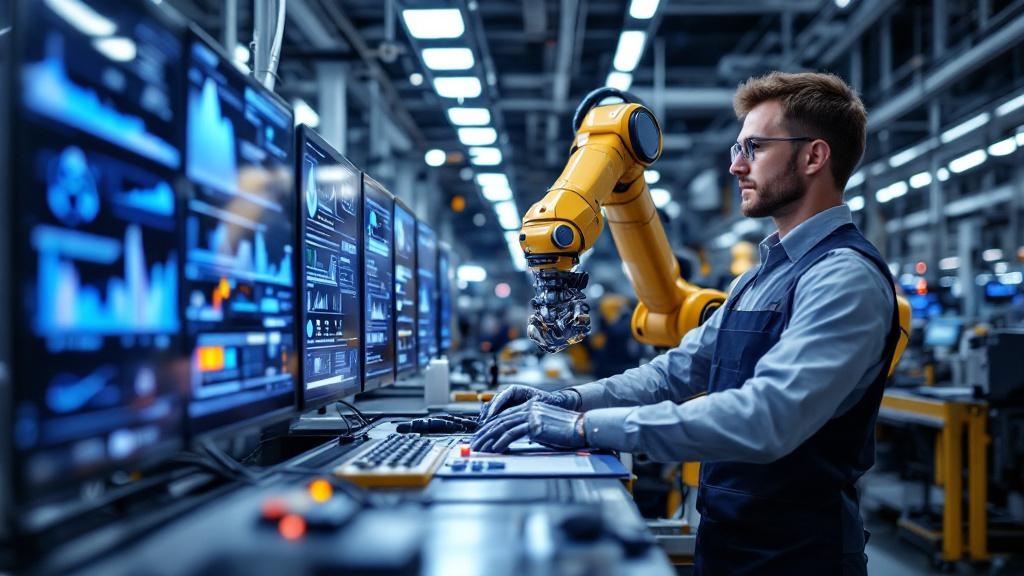
The forum's AI industrial applications symposium moved well beyond slide decks. Chinese industrial parks are deploying AI-powered humanoid robots on production lines and for security patrols within industrial zones. Facilities in Wuhan are generating 100 hours of daily training data for embodied intelligence systems, giving humanoid robots the sensory and situational information they need to function reliably in unstructured real-world environments.
Alibaba chairman Joe Tsai identified three structural advantages underpinning China's industrial AI readiness: sustained investment in power grid infrastructure, a commitment to open-source model development, and the depth of the country's manufacturing supply chain. These are not software advantages. They are physical infrastructure advantages built over decades, and they cannot be replicated quickly by competitors, European or otherwise.
Apple chief executive Tim Cook, also present at the forum, acknowledged the sophistication of Chinese developers and the degree of automation now visible across Chinese manufacturing facilities. Whether or not Cook's remarks carry strategic intent, the observation itself carries weight: the company that defined the smartphone era is watching China's AI-enabled factories with close attention.
"We Will See More DeepSeek Moments"
The most candid assessment from the forum came from Denis Depoux, global managing director of Roland Berger, the Munich-headquartered strategy consultancy. Depoux told delegates he expected the pattern set by DeepSeek's January 2025 market shock to repeat itself across multiple domains.
"I would assume that we will see more DeepSeek moments. AI development in China is very vibrant, with many models competing, and pretty much every month there is something new," Depoux said.
Depoux's framing is important because it reframes the AI competition from a binary frontier-model race into something more operationally disruptive: a continuous sequence of application-layer breakthroughs, each one potentially reshaping competitive dynamics in specific industries. For European companies supplying into or competing with Chinese industrial markets, this is not a theoretical concern. It is a quarterly operating risk.
Roland Berger's perspective matters here not simply because Depoux was present in Beijing, but because the firm advises a significant proportion of Europe's industrial base. When a consultancy with that client roster says application-layer disruption is coming in monthly cycles, European manufacturers should pay close attention.
ByteDance's Creative Layer and What It Signals
ByteDance has added a further dimension to the picture with its Seedance 2.0 text-to-video model, which generates high-quality, cinematic video clips from text prompts. The model is not a factory tool, but it represents the kind of creative-layer breakthrough that disrupts industrial design, product visualisation, and marketing workflows, areas where China's manufacturing base increasingly intersects with its consumer economy. European industrial designers and brand teams should consider this a direct competitive signal.
The European Competitive Position
Europe's response to China's industrial AI push is fragmented but not absent. Germany, through institutions such as DFKI and the Fraunhofer Society, has genuine depth in applied industrial AI research. The EU's proposed AI factories initiative, designed to give European companies access to high-performance computing for AI training, is a direct attempt to close the infrastructure gap that Alibaba's Joe Tsai identified as one of China's structural advantages.
But the speed gap is real. As Chinese factories embed AI into physical processes at scale, European competitors face a structural disadvantage that cannot be closed by chatbot deployments or dashboard analytics. The domain-specific model shift Liu Liehong described at the forum is exactly where European industrial groups need to be investing now, building proprietary datasets, commissioning specialised models, and treating AI integration as a capital expenditure priority rather than an IT project.
The EU AI Act, which came into full effect in 2024, places compliance obligations on AI systems used in high-risk contexts, including certain manufacturing applications. Some European executives have privately expressed concern that regulatory complexity could slow deployment at precisely the moment when speed matters most. That tension, between responsible governance and competitive urgency, is the central challenge for European industrial AI strategy through the rest of the decade.
The factory floor is being rewired. The question for European manufacturers is not whether to respond, but how fast they can move.




Comments
Sign in to join the conversation. Be civil, be specific, link your sources.