A European Skills Gap Is Widening Fast: What a $25 Million Asian Upskilling Fund Teaches Us
Google.org and the Asian Development Bank have committed $25 million to retrain 720,000 workers across Asia by 2027. The methodology, locally delivered, community-specific AI training rather than generic platform courses, offers a direct lesson for European manufacturers and policymakers facing an equally urgent skills deficit.
Europe's AI skills gap is not a future problem. It is happening now, on factory floors in Stuttgart, in logistics hubs in Felixstowe, and in SME workshops across the Ruhr valley. While Brussels publishes AI strategies and London champions its AI Opportunities Action Plan, the workers who must actually operate alongside intelligent systems are largely being left to figure it out themselves. A $25 million programme launched in Asia offers a model that European policymakers and manufacturers should study closely, and then scale with public money.
What the Fund Actually Does
The AI Opportunity Fund, backed by Google.org and the Asian Development Bank, targets 720,000 workers trained by 2027. Phase one, which ran through 2025, delivered training to over 300,000 workers via 48 partner organisations. Phase two, launched in early 2026, adds 18 new local training providers. The programme is managed by AVPN, the Asian Venture Philanthropy Network, and critically, it operates through local organisations rather than imposing a single top-down curriculum.
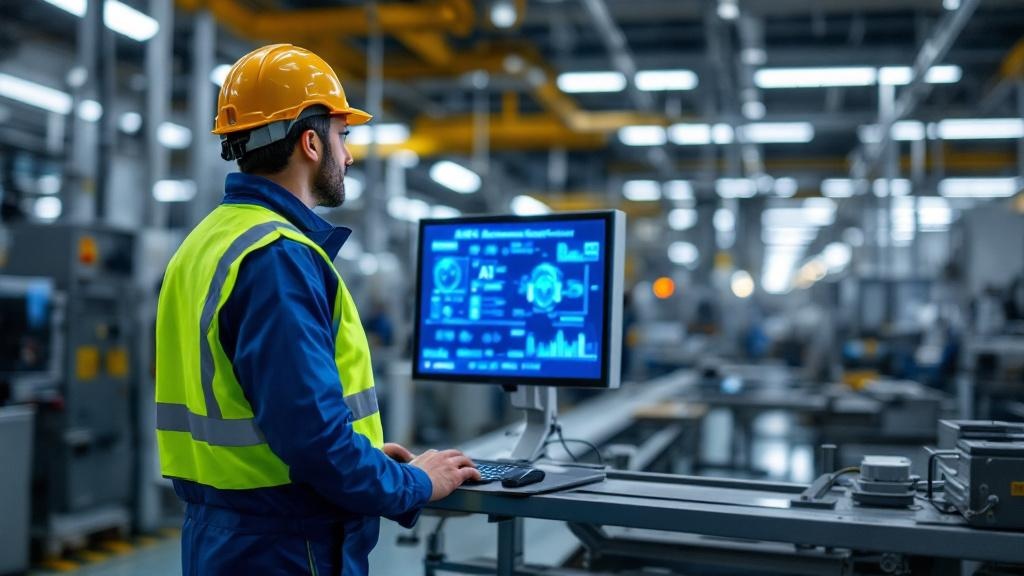
This distinction matters enormously. A factory floor supervisor operating AI-assisted quality control systems needs fundamentally different training from a healthcare worker using AI diagnostic tools or a logistics coordinator managing AI-optimised routing. The fund's design acknowledges this by funding local organisations to develop their own curricula, rather than translating generic Western platform courses and calling it upskilling.
Advertisement
A parallel strand, the AIM programme targeting micro, small, and medium enterprises, focuses not on individual workers but on helping small businesses integrate AI into their operations, covering everything from inventory management to customer engagement. For European manufacturing SMEs, which account for the overwhelming majority of industrial employment in Germany, Italy, and Poland, that focus on business-level integration rather than individual certification is a meaningful distinction.
Why Localisation Beats Scale
The reflexive European response to a skills crisis is to fund a platform. The EU's Digital Skills and Jobs Platform, launched under the Digital Decade policy programme, aggregates courses from dozens of providers. The UK's AI upskilling offers, including those channelled through the Department for Science, Innovation and Technology, lean heavily on self-directed online learning. Both approaches share a structural weakness: they assume that access to content equals acquisition of skill.
Ulrike Malmendier, a behavioural economist at the European University Institute in Florence who has studied workforce adaptation to technological change, has argued consistently that effective reskilling requires contextual relevance, not just content availability. Workers engage with training that maps directly onto their daily tasks and sector-specific challenges. Generic AI literacy modules, however well-produced, produce generic results.
Jeremy Fleming, former director of GCHQ and now a senior fellow at the Cambridge Centre for the Future of Intelligence, has made a related point in the security context: that AI capability without human judgement is a liability, not an asset. The same logic applies directly to manufacturing. A machine operative who has completed a generic generative AI course but has no understanding of how AI-driven quality control works in their specific production environment is not more productive; they are simply more confused.
The European Government Gap
National governments across Europe are investing in AI strategy. The EU AI Act creates a compliance framework. France has committed significant funding through its national AI strategy, anchored partly around Mistral AI as a domestic champion. The UK government's AI Opportunities Action Plan, published in January 2025, identifies workforce development as a priority. Germany's coalition has spoken at length about AI in manufacturing competitiveness.
But the detail, as in Asia, often stops at announcements. Specific programme names, trainee targets, and measurable sector-level outcomes remain sparse. The manufacturing sector, which employs roughly 30 million people across the EU and contributes approximately 15 per cent of EU GDP, receives no dedicated AI upskilling stream comparable to what the Asian fund is delivering for garment workers or factory supervisors.
The numbers tell the story bluntly:
720,000 workers targeted by the Asian fund by 2027, with $25 million committed
30 million manufacturing workers in the EU alone, the majority of whom will face some degree of AI-driven role transformation within the decade
Zero dedicated EU-level programmes with comparable per-sector specificity and localised delivery models for manufacturing AI skills
What European Manufacturers Should Take From This
The lesson from the Asian fund is methodological, not numerical. Localised, community-specific training delivered through trusted sector organisations outperforms centralised platform-based programmes. European manufacturing has a natural infrastructure for exactly this kind of delivery: industry associations, trade unions, Chambers of Commerce, Fraunhofer Institutes, Catapult centres in the UK. These bodies already have the sectoral credibility and worker relationships that make contextual training work.
The question is whether European funders, whether the European Investment Fund, Innovate UK, or national industry ministries, are willing to fund local delivery organisations to design their own AI training content rather than procuring off-the-shelf courses and distributing licences. The evidence from the Asian model suggests strongly that the former approach delivers better outcomes.
Training 720,000 workers across an entire continent is, as the Asian fund's architects acknowledge, a start rather than a solution. Europe's manufacturing workforce is at least 40 times larger. The arithmetic alone makes clear that no philanthropic programme, however well-designed, can close this gap. Only systematic public investment, structured around local delivery, sector-specific curricula, and measurable outcomes, will move the dial. The model exists. Europe now needs the ambition to replicate it at the scale the problem demands.
Updates
published_at reshuffled 2026-04-29 to spread distribution per editorial directive
Byline migrated from "James Whitfield" (james-whitfield) to Intelligence Desk per editorial integrity policy.
AI Terms in This Article2 terms
generative AI
AI that creates new content (text, images, music, code) rather than just analyzing existing data.
AI-driven
Primarily guided or operated by artificial intelligence.
Advertisement
Comments
Sign in to join the conversation. Be civil, be specific, link your sources.




Comments
Sign in to join the conversation. Be civil, be specific, link your sources.