Zoox's purpose-built robotaxi hits public streets, and Europe's regulators are watching closely
Amazon's autonomous vehicle unit Zoox has launched a public robotaxi service in San Francisco, operating purpose-built vehicles with no steering wheel, pedals, or mirrors. The move sets a regulatory and commercial precedent that European policymakers, from Brussels to Berlin, cannot afford to ignore as they finalise their own autonomous mobility frameworks.
Amazon's self-driving unit Zoox has crossed a threshold that the autonomous vehicle industry has been edging towards for years: a purpose-built robotaxi, stripped of every manual control, is now carrying members of the public on real city streets. The San Francisco launch of Zoox's "early rider" programme is not merely a Silicon Valley story. For European automotive incumbents, mobility startups, and regulators, it is a competitive and regulatory signal that demands an immediate, serious response.
From closed testing to public access
Zoox has operated test vehicles in San Francisco since 2017, but the new programme fundamentally changes the terms of engagement. Previously restricted to employees and invited guests, the service now accepts public applications via a dedicated app covering zones including SoMa, Mission Bay, and the Design District. Unlike the company's Las Vegas operation, which relies on fixed pickup and drop-off points, San Francisco offers true point-to-point service. Passengers request rides from their exact address and are delivered within roughly one block of their destination.
Advertisement
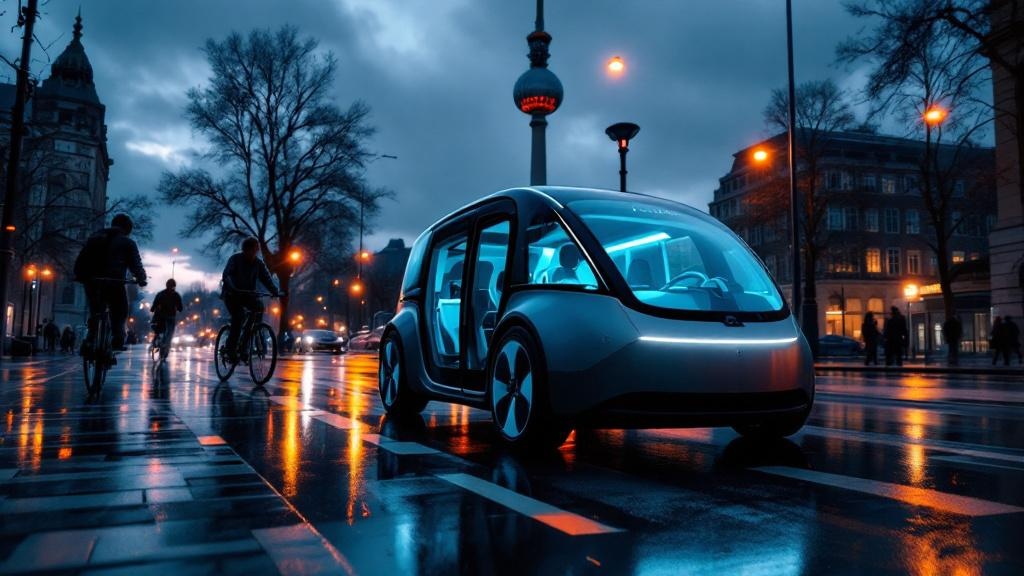
The electric, bidirectional vehicle features four inward-facing seats and eliminates all manual driving controls entirely. There is no steering wheel, no pedals, no mirrors. Cameras replace mirrors; software replaces the driver. This clean-slate design treats mobility as a service rather than retrofitting an existing car for autonomous operation, and it represents a clear philosophical break from the approach taken by most European OEMs, who are iterating towards autonomy from within the constraints of conventional vehicle architecture.
The regulatory unlock that makes it possible
The San Francisco launch rests on a pivotal regulatory decision. In August 2025, the US National Highway Traffic Safety Administration issued its first exemption under the expanded Automated Vehicle Exemption Programme, permitting Zoox's purpose-built vehicles to operate without conforming to all conventional Federal Motor Vehicle Safety Standards. The exemption currently covers demonstration use only; commercial fare collection will require further approval.
European regulators are at an analogous inflection point, but progress has been uneven. The EU's new General Safety Regulation, which came into force progressively from July 2022, mandates a raft of advanced driver assistance systems on new vehicles, but it stops well short of creating a pathway for vehicles with no manual controls at all. Hendrik Wüst, Minister-President of North Rhine-Westphalia and a prominent voice on industrial policy within Germany's automotive heartland, has repeatedly called on Brussels to accelerate the creation of a harmonised EU type-approval framework for fully autonomous vehicles, arguing that European carmakers risk ceding the design frontier to American and Chinese rivals while waiting for regulatory clarity.
Meanwhile, the European Union Agency for the Space Programme and the Joint Research Centre have both flagged that the current EU regulatory architecture was not designed for vehicles without a human driver in the loop. Reaction from the European Parliament's transport committee has been cautious: members acknowledge the need for a new framework but remain divided over liability rules and data-sharing obligations, two issues that the US system has so far sidestepped rather than resolved.
Europe's competitive position: strong on engineering, slow on deployment
Europe is not absent from the autonomous vehicle race. Wayve, the London-based autonomous driving company backed by SoftBank and Microsoft, is developing embodied AI for vehicles and has conducted supervised autonomous trials on British public roads. Mobileye, which supplies vision-based autonomy systems to European OEMs including Volkswagen and BMW, is expanding its supervised autonomy programmes across Germany and Israel. Neither, however, has yet operated a fully driverless, purpose-built public service at the scale Zoox is now attempting.
Anna Andueza, analyst at the Brussels-based think tank Transport and Environment, has argued publicly that Europe's strength in battery technology and vehicle engineering is being undermined by regulatory fragmentation. "We have the industrial base. What we lack is a single market for autonomous mobility," she noted in a May 2025 briefing on the future of road transport. That assessment is hard to dispute when a company operating out of Foster City, California, has just received a federal exemption that no European city, despite years of pilot programmes in places such as Gothenburg, Tallinn, and Milton Keynes, has managed to replicate at a comparable scale.
The competitive landscape
Zoox faces formidable competition in its home market. Waymo has completed more than 10 million paid rides and serves over one million rides per week across its operational geographies. Mobileye, Uber Technologies, and a cohort of better-funded startups are all circling the same opportunity. The key variables determining who wins are well understood: fleet utilisation rates and operational efficiency; regulatory approval timelines; public acceptance of autonomous technology; unit economics covering maintenance, insurance, and infrastructure; and the ability to expand geographically through local partnerships.
For European players, a further variable applies: the need to operate across multiple national regulatory regimes simultaneously. A robotaxi approved in Germany is not automatically approved in France or the Netherlands. Until the EU produces a harmonised autonomous vehicle type-approval regulation with genuine mutual recognition, European operators face a structural disadvantage relative to competitors operating within a single federal jurisdiction.
Safety, recall history, and the trust deficit
Zoox's launch is not without blemish. The company previously issued a recall relating to a braking issue, and safety scrutiny of autonomous vehicles in the US has intensified following incidents involving rival operators. These are not purely American concerns. The UK's Law Commission completed its review of automated vehicles in 2022 and recommended a new legal framework placing liability on the authorised self-driving entity rather than the human occupant, a model that European policymakers have studied carefully. The European Commission's proposed AI Liability Directive, still under negotiation as of mid-2025, will eventually determine how fault is allocated when an autonomous system causes harm, and the Zoox launch gives that debate fresh urgency.
Zoox targets annual production of 10,000 robotaxis by 2027 from its California manufacturing facility. Global deployment numbers will depend on regulatory approvals and market conditions, but the production ambition alone signals that this is no longer a research project. It is an industrial programme with a commercial roadmap, and Europe needs one too.
Zoox robotaxi versus a conventional vehicle: key differences
Driver controls: Conventional car has steering wheel and pedals; Zoox has none.
Seating orientation: Conventional cars use forward-facing seats; Zoox uses four inward-facing seats.
Directionality: Conventional vehicles are unidirectional; Zoox is bidirectional.




Comments
Sign in to join the conversation. Be civil, be specific, link your sources.