Amazon and UC Berkeley Give Robots Parkour Skills - and Europe Should Pay Close Attention
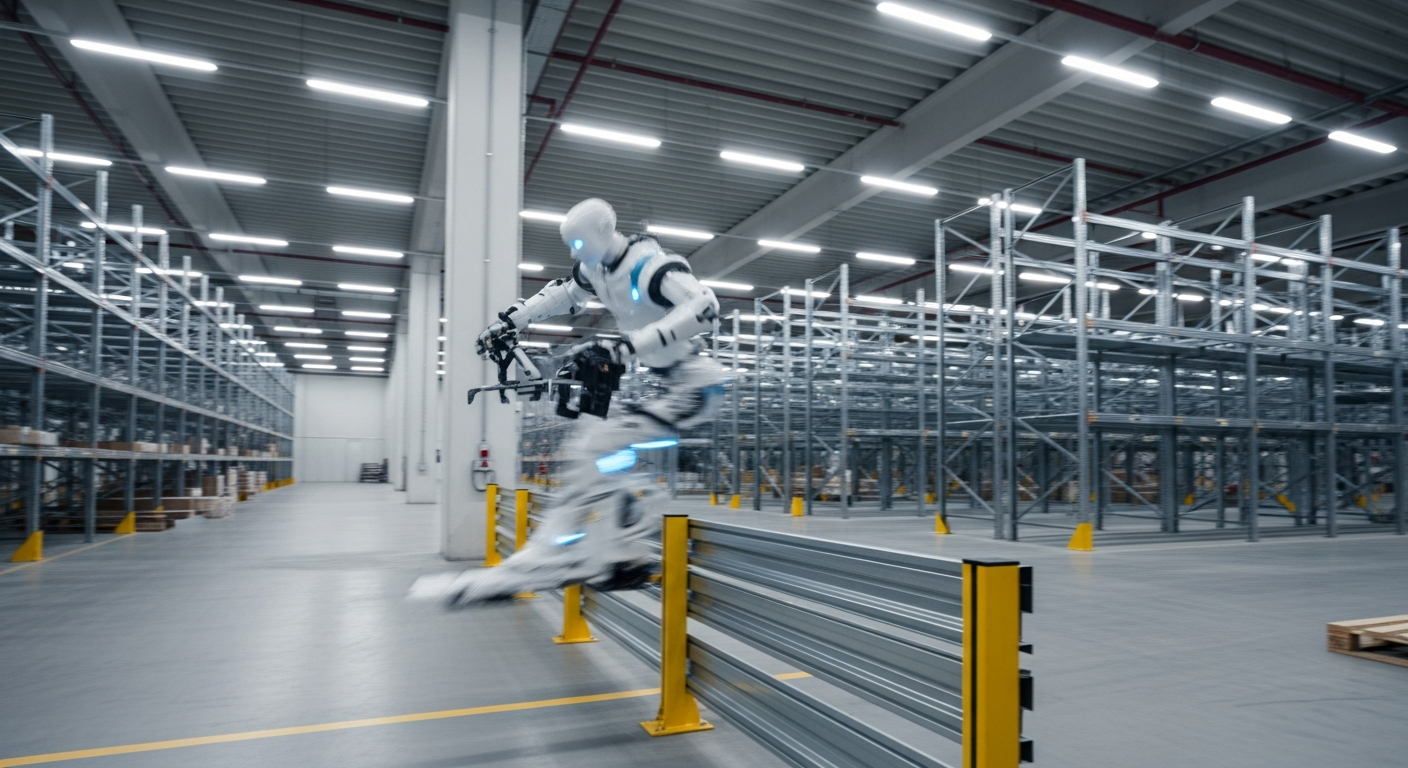
A new AI framework called Perceptive Humanoid Parkour enables a humanoid robot to vault barriers at 3 m/s, climb walls and traverse obstacle courses autonomously. Developed by Amazon and UC Berkeley, the research has immediate implications for European logistics, disaster response and industrial inspection sectors.
Humanoid robots capable of vaulting barriers at 3 m/s, scaling walls nearly as tall as themselves, and navigating complex obstacle courses without a single human command are no longer a speculative proposition. A research framework published in early 2026 by Amazon Frontier AI & Robotics and the University of California, Berkeley has produced exactly that, and the implications for European industry, safety regulators and robotics investors are concrete and immediate.
[[KEY-TAKEAWAYS:The PHP framework enables real-time autonomous parkour on a commercially available humanoid robot.|The Unitree G1 vaulted barriers at 3 m/s and climbed walls 96% of its own height.|A single unified policy selects and executes skills using only onboard depth sensing.|European logistics, disaster response and industrial inspection are the most immediate beneficiaries.|EU AI Act provisions on high-risk autonomous systems will apply directly to deployments of this kind.]]
Advertisement
The system, called Perceptive Humanoid Parkour (PHP), enables a Unitree G1 humanoid robot to execute fluid, contact-rich movements drawn directly from human parkour practitioners. The arXiv preprint, authored by Zhen Wu, Xiaoyu Huang and colleagues, is striking enough to warrant serious attention from anyone tracking the convergence of robotics and artificial intelligence in European R&D and policy circles.
What the PHP Framework Actually Does
The core problem with teaching humanoid robots to move dynamically is not hardware. It is the challenge of translating the fluid, opportunistic decision-making of a human body into something a machine can learn and generalise. Previous approaches to humanoid locomotion produced robots that walk steadily on varied terrain, but human-like agility demands something far more sophisticated: long-horizon planning, real-time perception, and the ability to chain multiple skills together without stopping to recalibrate.
PHP addresses this through a modular architecture combining two key components: motion matching and a teacher-student reinforcement learning pipeline. The team first assembled a dataset of human parkour videos, decomposed those movements into reusable atomic actions, and then used nearest-neighbour search in a feature space to compose those actions into smooth, long-horizon movement sequences. The elegance of this approach is that it preserves the fluidity of human motion rather than engineering stiff, mechanical approximations.
From Human Video to Robot Policy
Once the motion-matching stage produces kinematic trajectories, the researchers train individual skill controllers using reinforcement learning. RL allows the system to refine movements through iterative trial and error, rewarding the robot for successfully executing each parkour skill. Those individual controllers are then distilled into a single unified policy that uses onboard depth-sensing imagery to make autonomous decisions about which skill to deploy in any given situation.
This perception-driven decision-making is what separates PHP from earlier humanoid movement research. The robot does not need a human operator to select its next move. It reads the environment in real time, chooses the appropriate skill, and executes it, adapting to perturbations mid-course if obstacles shift position. The result is genuine closed-loop autonomy, not a scripted sequence of pre-programmed actions.
Real-World Results on the Unitree G1
The framework has been validated on the Unitree G1, a commercially available humanoid robot manufactured by Unitree Robotics of Hangzhou, China. The choice of hardware matters. Unitree's platforms are designed for accessibility and real-world deployment, which means these results are not confined to a bespoke laboratory prototype that no industrial operator could ever actually procure.
In real-world trials, the G1 demonstrated a range of highly dynamic skills:
Cat-vaulting over a short obstacle immediately followed by a dash-vault over a taller barrier, both at approximately 3 m/s
Climbing onto a 1.25-metre wall (96% of the robot's own height) and rolling down the other side
Speed-vaulting over obstacles at approximately 3 m/s
A 60-second continuous autonomous traversal of a complex multi-obstacle parkour course, selecting skills independently and transitioning between them without interruption
These are not controlled single-obstacle demonstrations. The 60-second course traversal with autonomous skill selection and real-time adaptation to obstacle perturbations represents a qualitative leap in what humanoid robots can do in unstructured environments. This is the kind of capability that makes disaster response, industrial inspection, and search and rescue genuinely tractable use cases, not speculative ones.
The European Dimension: Regulation, Research and Industrial Readiness
For European observers, the PHP framework lands in a particular context. The EU AI Act, which began phasing in from August 2024, includes provisions directly relevant to autonomous robots operating in public or semi-public spaces. Systems that make real-time decisions in safety-critical environments are classified as high-risk under Annex III, triggering conformity assessments, transparency obligations and human oversight requirements. Dragos Tudorache, the Romanian MEP who co-authored the AI Act, has repeatedly emphasised that the regulation is designed to be technology-neutral but sector-specific, meaning that agile humanoid robots operating in logistics warehouses or disaster sites will face meaningful scrutiny before they can be commercially deployed across EU member states.
ETH Zurich, one of Europe's leading robotics research institutions, has been running parallel work on legged robot locomotion through its Robotic Systems Lab. Professor Marco Hutter's group has demonstrated agile quadruped movement on difficult terrain, and the lab has explicitly flagged the challenge of transferring such capabilities to full humanoid platforms. The PHP framework's approach to motion matching from human video is directly relevant to that ongoing research agenda, and it would be surprising if ETH Zurich's robotics teams are not already studying the arXiv preprint closely.
On the industrial deployment side, Boston Dynamics, which operates its European headquarters out of Waltham, Massachusetts but counts major European automotive and logistics clients among its customer base, has long positioned its Atlas humanoid as the benchmark for dynamic movement. PHP's results on a commercially available, lower-cost platform like the Unitree G1 shift that competitive landscape. European manufacturers evaluating humanoid robot procurement no longer need to assume that cutting-edge agility requires cutting-edge hardware budgets.
Global Robotics Competition and What It Means for European Strategy
The research represents a direct collaboration between US academic and corporate research institutions and Chinese-manufactured hardware, a pattern that is increasingly central to how advanced robotics develops globally. China has made humanoid robotics a national strategic priority, with government-backed programmes and private investment flowing into companies including:
Unitree Robotics (quadruped and humanoid platforms)
Fourier Intelligence (rehabilitation and general-purpose humanoids)
UBTECH Robotics (humanoid and service robots)
Europe's response to this competitive dynamic has been patchy. The European Commission's Horizon Europe programme funds robotics research, and there are strong national programmes in Germany, France and Switzerland. But the continent does not yet have a humanoid robotics manufacturer capable of competing with Unitree on price or with Boston Dynamics on brand recognition. AGILITY Robotics, the Oregon-based maker of Digit, has begun European trials in logistics settings, but a genuinely European humanoid champion remains absent from the field.
This matters for strategic autonomy. If the PHP framework proves as generalisable as the researchers suggest, the competitive advantage will accrue to whoever deploys it fastest at scale. European logistics operators, construction firms and emergency services that wait for a fully domestically produced solution may find themselves at a meaningful disadvantage relative to competitors that adopt commercially available platforms running open-framework AI policies.
What Comes Next for Humanoid Agility
The researchers are clear that PHP is designed as a generalisable framework, not a one-off demonstration. The reinforcement learning pipeline can be applied to replicate other complex human movement patterns beyond parkour. Future work could extend the approach to:
Warehouse navigation in unstructured logistics environments
Stairwell traversal in building inspection scenarios
Disaster-site operations where human entry carries unacceptable risk
Hazardous environment inspection in nuclear or chemical facilities
The energy demands of running humanoid robots at this level of agility also deserve attention. As data centre infrastructure across Europe strains under AI workloads, the power requirements of physically intelligent robots add another layer of complexity to the sustainability picture. The European Commission's AI factories initiative, announced in early 2024, is focused on compute for model training, but the power envelope for physical AI at scale is a related and underexamined challenge.
The human oversight question cuts both ways. As robots become more autonomous, the people supervising them face new kinds of cognitive demand. Researchers at the University of Cambridge's Leverhulme Centre for the Future of Intelligence have documented real fatigue costs associated with extended AI-assisted work, and the same dynamics will apply to operators managing fleets of agile humanoid robots in high-stakes environments. The operational costs of physical AI are not purely mechanical; they are human too, and European deployment planners should factor that into their business cases from the outset.
The capability comparison tells the story plainly:
Stable walking on varied terrain: achieved by previous humanoid systems and by PHP
Dynamic vaulting at speed: limited to lab conditions previously; PHP achieves approximately 3 m/s in real-world trials
Wall climbing near robot height: not previously demonstrated; PHP achieves 1.25 metres (96% of robot height)
Autonomous multi-skill course traversal: not previously demonstrated; PHP completes a 60-second autonomous run
Real-time obstacle adaptation: previously limited; PHP achieves closed-loop control with onboard depth sensing
The gap between research demonstration and industrial deployment is narrowing faster than most enterprise planners in Europe currently appreciate. That is not a reason for alarm, but it is a very good reason for urgency in regulatory preparedness, procurement planning and skills development across the continent.
Updates
published_at reshuffled 2026-04-29 to spread distribution per editorial directive
AI Terms in This Article5 terms
reinforcement learning
Training AI by rewarding good outcomes and penalizing bad ones.
benchmark
A standardized test used to compare AI model performance.
at scale
Applied broadly, to a large number of users or use cases.
cutting-edge
The most advanced currently available.
compute
The processing power needed to train and run AI models.
Advertisement
Comments
Sign in to join the conversation. Be civil, be specific, link your sources.




Comments
Sign in to join the conversation. Be civil, be specific, link your sources.