What the PHP Framework Actually Does
The central problem in teaching humanoid robots to move dynamically has never been hardware. It has been the translation of fluid, opportunistic human decision-making into something a machine can learn and generalise. Earlier locomotion research produced robots that walk steadily on varied terrain, but genuine human-like agility demands far more: long-horizon planning, real-time perception, and the ability to chain multiple skills together without stopping to recalibrate.
PHP addresses this through a modular architecture combining two key components. The team first assembled a dataset of human parkour videos, decomposed those movements into reusable atomic actions, and used nearest-neighbour search in a feature space to compose those actions into smooth, long-horizon movement sequences. The result preserves the fluidity of human motion rather than producing the stiff, mechanical approximations that have characterised earlier humanoid locomotion systems.
Individual skill controllers are then trained using reinforcement learning, allowing the system to refine movements through iterative trial and error, rewarding the robot for successfully executing each parkour skill. Those controllers are distilled into a single unified policy that uses onboard depth-sensing imagery to make autonomous decisions about which skill to deploy in any given situation.
From Human Video to Robot Policy
The perception-driven decision-making at the heart of PHP is what separates it from earlier humanoid movement research. The robot does not need a human operator to select its next move. It reads the environment in real time, chooses the appropriate skill, and executes it, adapting to perturbations mid-course if obstacles shift position. This is genuine closed-loop autonomy, not a scripted sequence of pre-programmed actions.
As the paper's authors, Zhen Wu, Xiaoyu Huang, and colleagues, put it directly: the robot uses only onboard depth sensing and a discrete 2D velocity command to select and execute whether to step over, climb onto, vault, or roll off obstacles of varying geometries and heights.
The framework was validated on the Unitree G1, a commercially available humanoid robot manufactured by Unitree Robotics and widely used in academic and industrial research settings globally. Critically, the G1 is not a bespoke laboratory prototype. It is an accessible, real-world deployment platform, which means these results travel beyond the controlled conditions of a university lab.
Real-World Results on the Unitree G1
In real-world trials, the G1 demonstrated a range of highly dynamic skills:
- Cat-vaulting over a short obstacle immediately followed by a dash-vault over a taller barrier, both at approximately 3 m/s
- Climbing onto a 1.25-metre wall (96% of the robot's own height) and rolling down the other side
- Speed-vaulting over obstacles at approximately 3 m/s
- A 60-second continuous autonomous traversal of a complex multi-obstacle parkour course, with independent skill selection and uninterrupted transitions between movements
These are not controlled single-obstacle demonstrations. The 60-second course traversal with autonomous skill selection and real-time adaptation to obstacle perturbations represents a qualitative leap in what humanoid robots can do in unstructured environments. Disaster response, industrial inspection, and search and rescue are no longer speculative use cases for this class of capability. They are tractable, near-term applications.
The European Dimension
Europe has a direct stake in where this technology lands. The EU's AI Act, which entered into force in August 2024, classifies certain autonomous robotic systems as high-risk, imposing conformity assessments, human oversight requirements, and transparency obligations. Humanoid robots operating autonomously in unstructured public or industrial environments will almost certainly fall within that high-risk category, and the regulatory clock is already ticking faster than most enterprise planners appreciate.
Professor Bernhard Scholkopf of the Max Planck Institute for Intelligent Systems in Tubingen, one of Europe's foremost voices on machine learning and physical AI, has argued consistently that embodied intelligence requires its own evaluation standards, distinct from the benchmarks applied to language models. The PHP framework's 60-second autonomous course traversal is exactly the kind of real-world metric the field needs to standardise, and European research bodies are well positioned to lead that standardisation effort.
Dragomir Anguelov, head of research at Waymo and a European-trained computer vision researcher, has similarly noted that closed-loop autonomy in physical environments demands validation frameworks that go beyond laboratory metrics. The robotics field is converging on that view rapidly, and European institutions risk being rule-takers rather than rule-setters if they do not engage now.
For European industry, the implications are practical and pressing. Consider the sectors most immediately relevant:
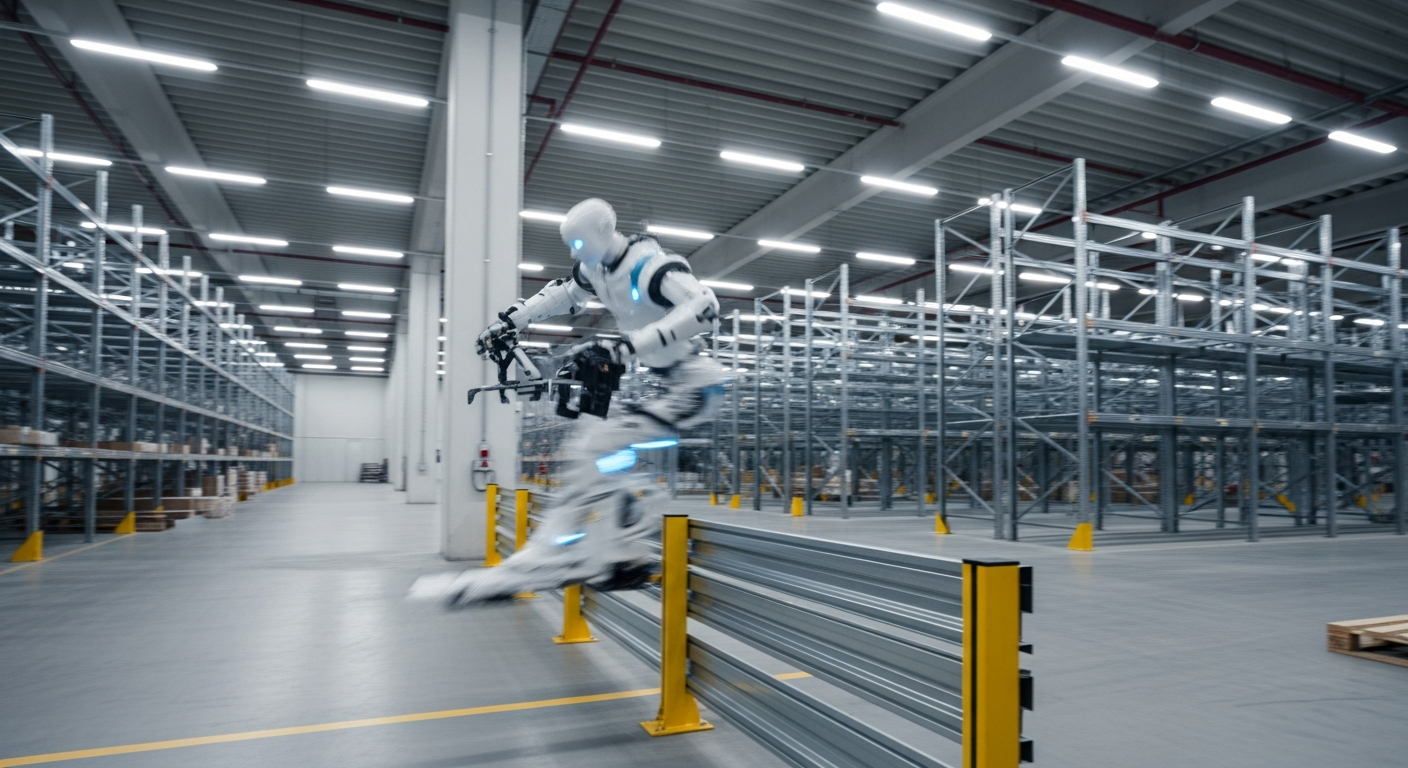
- Logistics and warehousing: Operators such as DHL, Deutsche Post, and CEVA Logistics are already piloting robotic automation in distribution centres. Humanoid robots capable of navigating unstructured warehouse layouts without infrastructure modification would remove one of the principal barriers to broader deployment.
- Industrial inspection: Offshore wind farms, nuclear facilities, and chemical plants across the UK, Germany, and France present environments where human entry carries serious risk. Agile humanoid robots capable of climbing, vaulting, and adapting to complex terrain in real time are a compelling alternative.
- Disaster response: European civil protection agencies have long sought robotic platforms capable of navigating collapsed structures. The PHP framework's demonstrated ability to traverse rubble-equivalent obstacle courses makes this application concrete rather than aspirational.
- Construction: Labour shortages across the EU and UK construction sector are acute. Robots that can navigate active building sites without requiring those sites to be redesigned around machine constraints represent a genuinely transformative capability.
The Broader Competitive Context
The choice of the Unitree G1 as the test platform reflects a structural reality in advanced robotics. Chinese manufacturers, including Unitree, Fourier Intelligence, and UBTECH, have become the dominant hardware substrate for cutting-edge locomotion research globally. China has made humanoid robotics a national strategic priority, with government-backed programmes and private investment explicitly targeting agile locomotion as a pillar of industrial competitiveness.
Europe's response has been fragmented. Fraunhofer Institute robotics programmes in Germany, the UK Research and Innovation funded National Robotarium in Edinburgh, and ETH Zurich's robotics and perception group are all producing world-class research. However, the translation from academic output to commercially deployed hardware remains slower in Europe than in either the United States or China. The PHP framework is a direct product of US academic-corporate collaboration running on Chinese hardware. European institutions are largely absent from that particular equation.
Regulatory and safety frameworks for robots operating in public and industrial spaces are still being developed across the EU and UK. The AI Act provides a foundation, but sector-specific guidance for agile humanoid systems has not yet emerged from either the European AI Office or the UK's AI Safety Institute. That gap creates both an opportunity and a risk as capabilities advance at pace.
What Comes Next for Humanoid Agility
The researchers describe PHP as a generalisable framework, not a one-off demonstration. The reinforcement learning pipeline can be applied to replicate other complex human movement patterns well beyond parkour. The near-term extension roadmap includes:
- Warehouse navigation in unstructured layouts
- Stairwell traversal and multi-floor building access
- Disaster-site operations in collapsed or obstructed environments
- Hazardous environment inspection where human entry is prohibitively risky
The energy demands of running humanoid robots at this level of agility also deserve attention. As European data centre infrastructure strains under AI workloads, the power requirements of physically intelligent robots add another layer of complexity to the sustainability picture. The EU's energy efficiency directives will eventually need to account for physical AI as explicitly as they do for cloud compute.
The cognitive load question cuts both ways. As robots become more autonomous, the humans overseeing them face new kinds of mental demands. Researchers at ETH Zurich studying human-robot interaction have documented real fatigue costs in supervisory control scenarios, and those dynamics will apply directly to operators managing fleets of agile humanoid robots in high-stakes environments. Deployment planning that ignores operator wellbeing from the outset will pay for it in safety incidents.
The gap between research demonstration and industrial deployment is narrowing faster than most European enterprise planners realise. PHP is not a curiosity. It is a signal.




Comments
Sign in to join the conversation. Be civil, be specific, link your sources.