Generative AI now produces synthetic faces that fool human experts 70% of the time, posing serious risks for European digital trust, democratic integrity, and online safety. New research from the University of Reading shows that just five minutes of targeted training can dramatically sharpen detection skills, offering a scalable tool for digital literacy programmes across the EU and UK.
Artificial intelligence has crossed a genuinely disturbing threshold in digital deception. Generative adversarial networks (GANs) now produce synthetic faces so convincing that they routinely fool even the most skilled human observers, creating what researchers term "hyperrealism": a condition in which fabricated faces appear more authentic than actual photographs. For European educators, regulators, and platform operators, this is no longer a theoretical concern. It is a live and escalating problem.
A study published in Royal Society Open Science delivers a sobering finding. So-called "super recognisers", an elite cohort with exceptional facial recognition abilities, performed no better than random chance when tasked with identifying AI-generated faces. Ordinary participants fared worse still, correctly spotting fake faces only 30% of the time. The research was led by Katie Gray, associate professor of psychology at the University of Reading, whose team focused on how training interventions might close that gap.
Advertisement
Five Minutes of Training Makes a Measurable Difference
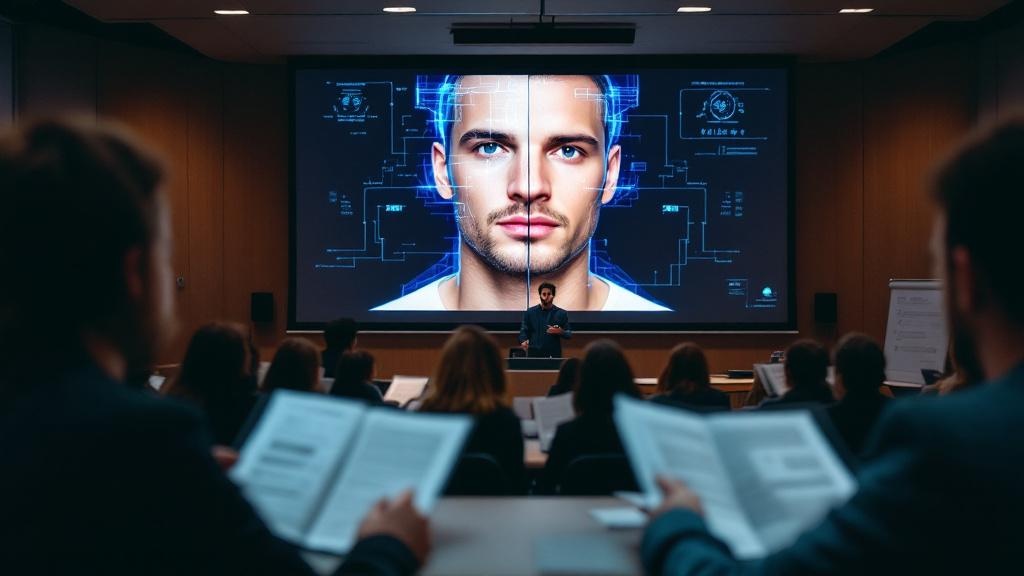
The study's most encouraging result came from a brief instructional session. Just five minutes of targeted training improved detection rates substantially: super recognisers reached 64% accuracy, whilst typical participants achieved 51%. Gray's training drew attention to common AI rendering errors, including unusual hairlines, unnatural skin textures, and the occasional "middle tooth" that appears in generated smiles. The session also highlighted AI faces' tendency toward mathematical perfection, with levels of symmetry and proportionality that are exceptionally rare in natural human appearance.
Gray noted that "understanding the unique skills of super recognisers could pave the way for more effective AI detection strategies in the future", proposing a human-in-the-loop approach that combines algorithmic detection with sharpened human capabilities. For European schools, universities, and workplace training programmes, this model is immediately practical. Unlike complex technical solutions requiring specialist infrastructure, these detection skills can be taught quickly and retained by ordinary users.
The Technology Driving the Deception
GANs operate through an adversarial process in which two neural networks compete. A generator creates synthetic faces derived from real-world data, whilst a discriminator evaluates their plausibility. Through millions of iterations, the generator becomes extraordinarily proficient at creating images that defeat both the discriminator and human observers. The result is a technological arms race that has accelerated sharply in recent years.
Modern systems can produce faces with specific emotional expressions, defined age ranges, and particular demographic characteristics. The sophistication now extends beyond static images to video deepfakes, raising acute concerns about political manipulation and identity fraud in contexts ranging from European election campaigns to financial services onboarding. The ease of access compounds this: user-friendly interfaces have democratised synthetic face generation, placing powerful deception tools within reach of anyone with basic computer skills.
Dragos Tudorache, the Romanian MEP who steered the EU AI Act through the European Parliament, has consistently argued that synthetic media poses one of the most immediate risks to democratic discourse. The AI Act's provisions on deepfakes and mandatory labelling of AI-generated content reflect exactly the kind of systemic concern that Gray's research quantifies at the human level.
Detection Strategies That Actually Work
Effective AI face detection hinges on understanding where generative algorithms routinely fail. The University of Reading research identified several reliable indicators that trained observers can learn to spot:
Hairline irregularities, where individual strands appear unnaturally uniform or geometrically perfect
Skin texture anomalies, particularly around the eyes and mouth, where complex lighting effects continue to challenge AI systems
Dental abnormalities, including the appearance of extra teeth or perfectly symmetrical arrangements
Background inconsistencies, where lighting or perspective fails to match the subject
Pupil and iris details that lack the natural variation found in human eyes
Beyond specific flaws, researchers noted that AI-generated faces frequently exhibit proportional perfection that is rarely seen in natural human variation. The golden ratio appears more often in synthetic faces, producing an uncanny valley effect for those trained to notice it. Participants who slowed down their assessment process consistently outperformed those who relied on rapid, instinctive judgements, suggesting that the AI's deceptive power is most effective against hasty appraisal.
The performance data across approaches illustrates the scale of the challenge:
Untrained human assessment: 30 to 41% accuracy
Five-minute training programme: 51 to 64% accuracy
Automated detection algorithms: 70 to 85% accuracy
Human-AI hybrid approach: 85 to 90% accuracy
What This Means for Europe's Education and Regulatory Agenda
Europe faces a particular set of pressures here. The EU AI Act, now entering its phased implementation period, places obligations on providers of high-risk AI systems and mandates transparency around synthetic content. But legislation alone will not close the perception gap that Gray's research exposes. Regulatory frameworks need a human literacy component to be effective, and that is where the five-minute training model becomes genuinely significant for European policymakers.
Marietje Schaake, the Dutch tech policy expert and former MEP who now directs the International Forum for Democratic Studies' tech and democracy programme, has long argued that digital literacy must be treated as a civic infrastructure priority, not an optional add-on to media education. Her position aligns directly with the research: brief, scalable, targeted training can level the playing field regardless of baseline recognition ability, which matters enormously in a continent of 27 member states with highly variable digital education standards.
Educational initiatives built around the five-minute training model could be embedded into existing media literacy curricula across EU and UK secondary schools and universities. Given that the training requires no specialist equipment and can be delivered online, the barrier to adoption is low. The question is whether national education ministries and the European Commission's digital education action plan treat this as the urgent priority it plainly is.
Platform operators also carry responsibility. Social media companies operating under the Digital Services Act are required to assess and mitigate systemic risks, and the proliferation of AI-generated profile images and synthetic media is precisely the kind of risk that DSA audits should be scrutinising. Layered approaches combining automated detection, user reporting mechanisms, and digital literacy education are the minimum acceptable standard. Transparency about synthetic content gives users the context to make informed judgements about what they are looking at.
The battle between synthetic media generation and detection will only intensify. As AI systems grow more capable, detection methods and digital literacy skills must keep pace. The encouraging news from the University of Reading is that human adaptability, when supported by targeted training, remains a meaningful tool in preserving visual truth. Five minutes is not a solution. But it is a start, and European institutions should not wait for a perfect technical fix before acting on what the evidence already shows.
Updates
published_at reshuffled 2026-04-29 to spread distribution per editorial directive
Byline migrated from "Sofia Romano" (sofia-romano) to Intelligence Desk per editorial integrity policy.
Advertisement
Comments
Sign in to join the conversation. Be civil, be specific, link your sources.




Comments
Sign in to join the conversation. Be civil, be specific, link your sources.