Are Europe's CEOs Ready for AI Executive Challengers?
AI-only firms operating without a single human employee are moving from science fiction to credible competitive threat. With cost structures that traditional businesses cannot match and autonomous operations running around the clock, European executives face a strategic reckoning. The question is no longer whether these rivals will emerge, but how fast.
Fully autonomous companies, staffed entirely by AI systems and directed by no human CEO, are no longer a thought experiment. They represent a concrete and accelerating threat to established European businesses, and the continent's corporate leaders are not moving nearly fast enough to meet it.
[[KEY-TAKEAWAYS:AI-only firms can operate 24/7 at a fraction of human-staffed costs, upending traditional competitive logic|Flagship AI models now sustain over 30 hours of autonomous work, exceeding a standard human shift|Insurance, financial services and customer support face the sharpest near-term disruption risk in Europe|The EU AI Act provides a regulatory scaffold, but enforcement gaps remain significant|Hybrid human-AI models are the most viable survival strategy for incumbents right now]]
Advertisement
Microsoft, Amazon and a constellation of European AI laboratories are pouring billions into fully autonomous systems. Since 2022, more than 100 startups claiming autonomous operational capabilities have attracted successive venture capital rounds across London, Paris, Berlin and Amsterdam. The pace of development is compressing timelines that most board-level risk registers have not yet acknowledged.
The Investment Surge Behind Autonomous Business Models
The sudden visibility of AI-only firms is not hype without foundation. Flagship AI models have evolved from sustaining roughly one hour of autonomous work in May 2025 to more than 30 hours by September 2025. That figure exceeds a standard human working shift and marks a qualitative shift in what autonomous operations can actually deliver.
The economics are equally stark. AI developers operating autonomously currently cost in the region of £7 per hour in compute and infrastructure, compared with £25 to £60 per hour for a skilled human programmer in Western Europe. When that differential compounds across an entire organisation, the incentive for businesses to replace human workforces becomes almost irresistible from a pure margin perspective.
Carme Artigas, Spain's former Secretary of State for Digitalisation and co-chair of the United Nations AI Advisory Body, has repeatedly warned that Europe must treat autonomous AI deployment as a systemic economic risk, not merely a labour-market adjustment. Her position, stated at the AI for Good summit in Geneva, is that regulatory frameworks must anticipate autonomous firms rather than simply react to them after market disruption has already occurred.
Competitive Advantages That Traditional Firms Cannot Replicate
AI-only firms carry structural advantages that go well beyond normal efficiency gains. Their primary cost lines are energy, compute infrastructure and software licensing rather than salaries, pensions, office leases or HR overhead. That difference does not merely lower costs; it changes the entire competitive geometry of an industry.
Consider the insurance sector, arguably the most immediately vulnerable market in Europe. An AI-only insurer could process claims in minutes rather than weeks, price policies dynamically using real-time risk data, and operate continuously without the variability that comes from human fatigue or error. Premiums could fall dramatically. Incumbents with legacy systems and large workforces would find it almost impossible to match that cost base without radical restructuring.
The operational comparison is blunt:
Operating hours: Traditional firms run 8 to 12 hours daily; AI-only firms operate 24 hours a day, seven days a week, every day of the year.
Strategy updates: Human-led organisations revise strategy annually or quarterly; autonomous firms can update weekly or in real time based on live market simulation.
Response time: Human organisations respond to customer or market signals in hours to days; AI systems respond in seconds to minutes.
Scaling speed: Hiring and training takes months; AI capacity can scale almost instantly.
Strategic adaptability is perhaps the most underestimated advantage. Traditional businesses are slowed by planning cycles, departmental politics and implementation drag. An AI-only firm can propagate a strategic decision across its entire operational network in the time it takes a human executive to brief a direct report.
Yoshua Bengio, Turing Award laureate and scientific director of the Montreal Institute for Learning Algorithms, whose work is closely followed by European AI policy circles, has cautioned that the multi-agent coordination capabilities now emerging in frontier models are qualitatively different from anything seen previously. Speaking at the 2024 International Dialogue on AI Safety in Seoul, he noted that systems capable of sustained autonomous operation introduce accountability risks that regulators have barely begun to map, let alone address.
Survival Strategies for Human-Led European Businesses
The survival of incumbent firms depends on two parallel moves: embedding AI deeply into operations rather than bolting on isolated tools, and doubling down on capabilities that autonomous systems cannot replicate. Doing one without the other is insufficient.
Human advantages that remain genuinely defensible include:
Creative vision and discontinuous innovation that goes beyond pattern recognition in training data
Complex judgement in ambiguous, high-stakes situations where context is poorly defined
Empathy and emotional intelligence for high-value client relationships and sensitive service contexts
Ethical reasoning in morally complex scenarios where stakeholder interests conflict
Trust built through personal reputation and long-standing institutional relationships
Physical world integration across manufacturing, logistics and distribution networks
There is also a strategic positioning play available to traditional companies. As AI-only firms proliferate, they will lack human touchpoints by definition. Physical supply chains, regulatory compliance expertise, relationship networks and ethical oversight services become premium assets rather than legacy costs. European incumbents with deep sectoral knowledge can position themselves as indispensable nodes in ecosystems dominated by autonomous AI operations.
Hybrid models are not a compromise; they are the most commercially rational structure available right now. AI handles operational throughput and efficiency optimisation; humans provide strategic direction, ethical governance and relationship depth. The organisations that treat this as a permanent architecture rather than a transitional phase will outperform those waiting for the dust to settle.
Regulatory and Societal Pressure Points Specific to Europe
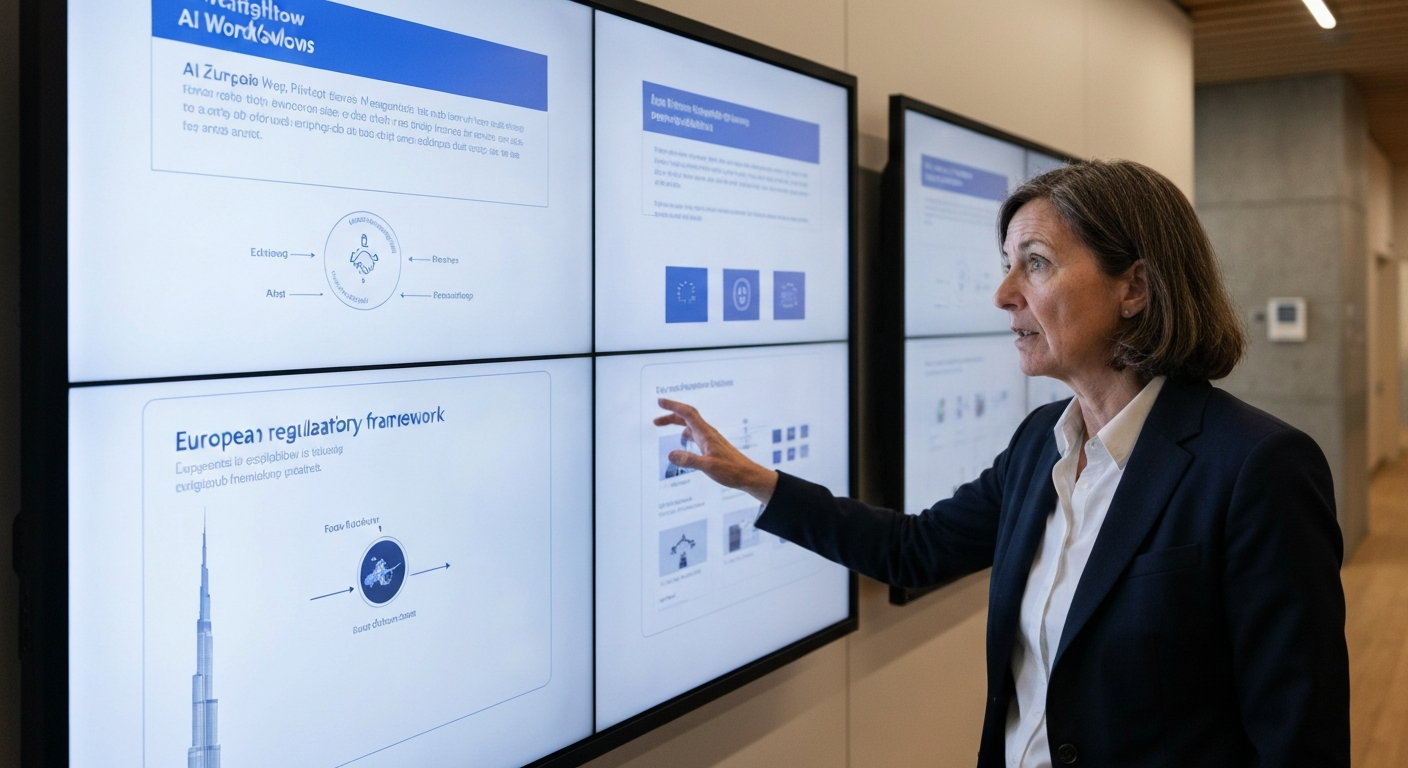
Europe enters this contest with a regulatory framework that no other region possesses: the EU AI Act, which came into force in August 2024, classifies certain autonomous systems as high-risk and imposes mandatory conformity assessments, transparency obligations and human oversight requirements. That framework is genuinely significant, but its enforcement infrastructure is still being built, and the pace of autonomous AI development is already straining its assumptions.
The accountability question is particularly acute in regulated sectors. When an AI-only firm makes a consequential decision in healthcare, financial services or legal advice, existing liability frameworks struggle to assign responsibility. There is no CEO to summon before a parliamentary committee, no board to hold accountable under director duties law.
Job displacement is the most politically sensitive dimension. White-collar professions across Europe, including insurance underwriters, financial analysts, compliance officers and customer service managers, face structural redundancy risk within a decade if autonomous AI capabilities continue on their current trajectory. Governments that delay workforce transition programmes are storing up a social crisis.
The competitive pressure between nation-states compounds every individual firm's dilemma. If the United Kingdom, seeking post-Brexit economic advantage, moves to a permissive regulatory stance on autonomous AI firms while the EU enforces stricter oversight, capital and talent will flow accordingly. That divergence is already visible in early regulatory signalling from Westminster versus Brussels.
Updates
published_at reshuffled 2026-04-29 to spread distribution per editorial directive
AI Terms in This Article4 terms
embedding
Converting text or images into numbers that capture their meaning, so AI can compare them.
AI safety
Research focused on ensuring AI systems behave as intended without causing harm.
regulatory framework
A set of rules and guidelines governing how something can be used.
compute
The processing power needed to train and run AI models.
Advertisement
Comments
Sign in to join the conversation. Be civil, be specific, link your sources.





Comments
Sign in to join the conversation. Be civil, be specific, link your sources.