Up to 30,000 Amazon Jobs At Risk in Europe as Robot Revolution Accelerates
Leaked internal documents reveal Amazon's plan to automate 75 per cent of its operations through advanced robotics, putting hundreds of thousands of warehouse roles at risk globally. European workers, regulators, and policymakers face urgent decisions as the company's automation blueprint begins reshaping logistics labour markets across the EU and UK.
Amazon is preparing to automate its way out of its human workforce, and Europe's warehouse sector is directly in the firing line. Leaked internal documents reveal the retail giant's plan to automate 75 per cent of its global operations through advanced robotics and AI-driven logistics, potentially displacing more than 600,000 warehouse workers worldwide. With Amazon operating major fulfilment networks in Germany, Poland, France, the UK, and Spain, the implications for European labour markets are severe and immediate.
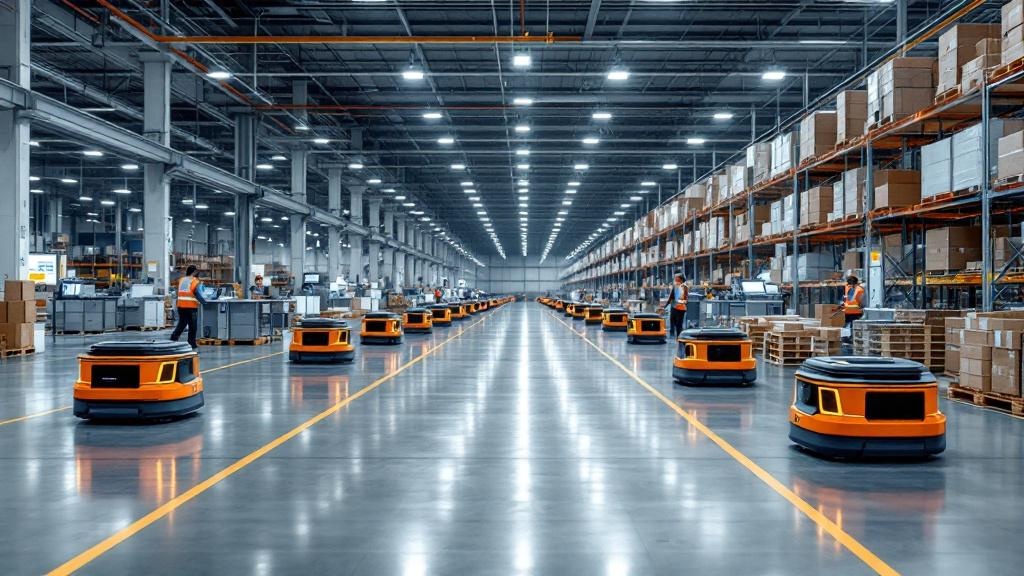
The company's robotics programme already involves more than one million autonomous machines across its global estate. It is targeting savings of 30 cents per package and up to $12.6 billion over three years. The scale of the investment signals this is not a pilot exercise. It is a structural transformation of how Amazon moves goods, and workers are the variable being optimised away.
Advertisement
The Shreveport Model Comes to European Warehouses
Amazon's pilot fulfilment centre in Shreveport, Louisiana, offers the clearest preview of what is coming. Robots now handle the majority of sorting and packing operations, reducing human involvement by 25 per cent. That model is set to expand to 40 additional locations by 2027, with some sites projected to employ 1,200 fewer workers each. European sites, where Amazon has invested heavily in automated infrastructure over the past five years, are natural candidates for this rollout.
The company's internal communications reveal a deliberate effort to manage public messaging around the transition. Teams are reportedly instructed to avoid words like "automation" and "AI", substituting phrases such as "advanced technology" and "good corporate citizenship." Despite this careful framing, Amazon spokespeople have not denied the contents of the leaked documents.
"Our robotics solutions are designed to automate tasks in an effort to continue improving safety, reducing repetition, and freeing our employees up to deliver for customers in more skilled ways," an Amazon spokesperson said. "Since introducing robots within Amazon's operations, we've continued to hire hundreds of thousands of employees to work in our facilities and created many new job categories worldwide."
Few labour economists find that claim persuasive at the scale now being discussed.
European Regulators and Unions Are Paying Attention
The EU's AI Act, which entered into force in August 2024, classifies certain AI systems used in employment and workforce management as high-risk, requiring transparency, human oversight, and fundamental rights impact assessments. Margrethe Vestager, former European Commission Executive Vice President for digital policy, has consistently argued that the EU must use its regulatory toolkit to ensure automation does not hollow out working conditions without accountability. The AI Act's employment provisions give national labour authorities concrete grounds to scrutinise Amazon's deployment plans before they reach full scale.
In the UK, the context is different but the concern is equally sharp. The Trades Union Congress has repeatedly called for legislation requiring employers to consult workers before deploying automation that displaces jobs. Paul Nowak, TUC General Secretary, warned in early 2025 that without a statutory right to consultation on AI and automation, workers would be left with no meaningful recourse as large employers restructured workforces at speed. Amazon's leaked timeline makes that warning look prescient.
The Numbers Behind the Disruption
Amazon CEO Andy Jassy acknowledged the direction of travel in a memo circulated in 2025, noting: "We will need fewer people doing some of the jobs that are being done today, and more people doing other types of jobs." That careful phrasing does not obscure the arithmetic. If 75 per cent automation is achieved across Amazon's network, the displacement in Europe alone could run to tens of thousands of roles, concentrated in lower-income regions where fulfilment centres were positioned precisely because labour was affordable and available.
Germany, Poland, and the Czech Republic host some of Amazon's largest European fulfilment operations. These are also economies where logistics and warehousing represent a significant share of employment for workers without university qualifications. The transition risks are not evenly distributed.
What a Credible European Response Looks Like
Preventing automation is neither possible nor desirable. The productivity gains are real, and European manufacturers and logistics operators who fail to adopt advanced robotics will lose competitiveness to rivals who do. The question is not whether Amazon automates. The question is who bears the cost of the transition and who captures the gains.
A credible European response requires action across several fronts:
Mandatory worker consultation requirements before large-scale automation deployments, enforceable under national labour law and the EU AI Act's high-risk provisions
Expanded funding for retraining programmes focused on robotics maintenance, AI systems oversight, and technical operations roles, building on existing EU Skills Agenda commitments
Sector-level collective bargaining agreements that tie productivity gains from automation to worker transition funds, as pioneered in parts of the German manufacturing sector
Policy innovation at member-state level, including trials of worker transition income support for those displaced from logistics and retail roles
Educational reform to embed AI literacy, data management, and human-machine interaction skills into vocational training curricula across the EU and UK
Research from the Oxford Internet Institute and economist Carl Benedikt Frey, whose 2013 work on automation risk remains a foundational reference, suggests that physical logistics and warehousing roles sit among the highest-risk categories for displacement. That analysis predates the current generation of collaborative robotics. The risk today is meaningfully higher than it was a decade ago.
Competitors Will Follow
Amazon rarely stays alone in a strategic direction for long. If the Shreveport model delivers the projected cost savings, every major European logistics operator, from DHL and DPD to Zalando and its third-party fulfilment partners, will face investor pressure to match it. The competitive dynamics of e-commerce logistics do not permit one major player to achieve a 30-cents-per-package cost advantage without forcing a sector-wide response.
That is the structural reality European policymakers must plan for. Amazon's leaked documents are not just a story about one company. They are a signal about where the entire sector is heading, and on what timeline. Governments and unions that wait for the transition to arrive before designing a response will find themselves managing a crisis rather than shaping an outcome.
The window to act is open. It will not stay open indefinitely.
Updates
published_at reshuffled 2026-04-29 to spread distribution per editorial directive
Byline migrated from "Sofia Romano" (sofia-romano) to Intelligence Desk per editorial integrity policy.
Advertisement
Comments
Sign in to join the conversation. Be civil, be specific, link your sources.




Comments
Sign in to join the conversation. Be civil, be specific, link your sources.