The Rise of Helsing: How a Munich Defence-AI Startup Earned a $5 Billion Valuation
Helsing has crossed the threshold from software vendor to systems integrator, and its $5 billion valuation reflects exactly that shift. The Munich startup is no longer selling tools to prime contractors; it is positioning itself to become one, challenging BAE Systems and Rheinmetall on their own ground.
Helsing is not a defence-tech curiosity any more; it is a credible rival to the traditional prime contractors that have dominated European military procurement for decades. The Munich-based company reached a $5 billion valuation in early 2025 after a funding round led by General Catalyst, cementing its status as Europe's highest-valued defence-AI company and, more importantly, signalling a fundamental change in what Helsing actually does.
The story of Helsing is often told as a software story: a team of machine-learning engineers who persuaded sceptical defence ministries that artificial intelligence could make aircraft sensors smarter, that autonomy software could compress the observe-orient-decide-act loop, and that a startup culture could move faster than a legacy prime. That story is true, but it is already out of date. The more consequential story is about systems integration, prime contractor ambition, and whether a nine-year-old company can genuinely displace incumbents who have been building relationships with procurement offices since before the Cold War ended.
Advertisement
"Helsing is not selling tools to prime contractors any more. It is positioning itself to become one."
AI in Europe editorial analysis
Helsing was founded in 2021 by Gundbert Scherf and Torsten Reil, two figures with unusually direct access to the policy world. Scherf had served in the German Federal Ministry of Defence as a senior official; Reil came from computational neuroscience and had co-founded the games-AI company NaturalMotion. Their explicit pitch from day one was that Europe needed a sovereign AI champion for defence, one that would not route sensitive military data through American hyperscaler infrastructure. That sovereignty argument landed at exactly the right moment. Russia's full-scale invasion of Ukraine in February 2022 arrived barely a year after Helsing's founding and transformed the urgency of every conversation the company was having with governments and procurement agencies.
The early contracts reflected the software-vendor model. Helsing won work integrating AI capabilities into the Eurofighter Typhoon sensor suite, a programme that involved close collaboration with Airbus Defence and Space and the partner nations of the Eurofighter consortium. The company also secured contracts related to autonomous systems software for the Bundeswehr, Germany's armed forces, with procurement notices through 2024 and into 2025 confirming ongoing work on electronic warfare and sensor-fusion applications. These were meaningful contracts, but they still positioned Helsing as a subcontractor or technology supplier rather than as the integrating authority.
From Software Shop to Systems Integrator
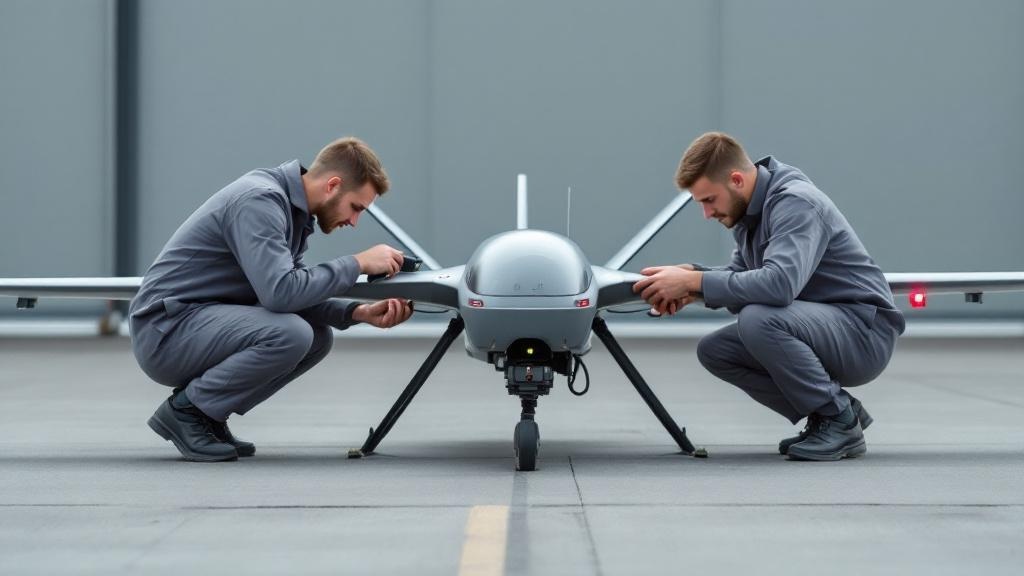
The shift in ambition became visible in Helsing's expansion into hardware-adjacent territory. The company launched GF-1, its own AI-enabled combat drone, in 2024, an unmanned aerial vehicle designed not merely to carry a sensor payload but to operate as part of a networked swarm. That product announcement was a statement of intent. Building and fielding a drone requires managing supply chains, certifying hardware, handling export controls, and accepting liability for physical performance in contested environments. None of those activities sit comfortably inside a pure software-licensing model. They are the activities of a systems integrator.
Helsing has also moved into the ground domain. Its work on autonomous ground vehicle software, combined with the company's growing headcount in Germany and the United Kingdom, points to an organisation that is deliberately broadening its platform surface. The UK presence is significant: Helsing opened a London office and has engaged with the British Ministry of Defence, giving it a foothold in two of Europe's three largest defence budgets simultaneously.
The General Catalyst-led round that pushed the valuation to $5 billion was not simply a vote of confidence in the software. General Catalyst has been explicit in its thesis that the next generation of defence prime contractors will be technology-native companies rather than manufacturing conglomerates that bolt on software. Helsing fits that thesis precisely. The investor logic is that the company's proprietary AI stack, combined with its growing hardware integration capability and its government relationships, creates the kind of defensible position that historically only incumbents like BAE Systems and Rheinmetall have occupied.
The Prime Contractor Question
Whether Helsing can actually achieve prime contractor status is a harder question than whether it deserves a $5 billion valuation. Prime contractors do not just integrate systems; they carry programme risk across multi-decade delivery schedules, manage thousands of subcontractors, navigate the political economy of industrial workshare across multiple NATO member states, and maintain the kind of institutional memory that survives multiple changes of government. Helsing has none of that legacy infrastructure, which is both its greatest vulnerability and, paradoxically, part of its appeal to procurement reformers who believe the legacy model is exactly what needs disrupting.
Rheinmetall, for its part, has been investing heavily in its own digital and AI capabilities. The Dusseldorf-based defence and automotive group announced a dedicated digital unit and has pursued partnerships with technology companies as part of its own transformation agenda. BAE Systems has made similar investments through its AI Labs and its work with the UK's Defence Science and Technology Laboratory. Neither incumbent is standing still.
But incumbents face a structural problem that Helsing does not. Their legacy revenue streams depend on platforms and programmes that were designed before modern AI existed. Upgrading those programmes to incorporate genuine AI capability often requires renegotiating fixed-price contracts, managing integration risk across hardware that was never designed for software-defined operation, and accepting schedule delays that carry reputational and financial consequences. Helsing, building from a clean sheet, can make different architectural choices from the start.
The Bundeswehr as Anchor Customer
Germany's position as Helsing's home market is a material advantage. The Bundeswehr is in the middle of its largest modernisation programme in a generation, driven by the Zeitenwende policy pivot that followed the 2022 invasion of Ukraine and by Chancellor Olaf Scholz's commitment of an additional 100 billion euros to defence investment. That spending has to go somewhere, and the German defence procurement apparatus has signalled a preference for domestic and European suppliers where capability is comparable. Helsing, as a German company with genuine AI capability, is well positioned to capture a disproportionate share of the digital and autonomous systems budget.
Bundeswehr procurement notices through 2025 have referenced AI-enabled situational awareness, electronic warfare software, and autonomous logistics applications, all areas where Helsing has stated product offerings. The company has not published detailed contract values, which is standard for sensitive defence work, but independent reporting by outlets including Sifted and Reuters has confirmed the breadth of the Bundeswehr relationship.
Sovereignty as Strategy
The sovereignty argument that Scherf and Reil deployed at Helsing's founding has only strengthened as the geopolitical environment has deteriorated. European governments are genuinely concerned about dependence on US-headquartered technology platforms for sensitive military AI applications, a concern that has intensified since debates within NATO about burden-sharing and the reliability of US security guarantees. Helsing's insistence on European data residency and its refusal to integrate with hyperscaler infrastructure that falls under US jurisdiction is not merely a marketing position; it is a structural feature of the product that commands a premium in government procurement.
The European Defence Agency has been pushing member states to develop sovereign AI capabilities, and the European Commission's defence industrial strategy includes explicit provisions for supporting AI in the defence sector. Helsing benefits from that policy environment in a way that US competitors cannot, and in a way that even European incumbents with significant US business exposure find complicated.
The scale of Helsing's trajectory, and the market it is entering, becomes clearer when the key figures are placed alongside one another. From founding valuation to the size of the broader European defence-AI market, the numbers tell the story of a company moving at a speed that traditional procurement cycles were never designed to accommodate.
Helsing's growth reflects broader forces reshaping European defence investment. The Bundeswehr's 100 billion euro modernisation fund, the doubling of German defence spending toward the NATO two-percent-of-GDP target, and the European Commission's commitment to defence industrial investment are all creating a procurement environment that simply did not exist when the company was founded in 2021. Helsing has timed its systems-integration pivot to arrive precisely as that spending begins to flow.
The valuation debate is, in one sense, a distraction. A $5 billion number means little until Helsing either lists on a public market or is acquired, and neither event appears imminent. What matters operationally is whether the company can win the kind of large, multi-year prime contracts that would validate the systems-integrator thesis. The next 24 months will likely determine whether Helsing is Europe's defence-AI future or an exceptionally well-funded proof of concept.
THE AI IN EUROPE VIEW
Helsing deserves its reputation as Europe's most serious attempt to build a technology-native defence prime contractor, and the $5 billion valuation is defensible if you accept the premise that the company is genuinely transitioning from software vendor to systems integrator. We accept that premise, with significant caveats.
The sovereign-AI argument is real and commercially valuable. European governments are right to want military-grade AI that does not route through infrastructure subject to foreign jurisdiction, and Helsing has built its architecture around that requirement from the beginning. That is a genuine competitive moat, not a branding exercise.
The harder problem is programme management at scale. Helsing has never delivered a major defence programme as prime contractor. It has never managed the workshare politics of a multi-nation consortium. It has never absorbed a schedule slip on a fixed-price contract that costs more to recover than the contract is worth. These are not software problems; they are organisational and political ones, and they have destroyed better-funded companies than Helsing.
The Bundeswehr relationship and the General Catalyst backing buy time and credibility, but they do not substitute for earned programme delivery. Helsing should be treated as the most credible challenger to the traditional prime model in Europe, not yet as a proven alternative to it. The distinction matters enormously for procurement decision-makers who are being asked to put operational capability on the line.
Updates
published_at reshuffled 2026-04-29 to spread distribution per editorial directive
Byline migrated from "Sebastian Müller" (sebastian-muller) to Intelligence Desk per editorial integrity policy.
AI Terms in This Article5 terms
at scale
Applied broadly, to a large number of users or use cases.
moat
A competitive advantage that protects a business from rivals.
pivot
Fundamentally changing a business strategy or product direction.
hyperscaler
A massive cloud computing provider like AWS, Azure, or Google Cloud.
sovereign AI
National initiatives to develop domestic AI capabilities independent of foreign providers.
Advertisement
Comments
Sign in to join the conversation. Be civil, be specific, link your sources.





Comments
Sign in to join the conversation. Be civil, be specific, link your sources.