The Rise of French Deep-Tech AI: Pasqal, Quandela, and the Quantum-AI Bridge
Beyond the LLM headlines, France has quietly assembled the densest quantum-AI startup cluster in Europe. Pasqal, Quandela, and Alice & Bob are each pushing towards commercial relevance, backed by Bpifrance and CEA-Leti. The question is whether their technical ambitions can translate into durable business before the window closes.
France has built something genuinely unusual in the European deep-tech landscape: a quantum-AI cluster that is not a government vanity project but a collection of commercially-oriented startups with credible technical foundations and real institutional backing. Pasqal, Quandela, and Alice & Bob are the three names that matter most, and each is pursuing a distinct path towards making quantum computing useful to AI workloads before the hype cycle exhausts itself.
The strategic logic behind this cluster did not emerge spontaneously. It was seeded by decades of investment in fundamental physics at institutions including CEA-Leti in Grenoble and the Laboratoire Charles Fabry near Paris, and it has been accelerated by the French Quantum Plan, launched in January 2021 with a commitment of 1.8 billion euros over five years, coordinated in large part through Bpifrance. That plan explicitly targeted the translation of academic quantum research into industrial capability, and the results are now visible in the funding rounds and product roadmaps of the leading startups.
Advertisement
"Neutral-atom processors allow programmable qubit arrays that map naturally onto the graph-structured optimisation problems at the heart of many enterprise AI pipelines, which is precisely why Pasqal's hybrid approach is attracting serious enterprise interest rather than purely academic attention."
Editorial analysis, AI in Europe
Pasqal is the furthest along in terms of hardware scale. Founded in 2019 by Georges-Oliver Reymond and Christophe Jurczak, with scientific roots at the Institut d'Optique and close ties to Nobel laureate Alain Aspect, the company builds neutral-atom quantum processors. In 2023 it completed a funding round of 100 million euros, one of the largest quantum raises in European history at that point, with participation from the European Innovation Council Fund, Bpifrance, and Temasek. Its commercial proposition is increasingly focused on quantum-AI hybrid workflows, specifically on using neutral-atom processors to accelerate certain classes of optimisation problems that feed into machine learning pipelines. Pasqal has signed research and deployment agreements with Crédit Agricole, BASF, and Johnson & Johnson, which positions it closer to enterprise revenue than most of its European peers.
The neutral-atom approach that Pasqal uses has a particular relevance for AI applications because it allows the programmable arrangement of qubits in two-dimensional and three-dimensional arrays, which maps naturally onto graph-structured problems common in combinatorial optimisation and, increasingly, in training data curation and feature selection for large models. The company has published work on variational quantum algorithms that can be run on its 100-qubit Fresnel processor, and its research team has collaborated with CEA-Leti on error characterisation methods that are a prerequisite for any serious enterprise deployment.
Quandela: Photonics Takes a Different Route
Quandela operates in a fundamentally different part of the quantum hardware space. Founded in 2017 and spun out of the Centre for Nanosciences and Nanotechnology (C2N) at the Université Paris-Saclay, Quandela builds photonic quantum computers based on single-photon sources. The company raised 50 million euros in a Series B round in 2023, with Bpifrance again participating alongside Quantonation and EQT Ventures. Its Mosaiq cloud platform allows users to run photonic quantum circuits remotely, and it has positioned this as an entry point for AI researchers who want to experiment with quantum feature maps and quantum kernel methods without needing to understand the underlying hardware.
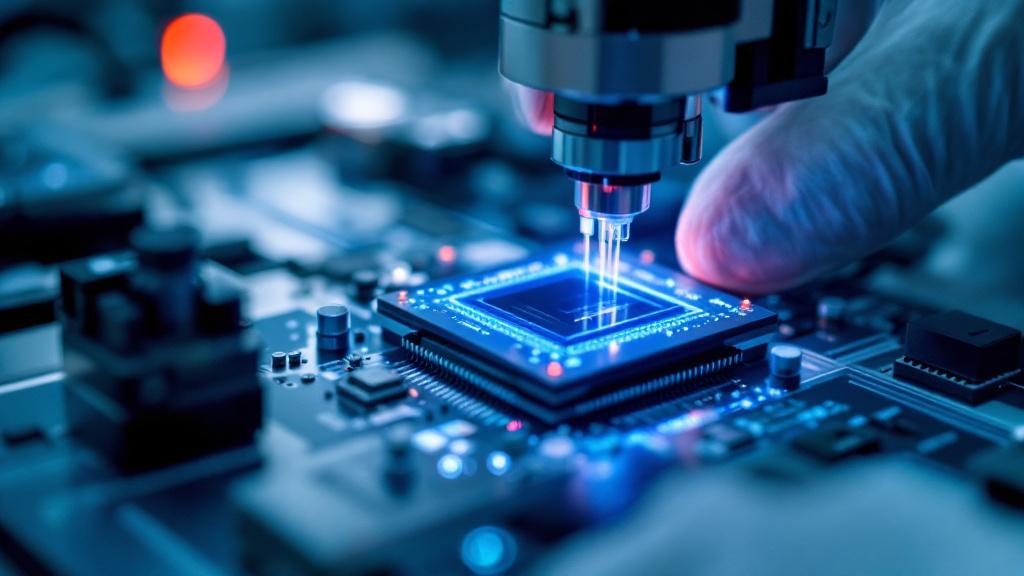
The photonic route has distinct advantages for certain AI-adjacent tasks. Photons do not require the dilution refrigerators that superconducting qubits demand, which means Quandela's systems operate closer to room temperature for the photon generation and routing stages, reducing infrastructure costs for data centre integration. The company's Prometheus single-photon source, developed initially through CEA-Leti partnerships, achieves indistinguishability rates that its technical papers cite as among the highest recorded in a manufacturable device. For quantum machine learning tasks that rely on interference-based computation, that indistinguishability is not a marginal improvement but a foundational requirement.
Quandela has been candid about where it sits on the maturity curve. Chief executive Niccolo Somaschi has stated publicly that near-term photonic systems are most useful for proof-of-concept demonstrations of quantum advantage on specific problem types rather than general-purpose computation. That honesty is strategically important: it sets expectations with enterprise customers in a way that avoids the credibility damage that has afflicted some North American quantum firms that over-promised on timelines.
Alice and Bob: The Error Correction Bet
Alice & Bob is making the most technically audacious wager of the three. Founded in 2020 by Theo Rybarczyk and Raphael Lescanne, the Paris-based startup is building cat qubits, a superconducting qubit architecture specifically designed to suppress one class of errors (bit flips) at the hardware level, reducing the overhead required for quantum error correction. The company raised 30 million euros in a Series A round in 2022, with participation from Bpifrance and Supernova Invest, and it has published peer-reviewed work in Nature Physics and Physical Review X that provides independent validation of its core technical claims.
The relevance of Alice & Bob's approach to AI is somewhat less direct than Pasqal's or Quandela's, but it matters for the longer arc. The central bottleneck to using quantum computers for serious AI workloads is not qubit count but qubit quality: logical error rates need to fall by several orders of magnitude before quantum hardware can run algorithms complex enough to offer genuine advantage over classical accelerators for training or inference. Alice & Bob's cat qubit architecture, if it delivers on its published results at scale, could dramatically reduce the number of physical qubits required per logical qubit, which in turn compresses the timeline to fault-tolerant quantum AI computation.
The company has been explicit that it is targeting fault-tolerant quantum computing as its end state, with a roadmap that projects a 100-logical-qubit system by the late 2020s. That is an ambitious claim, and the history of quantum computing is littered with roadmaps that slipped. But the technical peer review record for Alice & Bob's cat qubit work is stronger than that of many competitors making similar timeline claims.
The financial and technical metrics behind France's quantum-AI cluster illustrate both the scale of the public commitment and the genuine commercial progress these companies have made. The figures below draw on disclosed funding rounds, published roadmaps, and Bpifrance programme data to give a grounded picture of where the sector stands heading into the second half of the decade.
Bercy's Strategic Bet: Justified or Overextended?
The French Ministry of Economy and Finance, commonly referred to as Bercy, has framed quantum computing as a sovereign technology priority alongside AI and semiconductors. The 1.8 billion euro Quantum Plan, announced under Bruno Le Maire, is one of the largest national quantum investments in Europe on a per-capita basis, and it explicitly links quantum capability to AI competitiveness on the grounds that fault-tolerant quantum hardware will eventually enable AI training and inference tasks that are intractable on classical hardware.
That strategic framing is coherent but it rests on a timeline assumption that remains genuinely contested. The honest version of the argument is that France is making an options bet: if fault-tolerant quantum computing arrives in the 2030s as some researchers expect, France wants to have the domestic industrial base to exploit it. If it arrives later, or not at all for certain problem classes, the investment in deep-tech talent and infrastructure still yields spillovers into adjacent fields including classical AI hardware, photonics for data centre interconnects, and advanced materials.
CEA-Leti's role in this ecosystem deserves particular emphasis. As a research and technology organisation with more than 4,000 staff in Grenoble, CEA-Leti provides the manufacturing process development and reliability testing that allows startups like Pasqal and Quandela to translate laboratory demonstrations into devices that can be replicated at scale. Without that infrastructure, the French quantum cluster would look more like a collection of academic spinouts than a nascent industry. The integration between CEA-Leti and the commercial layer is one of the structural advantages France holds over, for example, the UK's quantum programme, which has strong universities but a less developed applied research bridge.
The commercial trajectories of Pasqal, Quandela, and Alice & Bob diverge meaningfully in the near term. Pasqal is the closest to generating recurring enterprise revenue from its hybrid quantum-classical optimisation offering; Quandela is building a cloud access model that could accumulate a research customer base quickly; Alice & Bob is playing a longer game that requires sustained investor patience and continued technical validation. None of them are profitable, and none are close to the scale at which quantum hardware generates the kind of revenue that justifies their current valuations on a classical DCF basis. That is not unusual for deep-tech infrastructure plays, but it means that the next two years of commercial milestones will be defining. Enterprise pilot contracts need to convert to production deployments, and published qubit performance metrics need to hold up under independent benchmarking.
France's quantum-AI cluster is real, technically credible, and better resourced than anything comparable in Europe. Whether it delivers on its commercial promise within the strategic window that Bercy has defined is a different question, and one that will be answered not in government plans but in customer invoices and published error rates.
THE AI IN EUROPE VIEW
France's quantum-AI cluster is one of the few places in Europe where deep-tech policy and deep-tech execution are actually converging rather than running in parallel and never meeting. Pasqal, Quandela, and Alice & Bob are not the same company wearing different hats: they represent genuinely distinct technical bets on which part of the quantum stack will matter most for AI workloads, and that diversity is a sign of intellectual seriousness rather than duplication. Bpifrance and CEA-Leti deserve credit for structuring support in a way that enables commercial differentiation rather than forcing a single national champion model.
That said, the strategic narrative coming from Bercy sometimes outruns the evidence. Quantum advantage for AI training is not imminent, and framing quantum computing as a near-term AI competitiveness tool risks setting political expectations that the technology cannot meet on a ministerial timescale. The honest case for France's Quantum Plan is a ten-to-fifteen year infrastructure play, not a response to the current LLM moment. If the government and its industrial partners are clear-eyed about that distinction, the programme is worth every euro. If it becomes hostage to short-term milestone pressure, the risk is that genuinely promising companies are forced into premature commercialisation claims that damage their credibility with exactly the enterprise customers they need. Europe's quantum future may well be French. But patience is the price of admission.
Updates
published_at reshuffled 2026-04-29 to spread distribution per editorial directive
Byline migrated from "Marie Lefèvre" (marie-lefevre) to Intelligence Desk per editorial integrity policy.
AI Terms in This Article6 terms
LLM
A large language model, meaning software trained on massive text data to generate human-like text.
inference
When an AI model processes input and produces output. The actual 'thinking' step.
machine learning
Software that improves at tasks by learning from data rather than being explicitly programmed.
at scale
Applied broadly, to a large number of users or use cases.
ecosystem
A network of interconnected products, services, and stakeholders.
Series A
The first major round of venture capital funding.
Advertisement
Comments
Sign in to join the conversation. Be civil, be specific, link your sources.




Comments
Sign in to join the conversation. Be civil, be specific, link your sources.