Why Europeans Hate AI and What the Industry Must Do to Fix It
Visceral public hostility to AI is not irrational. It is structural, rooted in broken tech-industry trust, economic anxiety and a direct attack on professional identity. Silicon Valley keeps making it worse, and Europe is watching with particular scepticism. Here is what actually needs to change.
Scroll through the comments on any AI-related post on TikTok, Instagram, or LinkedIn and you will find something striking: not mild concern, not polite scepticism, but outright hostility. Visceral, cutting, and increasingly mainstream. The technology that Silicon Valley insists will reshape civilisation is, for a large and vocal portion of the European public, genuinely despised. That is not a small problem. It is a structural one, and the industry has largely brought it upon itself.
Understanding why people hate AI requires more than dismissing critics as Luddites. It demands an honest reckoning with broken trust, economic anxiety, cultural timing, and something far deeper: the way artificial intelligence attacks human identity at precisely its most fragile point.
Advertisement
A Long History of Hating the New
Technology has always attracted critics. Even writing faced opposition. Socrates argued in Plato's Phaedrus that the written word would "introduce forgetfulness into the soul." He was not entirely wrong, but he was profoundly alarmist. The irony, of course, is that we only know his view because Plato wrote it down.
When the printing press arrived in the 1500s, the Swiss scientist Conrad Gessner warned that the explosion of information would be "confusing and harmful" to the mind. Two centuries later, critics argued that newspapers would socially isolate readers and erode the communal ritual of receiving news from the pulpit. The automobile inspired headlines like "Nation Roused Against Motor Killings" in The Times. The phonograph, television, the internet, social media: each arrived to a chorus of alarm.
Some of those fears were justified. Television almost certainly shortened attention spans and amplified cultural polarisation. Social media demonstrably harmed adolescent mental health. The pattern is consistent: new technology brings genuine benefits and genuine harms, and the public is rarely wrong to ask hard questions. What distinguishes the AI backlash is its intensity. This is not reflexive fear of the new. It is something more structural, and Europe is at the sharp end of it.
Five Reasons Why People Hate AI Right Now
1. Bad Timing in a Broken Tech Ecosystem
Coming into the 2010s, the technology sector was culturally ascendant. Working at Google or Facebook carried real social cachet. By the time ChatGPT launched in late 2022, the mood had curdled entirely. The Cambridge Analytica scandal had exposed Facebook's contempt for user data. Studies linking Instagram to teenage depression were making front pages across Europe. Billions had been lost on meme coins and overpriced NFTs.
AI did not arrive into a welcoming environment. It arrived into one already primed for distrust. Research suggests that views on AI correlate strongly with prior views on social media: countries and regions that were more positively disposed towards social media platforms when ChatGPT launched have proved more receptive to AI. Those that view social media as a democratic threat, a view held widely in Germany, France, and the Nordic states, have been far more hostile. AI inherited the sins of an entire industry.
2. Job Anxiety Is Not Irrational
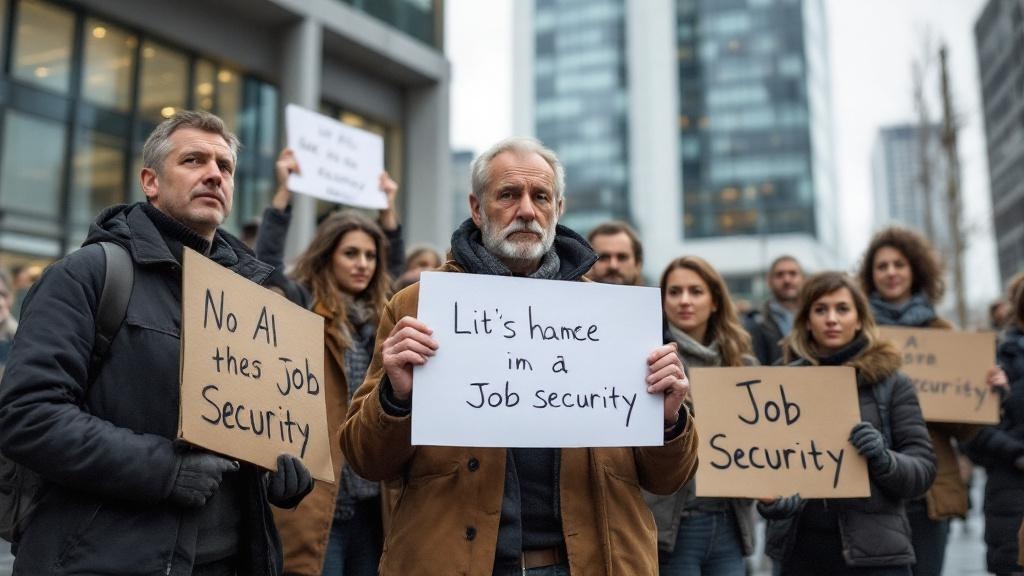
The economic timing compounded the problem. ChatGPT launched at a moment when most European workers were already pessimistic about their financial futures, squeezed between post-pandemic inflation and a cost-of-living crisis. Into that anxiety walked a technology whose own proponents described it using terms like "disruption," "transformation," and "copilot." To someone worried about paying rent in Amsterdam or Manchester, "copilot" sounds like a prelude to redundancy. The word "augmentation" sounds like the first step before elimination.
The instinct to dismiss job fears as irrational misreads the evidence. Knowledge workers in legal, creative, and administrative fields across Europe are already seeing AI-driven restructuring. The European Trade Union Confederation has repeatedly warned that the pace of AI deployment in white-collar sectors is outrunning any meaningful policy response. Acknowledging this honestly, rather than deflecting with optimistic projections about net job creation, is the only credible path forward.
3. Creatives Drive Culture, and AI Threatens Them Directly
The sharpest and most culturally influential critics of AI are creative workers. When the filmmakers behind The Brutalist revealed they used AI to improve Adrien Brody's Hungarian accent, the backlash was immediate across European film circles. AI-generated imagery in advertising campaigns by major European brands has provoked public complaints and, in some cases, regulatory scrutiny under the EU AI Act's transparency provisions. The emergence of synthetic actors and AI-generated music has kept the debate at peak cultural visibility on this side of the Atlantic too.
Creatives shape opinion. When they are vocally hostile, that hostility ripples into the broader culture in ways that a thousand positive press releases cannot counteract. The 2023 SAG-AFTRA strike in the United States made AI an industrial relations flashpoint that defined the news cycle globally for months. European equivalents, from French screenwriters' unions to German photographers' associations, have since raised their own formal objections. The cultural front is not a side issue; it is central to the trust deficit.
4. Authenticity Is In, and AI Is Synthetic
There is a powerful counter-cultural current running beneath the AI debate in Europe. Vinyl sales are at a 30-year high across the UK and Germany. Generation Z is buying film cameras and "dumb phones" in numbers that have surprised retailers. There is a genuine and growing appetite for the analogue, the tactile, and the imperfect. AI, by definition, is synthetic. It produces outputs that are statistically plausible rather than humanly felt.
This tension predates large language models. The nostalgia economy was already booming before transformer architectures became mainstream. AI has accelerated it, but it did not create it. Being offline has become aspirational. Being unplugged signals intentionality and self-possession. Into this cultural climate, the most powerful AI companies are asking people to trust machine-generated text, images, and voice with the same confidence they once extended to human professionals. That is a significant ask anywhere. In cultures with strong craft and artisanal traditions, as across much of continental Europe, it is an especially hard sell.
5. AI Attacks Identity at Its Highest Point
This is the most psychologically acute dimension of the backlash. Previous waves of automation displaced workers at the base of Maslow's hierarchy: the steam engine replaced physical labour, early software automated clerical tasks. These displacements were painful, but they did not touch what people considered their highest selves.
Generative AI is different. It attacks creativity, professional expertise, and intellectual identity: the capacities that educated, skilled workers have built their sense of self around. A graphic designer at a Berlin studio whose identity is bound up in beautiful visual work faces something qualitatively different from a factory worker whose role was mechanised in 1975. The factory worker was never told their creativity was replaceable. The graphic designer is being told exactly that, loudly, every day. A solicitor in Bristol who spent three years at law school and another four in articles is now watching AI tools handle document review and contract drafting. The displacement is not just economic. It is existential.
Anna Jobin, a researcher at the Swiss Federal Institute of Technology in Zurich (ETH Zurich) who has studied AI ethics and public perception extensively, has noted that the anxiety around generative AI differs from previous automation debates precisely because it targets the outputs that professionals have historically used to define their worth. That framing resonates strongly with what we are seeing in European labour markets.
How to Actually Fix the AI Trust Problem
The technology trajectory is not seriously in doubt: AI will achieve mass adoption. But the manner of that adoption matters enormously, both for the companies building these tools and for the societies absorbing them. A path through the hostility exists, but it requires honesty and strategic discipline that the industry has so far largely failed to demonstrate.
Lead With Life-Saving Use Cases
The most compelling applications of AI are the ones that address fundamental human needs. AI systems that detect cancer earlier than any radiologist, tools that flag sepsis risk in hospital wards, models that accelerate drug discovery: these applications operate at the base of Maslow's pyramid, preserving life and alleviating suffering. The NHS's early deployments of AI-assisted diagnostics in radiology, imperfect as they have been in implementation, consistently poll far more favourably with the British public than any chatbot or productivity tool. These applications should be the flagship narratives for AI adoption, not afterthoughts buried in a press release about model parameters.
Reframe Capability as Problem-Solving
The technology industry has a chronic habit of leading with capability metrics. "This model has one trillion parameters" communicates nothing useful to a nurse in Lyon or a small business owner in Leeds. "This product eliminates four hours of weekly paperwork" communicates everything. Some AI companies, including Paris-based Mistral AI, have begun shifting messaging towards concrete problem-solving in their communications with enterprise customers, recognising that the audience for technical benchmarks is vanishingly small compared to the audience for solved problems. This shift needs to become universal across the sector.
Change the Messenger
The loudest pro-AI voices remain venture capitalists and technology chief executives, two of the least trusted groups in public life on either side of the Atlantic. Research by Edelman's Trust Barometer consistently places technology CEOs near the bottom of European public trust rankings. An AI communications campaign fronted by farmers, community health workers, and independent tradespeople would be far more persuasive than any TED talk from a billionaire founder. Real users, filmed honestly, demonstrating genuine benefit: that is the playbook. Vague inspirational montages and thinly veiled competitor attacks are not.
Acknowledge Labour Market Disruption Honestly
The original Luddites were 19th-century English textile workers who destroyed weaving machinery in the 1810s. They were not simply afraid of the new; they understood that new machinery would enrich factory owners while impoverishing skilled craftspeople in the near term. They were largely correct about their own immediate circumstances. Telling a displaced worker that AI will create more jobs in aggregate is not wrong, but it is cold comfort and it is received as dismissive.
The credible position is acknowledgement followed by action: honest recognition that labour market disruption is real, paired with genuine advocacy for retraining programmes, transition support, and worker protections. Margrethe Vestager, the European Commission's former Executive Vice-President for a Europe Fit for the Digital Age, made precisely this point in multiple public addresses before leaving office: that the EU's comparative advantage in AI governance lies in pairing innovation with social protection, not treating the two as opposites. Companies and governments that skip the acknowledgement will face intensifying resistance. Those that lead with it will find the public more receptive than they expect.
Keep Humans Visible in AI Products
One underexplored approach is building initiatives that place human creativity at the centre of AI-enabled work. A competition inviting people across Europe to produce the best animated short using AI tools, for instance, would demonstrate how the technology levels the playing field for storytellers without institutional resources. The artist remains visible; the AI is a tool, not the subject. More initiatives of this kind, whether run by broadcasters, arts councils, or technology companies themselves, would do more for public sentiment than any amount of corporate communications spend.
The European Picture: Different Concerns, Structural Similarities
The AI trust deficit is not uniformly distributed across Europe, but the structural dynamics are broadly consistent. Germany combines high engineering expertise with deep cultural concern about surveillance and data privacy, rooted in its 20th-century history. France combines genuine AI investment, anchored by companies like Mistral AI and a strong academic base at institutions including INRIA and Sorbonne Universite, with a tradition of scepticism towards Anglo-American technology dominance. The UK sits in a distinctive position: post-Brexit, it has sought to position itself as a more permissive AI jurisdiction than the EU, but its public remains as sceptical as its continental neighbours.
Switzerland presents a particularly instructive case. As a non-EU member but closely integrated partner, Switzerland has watched the EU AI Act take shape while charting its own course. The Swiss Federal Council published its AI strategy framework in late 2023, emphasising risk-based governance and human oversight rather than blanket prohibition. Swiss institutions including ETH Zurich and EPFL Lausanne are among Europe's leading AI research centres, and the country's historically high institutional trust levels mean public hostility to AI is somewhat lower than in Germany or France. Even so, Swiss polling data from the Digital Society Initiative at the University of Zurich consistently shows majority concern about AI's impact on employment and privacy.
The Nordic countries present a more optimistic picture. Finland's long-standing investment in AI literacy, through national programmes that have now reached hundreds of thousands of citizens, has demonstrably reduced fear and increased constructive engagement. Estonia's digitally native public administration has built a baseline of comfort with algorithmic decision-making that most of Europe lacks. These are not accidents. They are the product of deliberate policy choices made years before ChatGPT made the issue urgent.
The lesson is consistent: where AI arrives embedded in useful services, where governments provide clear and honest frameworks, and where the public develops familiarity through practical use rather than media alarm, resistance is measurably lower. That is not a coincidence. It is a policy outcome.
What Silicon Valley Gets Wrong About European Resistance
There is a particular kind of smugness at work in the Valley's response to AI critics. The argument runs roughly: technology always wins, adoption always comes, the critics are always wrong in the end. This is partially true and strategically disastrous. The automobile did win, but it killed hundreds of thousands of people and restructured cities in ways that took a century to partially undo. Television did win, and it contributed to exactly the social harms its critics predicted.
Winning the technology race is not the same as winning public trust. A society that adopts AI under duress, resentfully and without adequate safeguards, will produce worse outcomes than one that builds genuine understanding and consent. The rapid expansion of AI into software development through so-called "vibe coding" practices is already straining developer communities in London, Berlin, and Amsterdam who feel the change is being imposed rather than chosen.
The hundreds of millions of Europeans who have not yet meaningfully engaged with AI are not a problem to be solved through better marketing. They are a constituency whose concerns deserve substantive responses. Silicon Valley's long-term commercial success in Europe depends on building trust with that constituency, not steamrolling it. The EU AI Act, whatever its implementation imperfections, reflects a democratic mandate that the technology cannot simply override. Understanding that is the beginning of a more mature conversation.
Technology Backlash Across History: A European Perspective
Writing (Ancient Greece): Fear of memory loss and intellectual decay. Outcome: enabled civilisational advancement.
Printing press (1500s): Conrad Gessner's warning of information overload and social confusion. Outcome: democratised knowledge across Europe.
Automobile (early 1900s): Mass casualties and social disorder. Outcome: transformed mobility; the risks were entirely real.
Television (mid-1900s): Shortened attention spans and passivity. Outcome: criticisms largely validated.
Social media (2000s and 2010s): Mental health harm and misinformation. Outcome: mixed, with significant confirmed harms.
Generative AI (2020s): Job displacement, identity threat, inauthenticity. Outcome: too early to assess; backlash is structural and shows no sign of abating.
The pattern offers both comfort and warning. Critics have been wrong before, but they have also been right. The honest position is that generative AI poses challenges that are genuinely novel in their psychological and economic character, and that dismissing them on historical grounds alone is intellectually lazy.
Updates
published_at reshuffled 2026-04-29 to spread distribution per editorial directive
Byline migrated from "Sebastian Müller" (sebastian-muller) to Intelligence Desk per editorial integrity policy.
AI Terms in This Article6 terms
parameters
The internal settings an AI model learns during training. More parameters generally means more capable.
transformer
The neural network architecture behind most modern AI language models.
generative AI
AI that creates new content (text, images, music, code) rather than just analyzing existing data.
AI-driven
Primarily guided or operated by artificial intelligence.
ecosystem
A network of interconnected products, services, and stakeholders.
AI governance
The policies, standards, and oversight structures for managing AI systems.
Advertisement
Comments
Sign in to join the conversation. Be civil, be specific, link your sources.




Comments
Sign in to join the conversation. Be civil, be specific, link your sources.