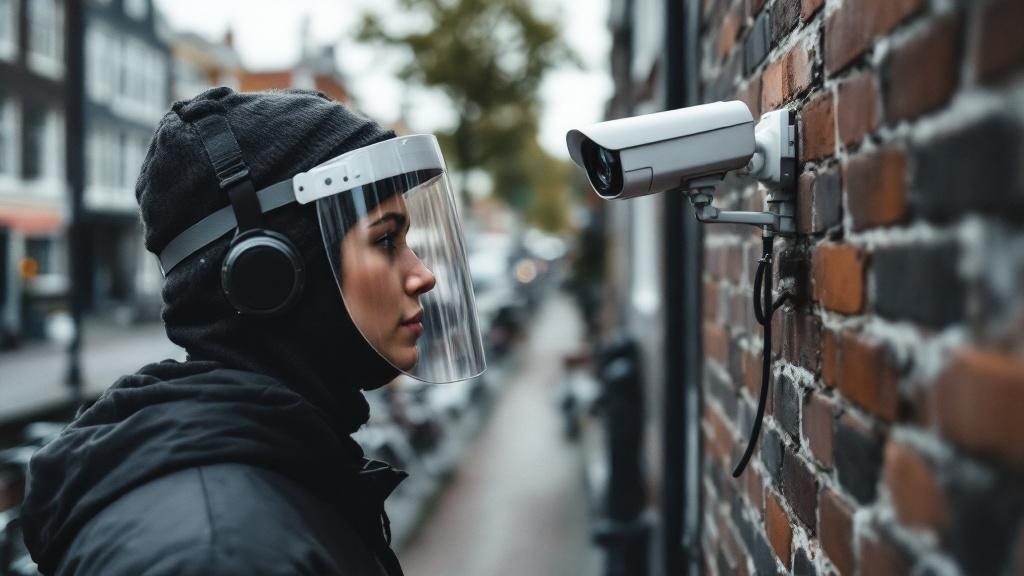
Crucially, the distortion is invisible to the human eye at conversational distance. A colleague, a shopkeeper, or a police officer standing in front of you sees a normal face. The camera, however, receives scrambled input data. Van Leeuwenstein describes this as a physical analogue of adversarial interference: the same principle that causes AI image classifiers to misidentify a panda as a gibbon when a few pixels are altered, except implemented in moulded plastic rather than code.
The design predates mainstream awareness of adversarial machine learning by several years, which partly explains why it retains a certain conceptual authority even as the underlying surveillance technology has advanced considerably.
The reality check: modern AI is not easily fooled
Van Leeuwenstein's prototype was produced in 2017, before convolutional neural networks became the dominant architecture for commercial face recognition and long before multi-modal biometric systems became standard in city-centre deployments. Experts in Europe are measured in their assessment of its current practical value.
Carissa Veliz, associate professor at the Oxford Internet Institute and author of "Privacy Is Power", has argued consistently that individual countermeasures are necessary but insufficient on their own: systemic legal constraints on who may deploy biometric surveillance, and under what conditions, are the only durable solution. Her position is directly relevant here. A mask that defeats a 2017 algorithm may fail against a 2024 system that combines gait analysis, body-shape recognition, clothing colour tracking, and mobile device signals simultaneously.
The EU AI Act, which entered into force on 01/08/2024, provides the most significant regulatory backstop Europe has yet produced. Under the Act, real-time remote biometric identification in publicly accessible spaces is prohibited for law enforcement except under tightly defined conditions, and high-risk AI systems used in biometric categorisation face mandatory conformity assessments. Dragoș Tudorache, the Romanian MEP who co-led the Parliament's negotiations on the AI Act, described the biometric provisions as "the red lines that define what kind of society we want to live in." Those red lines do not yet apply to private commercial operators in every scenario, which is precisely where the gap that van Leeuwenstein's mask addresses remains most relevant.
Part of a growing anti-surveillance fashion movement
Van Leeuwenstein's transparent shield belongs to a broader and increasingly sophisticated category of wearable resistance. The design landscape now includes:
- Infrared LED glasses that saturate camera sensors around the eye region, defeating older CCTV-grade recognition at close range.
- Adversarial clothing patterns, such as those developed by researchers at KU Leuven, that confuse object-detection models by embedding high-contrast geometric patches into fabric prints.
- CV Dazzle-style makeup, pioneered by artist Adam Harvey, which uses asymmetric blocks of colour and line to interrupt the oval-face detection heuristics still embedded in many recognition pipelines.
Each approach targets a different layer of the surveillance stack, and each carries a different social cost. A balaclava defeats almost everything but invites immediate human scrutiny. Adversarial clothing is socially invisible but only effective against specific model architectures. Van Leeuwenstein's mask sits in a useful middle ground: high social acceptability, moderate technical effect, and considerable symbolic weight.
The symbolic dimension matters in Europe right now. Civil liberties organisations including Privacy International and the Dutch digital rights group Bits of Freedom have used wearable anti-surveillance projects as focal points for public campaigns, arguing that making resistance tangible and aesthetic lowers the barrier to participation in privacy debates for people who would never attend a policy hearing or read a regulatory impact assessment.
Does the mask actually work, and is it legal?
Effectiveness varies significantly by deployment context. Against legacy systems still operating in many retail and transport environments, distortion masks can return genuine false negatives. Against tier-one law enforcement systems procured in the last three years, the picture is far less clear. Modern recognition pipelines often incorporate liveness detection, infrared imaging, and 3D depth mapping, none of which are defeated by a curved transparent shield designed to fool a standard RGB camera.
On legality, the position across EU and UK jurisdictions is nuanced. The transparent nature of the mask means it does not meet the threshold for face-covering bans that exist in some European countries, several of which were drafted with full opaque coverings in mind. In the United Kingdom, the Metropolitan Police's live facial recognition deployments have been challenged in court, most notably in the 2020 Bridges v South Wales Police ruling by the Court of Appeal, which found existing deployments unlawful under the Data Protection Act 2018. Wearing a transparent distortion mask in that context is arguably a reasonable exercise of the right not to be biometrically processed without consent, though no UK court has yet tested that specific argument.
One genuine risk is perverse attention. An operator or an AI flagging system designed to detect anomalous behaviour may identify an unusual accessory as a trigger for heightened scrutiny. Van Leeuwenstein's mask could, in certain environments, increase rather than decrease the probability of human review, a limitation its creator has acknowledged publicly.
The designer and his broader project
Jip van Leeuwenstein is based in the Netherlands and works at the intersection of critical design, robotics, and social commentary. His portfolio examines how technological systems reshape the terms of human autonomy, often by creating objects that make those systems visible and contestable. The Surveillance Exclusion mask has been exhibited at international electronic art events including ISEA2020, and it sits within a tradition of Dutch design culture that takes seriously the political dimensions of everyday objects.
The viral resurgence of the mask in 2024 is a reminder that public appetite for tangible, comprehensible responses to abstract technological threats remains strong. Regulatory frameworks, however well-drafted, are slow and invisible. A piece of curved plastic you can hold in your hand is neither.
As the AI Act's provisions roll into force across the EU over 2024 and 2025, and as the UK government consults on its own approach to AI regulation under the AI Safety Institute's remit, the cultural conversation van Leeuwenstein started in an art school studio in the Netherlands retains genuine relevance. It will not replace legislation. It will not defeat a state-level surveillance apparatus. But as a prompt for public thinking about consent, visibility, and the right to move through shared space without being perpetually catalogued, it continues to do its job precisely.




Comments
Sign in to join the conversation. Be civil, be specific, link your sources.