

Eric Migicovsky, the founder of the cult Pebble smartwatch brand, has returned to hardware with a deliberately modest ambition: a $75 smart ring that does one thing well, captures fleeting voice notes without ever touching a cloud server. The Index 01, made by his new venture Core Devices, is a direct rebuke of the feature-bloated AI wearable trend and arrives at a moment when European regulators and privacy advocates are demanding exactly the kind of data minimisation it promises.
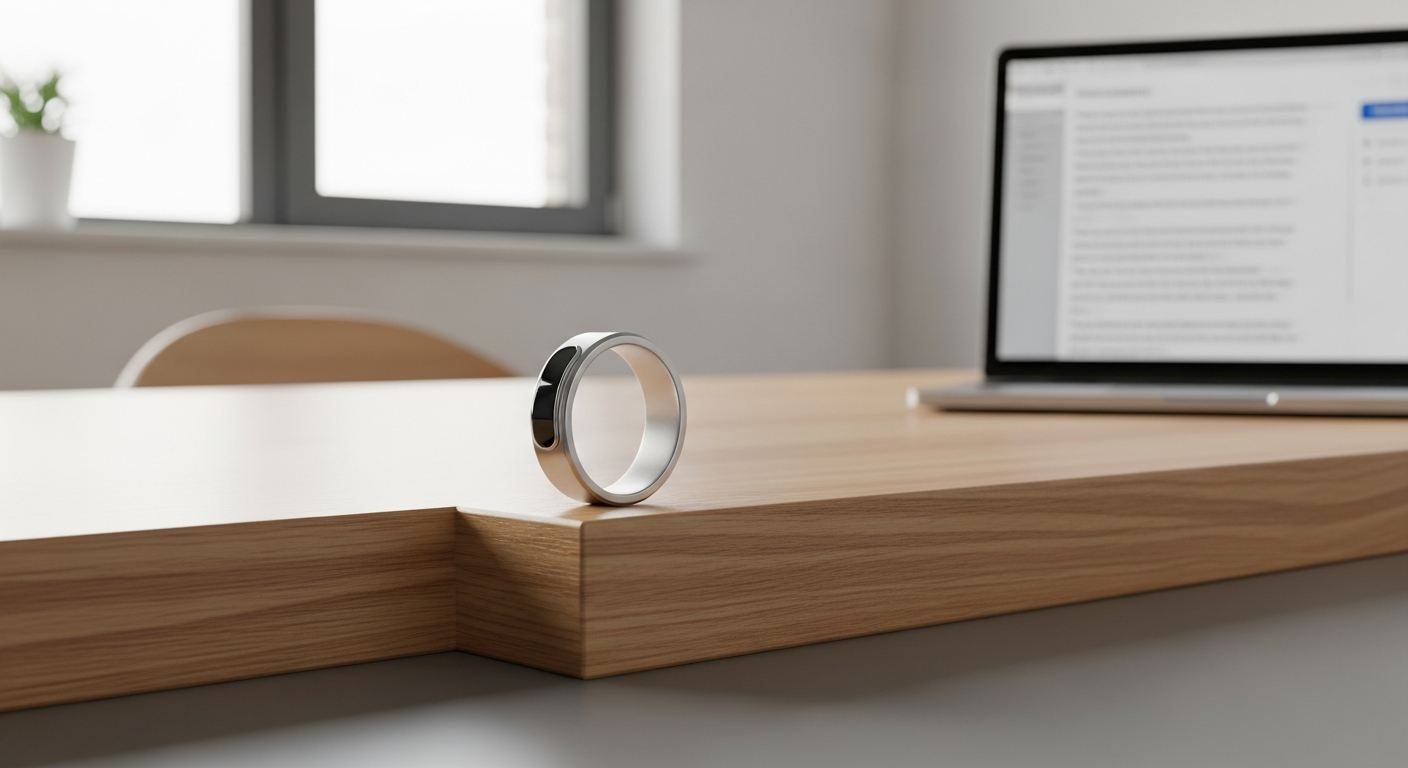
One Button, No Cloud, No Subscription
The Index 01 operates on a deliberately simple principle. Press and hold the button on the ring's side and it begins recording. Release it, and the audio is processed locally on your smartphone using open-source speech-to-text and AI models through the companion Pebble mobile app. No audio leaves your device, no corporate server analyses your words, and no monthly fee is required to keep the thing working.
That local-first architecture is not just a selling point; it is a design philosophy. Migicovsky has been explicit that the ring only records when the button is actively held, ruling out any accidental or covert capture. For European consumers who have spent the past two years watching regulators fine AI companies for unauthorised data processing, that is a meaningful distinction.
The stainless steel body is water-resistant to one metre, sufficient for daily use including showering, but not swimming. Crucially, it deliberately omits fitness tracking, sleep monitoring, and biometric sensors. That omission is what enables the headline feature: a battery life of approximately two years under typical use, compared with the one-to-seven days offered by most rival AI rings.
A Sustainable Hardware Model for a Throwaway Age
Migicovsky's return to hardware is being run on very different terms from the venture-backed Pebble era. Core Devices is a self-funded team of five, and the founder has said plainly that profitability from day one is the goal rather than hypergrowth.
"I wouldn't have gone back and changed anything. I loved what we built. I loved what we did. I love the company that we built, but it's not the only way to build a company. What I'm doing now is trying an alternative path, which is to start from profitability," Migicovsky has said.
When the battery eventually depletes after roughly two years, Core Devices offers a recycling programme rather than nudging users towards a new purchase. That lifecycle approach will likely attract attention from sustainability-focused procurement teams and from policymakers working on the EU's Ecodesign for Sustainable Products Regulation, which is progressively tightening requirements on electronics longevity and repairability.
The ring's button is also programmable beyond voice capture. Users can assign single or double presses to:
- Control music playback
- Trigger a camera shutter
- Send messages through Beeper, the messaging aggregator Migicovsky co-founded
- Display transcribed notes on a paired Pebble smartwatch screen
That flexibility keeps the device useful without expanding its feature footprint in ways that would compromise battery life or data hygiene.
Why This Matters in the European Context
The Index 01 lands at a pointed moment for AI wearables in Europe. The EU AI Act, which entered into force in August 2024 and is now rolling out in stages, imposes transparency and data-minimisation obligations on AI systems that interact with individuals. Devices that process voice data in the cloud face a more demanding compliance path than those that keep processing on-device.
Andrea Jelinek, former chair of the European Data Protection Board and a long-standing voice on AI privacy governance, has consistently argued that privacy-by-design is not an optional extra but a foundational requirement under the GDPR framework. The Index 01's architecture, in which no personal voice data is ever transmitted, represents a textbook implementation of that principle.
Separately, Lucilla Sioli, the European Commission's Director for Artificial Intelligence, has pointed to on-device AI processing as a key enabler of trustworthy AI deployment in consumer products, noting that it reduces systemic risk by keeping sensitive data out of centralised repositories that represent single points of failure or abuse.
Against that regulatory backdrop, the smart ring market in Europe is growing steadily. Finnish health-tech firm Oura, maker of the Oura Ring, has already established a significant European user base, and Samsung's Galaxy Ring entered the market in 2024. Neither, however, is positioned as a privacy-first, cloud-free voice capture device. The Index 01 is carving a niche that existing players have left open.
How the Index 01 Compares
The key differentiators between the Index 01 and typical AI ring or voice assistant products are worth setting out clearly:
- Data processing: Local only on the Index 01, versus cloud-hybrid or fully cloud-dependent on rivals
- Battery life: Approximately two years on the Index 01, versus one to seven days on most AI rings and eight to twelve hours on standalone voice assistants
- Subscription required: No, on the Index 01; often yes on competitors
- Recording trigger: Manual button press only, versus always-on voice activation or wake words on rival products
Pre-orders for the Index 01 are open now at $75, with the price set to rise to $99 after the pre-order window closes. The device is available in sizes 6 to 13 and in three finishes: silver, polished gold, and matte black. Both iOS and Android are supported.
Whether European consumers, increasingly attuned to data rights after years of GDPR enforcement, will embrace a single-purpose AI ring over a feature-rich alternative is an open question. What is not in doubt is that the Index 01 represents a coherent answer to a real concern, and that in Europe right now, coherent answers to data privacy concerns tend to find an audience.

Comments
Sign in to join the conversation. Be civil, be specific, link your sources.