The Numbers Behind the Festive AI Boom
The scale of engagement is striking. A single YouTube compilation of AI-generated Christmas visuals set to carols from the 1950s to the 1970s has amassed over five million views. Meanwhile, a fictional AI music group produced a holiday sampler that accumulated more than eight million streams across Spotify and Apple Music. These are not fringe curiosities; they are mainstream consumption figures that any traditional production house would envy.
This surge sits within a broader pattern of AI creative tools becoming embedded in everyday European digital life. Platforms including Runway, Stability AI, and Kling AI have all reported sharp increases in usage around seasonal periods, with Christmas representing the single busiest creative window of the year for generative video tools.
What the Technology Actually Does
Creating AI-generated holiday video content is less mysterious than it sounds, though the engineering behind it is genuinely sophisticated. The process typically involves several layers working in sequence:
- Natural language processing to interpret detailed prompts about Christmas themes, winter landscapes, and festive imagery
- Computer vision models trained on large datasets of holiday visuals and seasonal scenes
- Rendering algorithms that maintain coherence across frames, preventing the visual fragmentation that plagued early AI video
- Audio-visual synchronisation tools that align generated imagery to musical beats and mood shifts
- Post-processing filters that refine colour grading and final output quality
The results range from the warmly whimsical to the genuinely uncanny. Video game developer Karbonic, who has been vocal on the subject across social channels, noted the problem bluntly: "There are unnatural elements that give me the heebie jeebies," when describing AI-generated Christmas carols embedded within curated YouTube playlists. The so-called uncanny valley effect is real, and it remains one of the most honest critiques of where current generative video tools fall short.
European Voices on AI Creativity at the Holidays
The conversation about AI and creative expression has been particularly sharp in Europe, where both regulatory scrutiny and genuine artistic engagement with the technology are more advanced than most other markets.
Luc Julia, co-creator of Siri and now chief scientific officer at Renault, has consistently argued that AI tools augment rather than replace human creative instinct. His position is directly relevant here: the most effective AI Christmas content tends to be the product of careful human prompt engineering and curation, not fully automated generation. The human hand remains visible, even when the pixels are machine-made.
On the regulatory side, the EU AI Act, which entered into force in August 2024, includes provisions around transparency for AI-generated content, particularly synthetic media. Dragos Tudorache, the Romanian MEP who co-led the AI Act negotiations through the European Parliament, has emphasised that labelling AI-generated creative content is not a bureaucratic formality but a matter of trust with audiences. For festive playlists, that may seem like regulatory overreach. At commercial scale, however, it matters enormously.
Practical Uses Beyond Entertainment
The applications for AI-generated holiday visuals extend well beyond personal amusement. Businesses across the EU and UK are using these tools for:
- Background content at virtual Christmas events and hybrid office parties
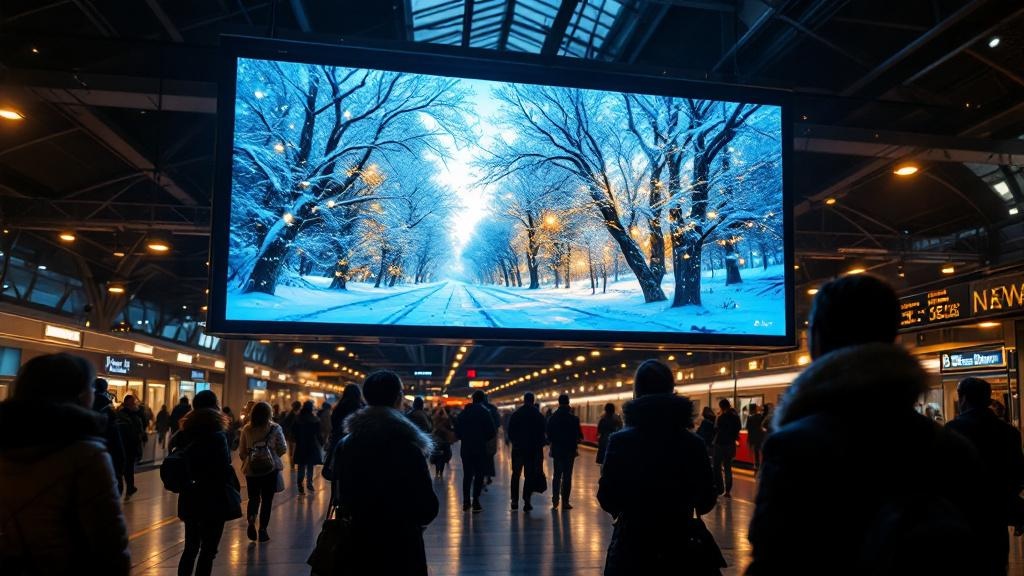
- Digital signage and ambient screens in retail and hospitality environments
- Personalised social media content for brands seeking low-cost seasonal creative
- Custom family keepsakes pairing favourite songs with bespoke visual sequences
The cost differential is significant. Traditional animated Christmas content requires weeks of production and budgets that put it out of reach for most small businesses. AI generation compresses that to hours, at a fraction of the cost. For independent retailers and hospitality businesses across Britain, France, Germany, and beyond, that accessibility is not trivial.
The legal picture, however, remains complicated. The copyright status of AI-generated visuals varies depending on the platform used and the jurisdiction in which the content is deployed. European operators should check platform terms of service carefully and take legal advice before any commercial application. The EU's approach to AI-generated works and authorship rights is still evolving, and the Christmas season is not the moment to discover a licensing problem.
Traditional Versus AI-Generated: A Practical Comparison
The honest comparison between traditional and AI-generated festive content reveals genuine trade-offs rather than a straightforward winner. Hand-crafted animations carry emotional resonance and visual consistency that AI tools still struggle to match. AI generation offers speed, cost efficiency, and a capacity for unexpected creative combinations that human teams rarely explore. Hybrid approaches, where human creatives guide and refine AI outputs, are increasingly producing the most satisfying results.
The technology is advancing rapidly. Image and video generation capabilities that felt experimental twelve months ago are now reliable enough for professional deployment. By Christmas 2025, the gap between AI-assisted and traditionally produced seasonal content will be considerably narrower.
What this festive season demonstrates most clearly is that AI creative tools have moved from the technology pages into ordinary cultural life. That is worth taking seriously, whether you are wrapping presents to a surreal AI snowscape or commissioning seasonal content for a European retail brand.



Comments
Sign in to join the conversation. Be civil, be specific, link your sources.