How to Run AI Models on Your Own Computer: A Practical Guide for European Professionals
The idea that local AI requires a server room or cloud subscription is finished. Two consumer graphics cards now match a 25,000-dollar data centre card at a fraction of the cost, and the software to make it work takes under five minutes to install. Here is everything a European professional needs to know.
Consumer hardware has quietly closed the gap with enterprise data centre equipment, and the software ecosystem has matured enough that any professional in the EU or UK can run a capable AI model on their own machine in under five minutes. The assumption that local AI is a niche hobbyist pursuit is no longer defensible.
[[KEY-TAKEAWAYS:Two consumer GPUs now match a 25,000-dollar data centre card at roughly a quarter of the cost.|Free tools like Ollama and LM Studio remove virtually all technical barriers to local deployment.|Running models locally means your data never leaves your machine, a critical GDPR advantage.|Local models handle coding, summarisation and document review capably for everyday professional tasks.|Cloud AI retains the edge for frontier reasoning and multimodal tasks, so a hybrid approach makes sense.]]
Advertisement
Your Laptop Already Outperforms Most Cloud Services for Everyday Work
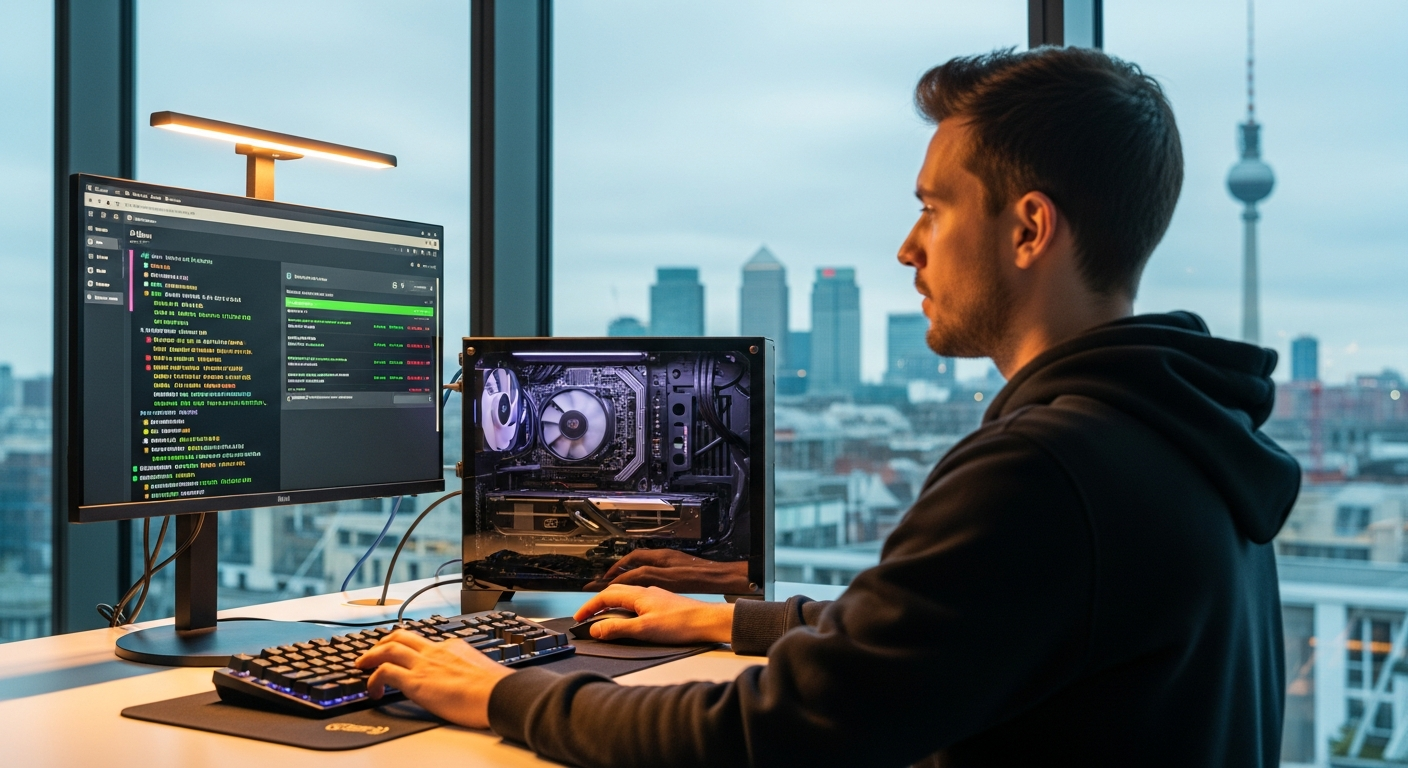
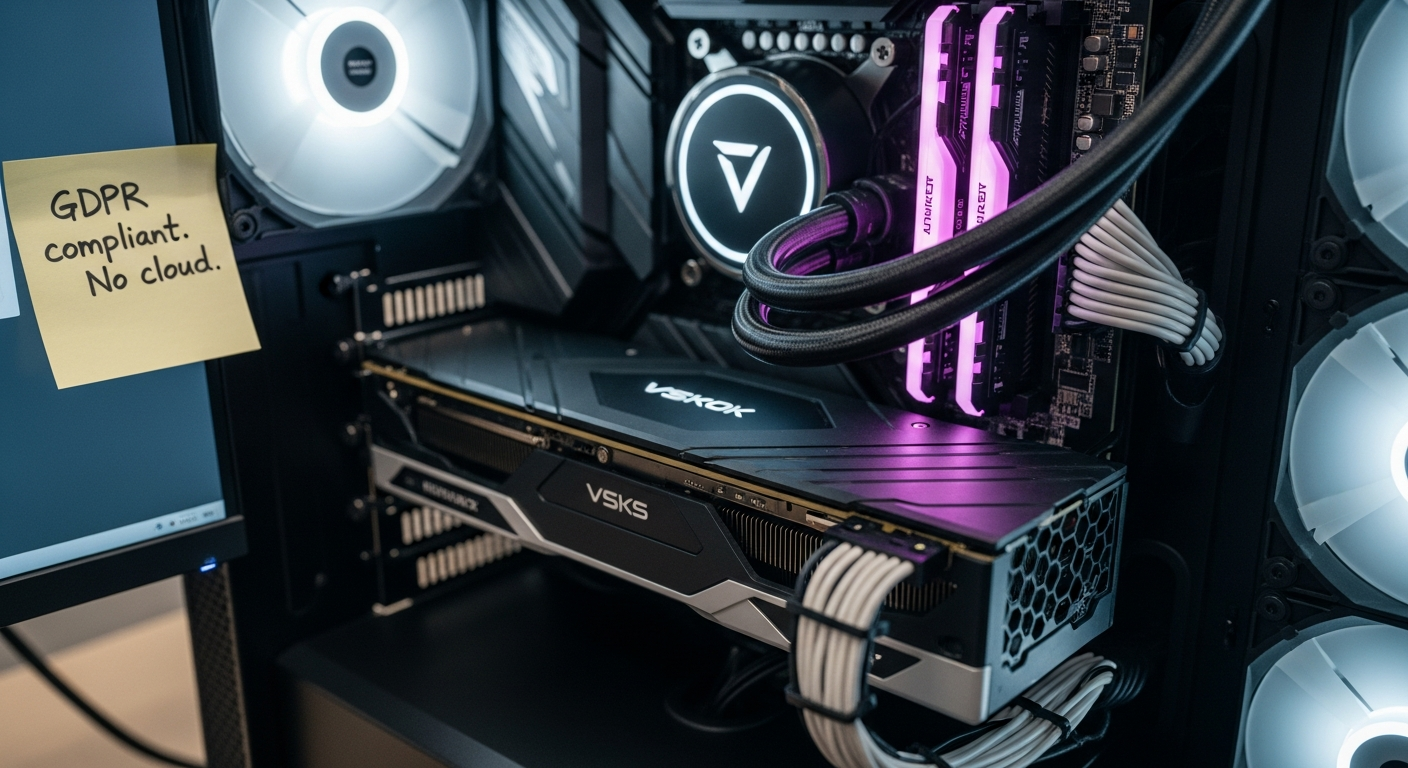
Two consumer-grade graphics cards can match the performance of a 25,000-dollar data centre card at roughly a quarter of the cost, and the software to make it work fits in a single terminal command. The shift towards local AI is not just about saving money. It is about privacy, speed, and control. When you run models on your own machine, your data never leaves your computer. There is no API call, no usage limit, and no terms of service that might change next month.
For professionals operating under the EU's General Data Protection Regulation, or the UK GDPR post-Brexit, that last point is not a minor convenience. It is a compliance advantage. Sending confidential client documents to a third-party cloud API creates data-processing obligations and potential liability. Running the same analysis locally eliminates the problem entirely.
Mistral AI, the Paris-based lab whose open-weight models have become a default choice for European developers wanting locally deployable AI, has consistently argued that sovereignty over model weights and inference infrastructure is a first-order concern for European organisations. The company's open-weight Mistral 7B model remains one of the most widely deployed local models precisely because it combines strong multilingual performance with a permissive licence and modest hardware requirements.
The Essential Toolkit, All Free
The local AI toolkit has matured remarkably over the past 12 months. Three tools cover the vast majority of use cases:
Ollama is the easiest entry point. It runs open-source AI models with a single command in your terminal, handling model downloading, memory management, and GPU acceleration automatically across macOS, Linux, and Windows. Type ollama run llama3 and you have a capable AI assistant running entirely on your hardware.
LM Studio provides a graphical interface for people who prefer clicking to typing. It lets you browse, download, and run models from a visual catalogue, adjust settings such as temperature and context length, and chat through a clean interface.
Jan is an open-source, privacy-first desktop client that has gained traction among European developers who want an offline-first experience without touching the command line.
The European AI Office, established under the EU AI Act framework and now operational in Brussels, has noted in its early guidance that organisations using local inference infrastructure face a materially different compliance profile than those relying on third-party API providers, particularly regarding data minimisation obligations under Article 5 of the GDPR. That regulatory framing is accelerating enterprise interest in exactly the tools described above.
Which Models to Run in 2025 and 2026
Not every model belongs on your laptop. The key is matching model size to your hardware. The main options worth considering are:
Phi-3 Mini (3.8 billion parameters): Designed by Microsoft specifically for local deployment. Runs on almost any modern computer with 8GB of RAM and punches well above its weight on reasoning and coding tasks.
Llama 3 8B (8 billion parameters): Meta's most versatile option for local use. Runs comfortably on a machine with 16GB of RAM and a modern GPU. Handles general conversation, writing, and document analysis capably.
Mistral 7B (7 billion parameters): The European-origin option. Strong multilingual performance, excellent instruction following, and a licence that explicitly permits commercial use.
Gemma 2 9B (9 billion parameters): Google DeepMind's locally deployable model. Well-suited to summarisation and classification tasks on mid-range hardware.
Llama 3 70B (70 billion parameters): Requires 48GB or more of GPU VRAM. Strictly a high-end desktop proposition, but competitive with cloud frontier models on complex analysis.
ETH Zurich's AI Centre has been tracking local model deployment patterns among European research institutions and reports that the 7-to-9 billion parameter range has become the practical sweet spot for most professional workloads, offering a strong balance between capability and hardware accessibility without requiring specialist data centre equipment.
Five-Minute Setup Guide
Here is how to go from nothing to a working local AI assistant using Ollama:
Install Ollama: Visit ollama.com and download the installer for your operating system. On macOS or Linux you can also run curl -fsSL https://ollama.com/install.sh | sh in your terminal.
Download a model: Open your terminal and type ollama pull llama3. This downloads the eight-billion parameter version, which is roughly 4.7GB.
Start chatting: Type ollama run llama3. You now have an AI assistant running entirely on your machine. Type any question and it responds directly in your terminal.
Connect to other tools: Ollama runs a local API server at localhost:11434. Any application that supports the OpenAI API format can point to this address and use your local model instead of a cloud service.
Local vs Cloud: Making the Right Choice
Local AI excels for privacy-sensitive work, offline access, and repetitive tasks where API costs accumulate quickly. If you are reviewing confidential client documents, writing code for a client project, or simply want AI assistance without an internet connection, local is the right choice.
Cloud AI still wins for frontier capabilities: the most complex reasoning, the largest context windows, and multimodal tasks such as image generation or video analysis. The practical approach for most European professionals is to use local models for everyday work and switch to cloud services only when you genuinely need capabilities that local hardware cannot deliver.
Four factors consistently drive the decision:
Privacy and compliance: Local inference eliminates third-party data-processing risk, which matters acutely under EU and UK GDPR for anyone handling sensitive personal or commercial information.
Cost at scale: A developer making 100 API calls per day to a cloud provider might spend between 50 and 200 euros monthly. The same workload on local hardware costs only electricity after the initial setup.
Latency: A model running on your GPU responds in milliseconds. Cloud API calls add network round-trip time that, even on good European broadband, can reach hundreds of milliseconds under load.
Model consistency: Cloud providers update and sometimes deprecate models without notice. A local model version stays exactly as you configured it, which matters for reproducible workflows and fine-tuning pipelines.
Common Questions
Do I need a powerful GPU?
Not for smaller models. Phi-3 Mini runs acceptably on CPU-only machines with 8GB of RAM. For the best experience with larger models, a GPU with at least 8GB of VRAM, such as an Nvidia RTX 3060 or Apple M2 chip, makes a noticeable difference in response speed.
Is local AI as capable as ChatGPT or Claude?
For many everyday tasks, the gap has narrowed dramatically. Local models handle conversation, summarisation, coding assistance, and document analysis capably. Frontier cloud models still lead in complex multi-step reasoning and specialised knowledge domains, but for the majority of professional workflows the difference is not material.
Can I use local models for commercial projects?
Most open-source models carry permissive licences allowing commercial use. Always verify the specific licence terms. Llama 3, Mistral 7B, and Phi-3 generally permit commercial deployment with proper attribution, though Llama 3 has a usage policy that restricts deployment at very large scale without a separate licence.
What happens if my internet connection drops?
Your local AI continues working without interruption. Once downloaded, models run entirely offline. This reliability advantage is particularly relevant for professionals working in secure environments, on trains across Europe, or in any setting where external network access is restricted.
Updates
published_at reshuffled 2026-04-29 to spread distribution per editorial directive
AI Terms in This Article6 terms
multimodal
AI that can process multiple types of input like text, images, and audio.
fine-tuning
Training a pre-built AI model further on specific data to improve its performance on particular tasks.
inference
When an AI model processes input and produces output. The actual 'thinking' step.
parameters
The internal settings an AI model learns during training. More parameters generally means more capable.
API
Application Programming Interface, a way for software to talk to other software.
GPU
Graphics Processing Unit, the powerful chips that AI models run on.
Advertisement
Comments
Sign in to join the conversation. Be civil, be specific, link your sources.




Comments
Sign in to join the conversation. Be civil, be specific, link your sources.