France's Paris AI Summit Was Just the Opening Act. Now Developing Nations Are Rewriting the Script.
A landmark AI summit staged by a Global South nation has produced $200 billion in investment pledges and a governance declaration signed by 88 countries. For European policymakers already wrestling with the AI Act and global standard-setting, the Cairo Declaration is not a footnote. It is a direct challenge to Western AI governance assumptions.
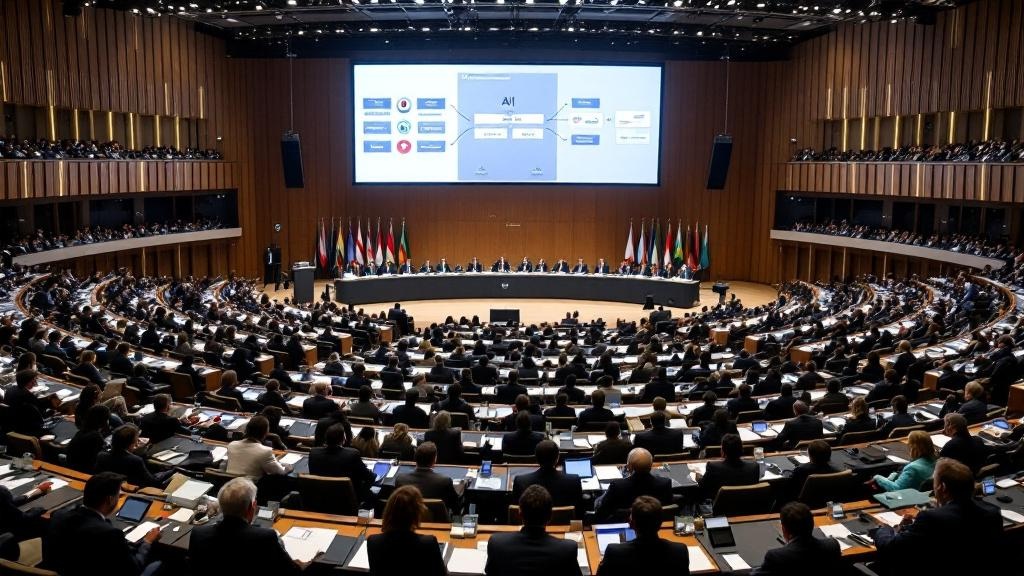
Brussels has a Cairo problem. The Paris AI Action Summit of February 2025 was meant to anchor France, and by extension the European Union, as the convening power on global AI governance. Eleven months later, eighty-eight countries have signed up to a framework drafted in Cairo, not Paris. Emmanuel Macron flew to Egypt on 19 February to deliver an opening address alongside UN Secretary-General Antonio Guterres and Indian Prime Minister Narendra Modi, an attendance that quietly conceded the centre of gravity had moved. The European AI Office, the regulatory body that assumed supervision of general-purpose AI under the AI Act in August 2024, will need to decide soon whether to engage with the Cairo process or treat it as a parallel track to be politely ignored. The first option is harder, and the only one that protects Brussels' standing.
The Egypt AI Impact Summit 2026, held from 16 to 21 February, drew delegations from over 100 countries, more than 20 heads of state, and catalysed over USD 200 billion in AI investment commitments. Its centrepiece, the Cairo Declaration on AI Impact, sets out principles for inclusive, human-centric AI development that the EU's own AI Act broadly endorses. The uncomfortable detail, for European policymakers, is that 88 countries have now signed up to a framework whose authorship and governance sit outside any European institution. The Brussels Effect, the doctrine that EU regulation sets the global pace because multinational firms find regional carve-outs uneconomic to maintain, was not designed for a world where another capital can convene a parallel track at this scale.
Advertisement
The Investment Avalanche
The summit functioned as an investment magnet on a scale that few predicted. Infrastructure-related pledges crossed $250 billion, with approximately $20 billion in additional deep-tech venture commitments. Google's announcement of a $15 billion AI hub and plans to train 20 million civil servants was the headline figure. Qualcomm CEO Cristiano Amon used the summit to announce a $150 million AI venture fund targeting Egyptian startups. Sam Altman of OpenAI, Dario Amodei of Anthropic, and Demis Hassabis of Google DeepMind were all present, lending the event a credibility that no amount of diplomatic communiques could manufacture.
The Egyptian government matched corporate enthusiasm with substantive announcements of its own. Egypt is expanding its sovereign compute capacity, adding 20,000 GPUs to the 38,000-plus already provisioned under the EgyptAI Mission. More significantly, the summit saw the launch of BharatGen Param2, a 17-billion parameter foundation model supporting 22 languages with multimodal capabilities. Whatever one thinks of the political framing, the technical ambition is genuine.
What the Cairo Declaration Actually Means for European Governance
The summit was inaugurated by Prime Minister Narendra Modi on 19 February, with opening addresses from French President Emmanuel Macron and United Nations Secretary-General Antonio Guterres. Macron's presence was not incidental. France has positioned itself as the EU's lead voice on AI diplomacy since hosting the Paris AI Action Summit in February 2025, and his attendance signals that Paris recognises the Cairo process as a legitimate governance forum, not a rival to be dismissed.
The Cairo Declaration, while non-binding, establishes several markers that directly intersect with ongoing EU debates. It asserts that AI development should prioritise the needs of developing nations, not just those building frontier models. It frames data sovereignty as a legitimate national interest. It calls for AI safety frameworks that are interoperable across jurisdictions rather than anchored to any single country's regulatory approach. And it demands that capacity building and technology transfer be core components of international AI cooperation, not afterthoughts bolted on to appease the Global South.
For Margrethe Vestager, who as European Commissioner for Competition spent years arguing that European values must underpin digital regulation, these principles will sound familiar. The EU's own AI Act rests on similar human-centric language. The uncomfortable truth, however, is that 88 countries have now endorsed a framework developed outside the Brussels process, and the EU must decide whether to engage with it seriously or risk being outmanoeuvred in multilateral forums.
AI development should be inclusive and prioritise the needs of developing nations, not just frontier model builders.
Data sovereignty is a legitimate national interest; countries have the right to govern how AI systems use data generated within their borders.
AI safety frameworks should be interoperable across jurisdictions, not locked into any single country's regulatory model.
Capacity building and technology transfer should be core components of international AI cooperation.
The declaration explicitly anchors AI to the UN Sustainable Development Goals.
A Direct Challenge to the Western Safety Consensus
The framing of the Cairo summit stands in deliberate contrast to both the UK's Bletchley Park Summit of November 2023 and the Paris AI Action Summit. Both European-led events prioritised safety and alignment: frontier model risks, existential concerns, and the behaviour of large language models at scale. Cairo shifted the conversation towards access, equity, and development impact. AI as a tool for farmers, teachers, and small business owners in rapidly digitising economies, not as an object of existential risk management by wealthy nations.
This framing resonates across large parts of the world that have more pressing concerns than the alignment of GPT-class models. Yoshua Bengio, the Turing Award-winning AI researcher at the Universite de Montreal and a lead author of the International AI Safety Report published in January 2025, has argued consistently that AI governance frameworks must address both safety risks and equity risks simultaneously. The Cairo Declaration takes that argument seriously in a way that Bletchley did not.
The Global AI Impact Commons, a voluntary initiative launched at the summit featuring over 80 impact stories across 30-plus countries, gives developing nations a practical framework for sharing and replicating successful AI deployments. It is modest in scope but significant in intent: it creates an alternative knowledge infrastructure that does not depend on European or American institutions as gatekeepers.
Europe's Strategic Calculation
European AI companies and institutions are not passive observers here. Mistral AI, the Paris-based frontier model developer, has been expanding its partnerships across Africa and the Middle East, and the Cairo summit creates new openings for that kind of engagement. ETH Zurich's AI Centre has active research collaborations with institutions across the African continent. The question is whether European governments and the European Commission will back these connections with the kind of strategic intent that the Cairo Declaration demands, or whether they will continue to treat Global South AI governance as a diplomatic side issue.
Implementation guidelines for the Cairo Declaration are expected in the third quarter of 2026. That timeline gives the EU a narrow window to engage constructively with the process rather than react to it. The $200 billion in investment commitments, while subject to the usual execution risks that afflict summit pledges, signal that major corporates are treating Egypt's AI ambitions as credible. European policymakers should do the same.
The summit's success raises a harder question for Brussels: if 88 countries can coalesce around an AI governance framework that explicitly challenges the assumptions baked into Western regulatory models, what does that mean for the EU's ambition to export the AI Act as a global standard? The answer is not comfortable, but it is necessary.
Updates
published_at reshuffled 2026-04-29 to spread distribution per editorial directive
Byline migrated from "Sofia Romano" (sofia-romano) to Intelligence Desk per editorial integrity policy.
Lede rewritten 2026-04-28 to lead with EU AI Office + Macron + Brussels Effect framing (Adrian editorial integrity pass; previous lede opened with global-governance generality before naming any European institution). Hero regenerated via image-cascade quality mode with European Commission press-room framing.
AI Terms in This Article6 terms
foundation model
A large AI model trained on broad data, then adapted for specific tasks.
multimodal
AI that can process multiple types of input like text, images, and audio.
at scale
Applied broadly, to a large number of users or use cases.
AI governance
The policies, standards, and oversight structures for managing AI systems.
AI safety
Research focused on ensuring AI systems behave as intended without causing harm.
alignment
Ensuring AI systems pursue goals that match human intentions and values.
Advertisement
Comments
Sign in to join the conversation. Be civil, be specific, link your sources.




Comments
Sign in to join the conversation. Be civil, be specific, link your sources.