Agriculture provides livelihoods for hundreds of millions of people across low and middle-income regions. The global digital farming market is worth approximately $30 billion in 2025 and is forecast to reach $84 billion by 2034. Yet the technology powering that growth remains designed for the data-rich, heavily mechanised farms of Iowa and the English Midlands, not the fragmented smallholdings of Romania, Greece, or Portugal.
When AI Cannot See the Field
The clearest illustration of this failure comes not from Europe but from Maharashtra, India, where the non-profit Farmers for Forests attempted to use Meta's open-source Detectron2 model to map tree cover on agricultural land. The result was catastrophic. The model missed more than half the trees because it had been trained exclusively on North American forest canopies. The team ultimately had to manually annotate 55,000 trees across 80 land parcels to build a dataset that reflected local conditions. The lesson travels directly to Europe: any region whose landscape was absent from the original training set will receive a degraded product.
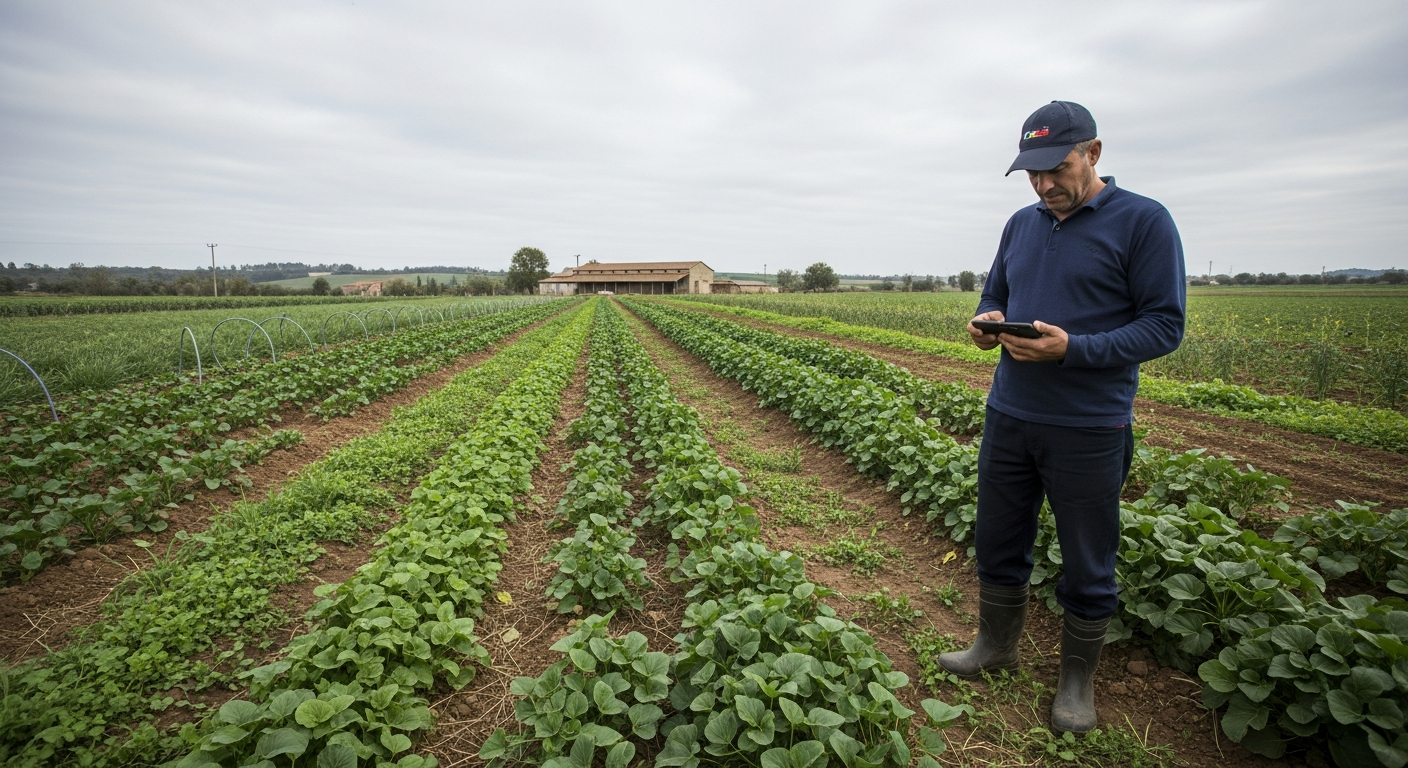
The same pattern repeats with crop identification. Satellite imagery tools trained on Western monoculture patterns cannot reliably distinguish between the polyculture smallholdings common in southern and eastern Europe, where a single hectare might carry olives, cereals, and market vegetables in close proximity. For farmers already operating on thin margins, an AI advisory tool that misreads their land is not merely useless; it is actively dangerous.
Hanna Tuomisto, Professor of Sustainable Food Systems at the University of Helsinki and a lead contributor to EU-funded precision agriculture research, has argued publicly that European agricultural AI must be trained on European ground-truth data, not retrofitted from models designed for commodity-scale American production. Her work on crop-yield modelling across Nordic and Baltic smallholdings underlines how even within Europe the data gap is severe once you move east or south of the Rhine.
Similarly, Luc Sanchez, a rural-digitisation policy analyst at the European Commission's Joint Research Centre in Ispra, has noted in published briefings that the EU's Farm to Fork strategy cannot succeed if the AI tools underpinning precision agriculture are calibrated to farming systems that bear no resemblance to the EU's own agricultural geography. The Commission's own statistics show that 65% of EU farms are smaller than five hectares; almost none of the leading commercial AI agriculture platforms were built with that reality in mind.
The Infrastructure Reality Check
Even when an AI model works technically, it often fails practically. Most agricultural AI tools assume reliable broadband connectivity, smartphone literacy, and a single decision-maker with purchasing authority. In rural Romania, Bulgaria, or the Portuguese interior, none of those assumptions hold reliably. This is not a developing-world problem; it is a rural-Europe problem.
Digital Green, an organisation that has reached over one million farmers across South Asia and sub-Saharan Africa, has built its FarmerChat platform in 16 languages specifically to address analogous gaps. The system has answered over eight million farmer queries to date. The design principles it embodies, namely low-bandwidth delivery, vernacular language support, and voice-first interfaces, are directly transferable to under-served rural communities within the EU itself.
The organisations making genuine progress share a common approach. Rather than adapting Western models downward, they build upward from local data. Key features of successful deployments include:
- Local data collection using ground-level photography rather than satellite-only imagery, which misses small-scale field boundaries and mixed-crop plots.
- Vernacular language and dialect support, critical in regions such as Catalonia, Occitania, or rural Greece where standard-language interfaces create barriers.
- Low-bandwidth or offline-capable delivery, since 4G coverage across EU rural areas remains patchy despite years of infrastructure commitments.
- Design for shared or communal decision-making, reflecting the cooperative farming structures common across France, Spain, and the new EU member states.
- Integration with existing farm equipment and advisory networks rather than requiring farmers to adopt entirely new hardware.
The Incentive Misalignment Problem
Recent analysis of agricultural AI failures has identified a structural problem that no amount of technical fine-tuning will resolve on its own. The incentives for large technology companies do not align with the needs of smallholder farmers. Building a crop-identification model for large arable farms in East Anglia or the Paris Basin is commercially rewarding because those operations can pay premium prices for precision agriculture tools and generate the clean, labelled data that improves the product. Building one for a five-hectare olive grove in the Peloponnese is not, at least not within the quarterly earnings framework that drives Silicon Valley investment decisions.
Approximately 28% of the global population, some 2.3 billion people, face moderate to severe food insecurity. AI has genuine potential to help, but only if models are trained on data that reflects the places where food insecurity actually exists. Within Europe, that means the rural periphery: smallholder regions of southern and eastern member states where farming income is lowest and climate vulnerability is highest.
The global AI-in-agriculture market was valued at $2.6 billion in 2025 and is expected to reach $13.0 billion by 2034. The critical question is how much of that growth will reach the farmers who need it most, rather than remaining concentrated in wealthy, data-rich operations where these models already function well.
Building From the Ground Up: What Works
The evidence base for what actually works is growing. Initiatives worth watching include:
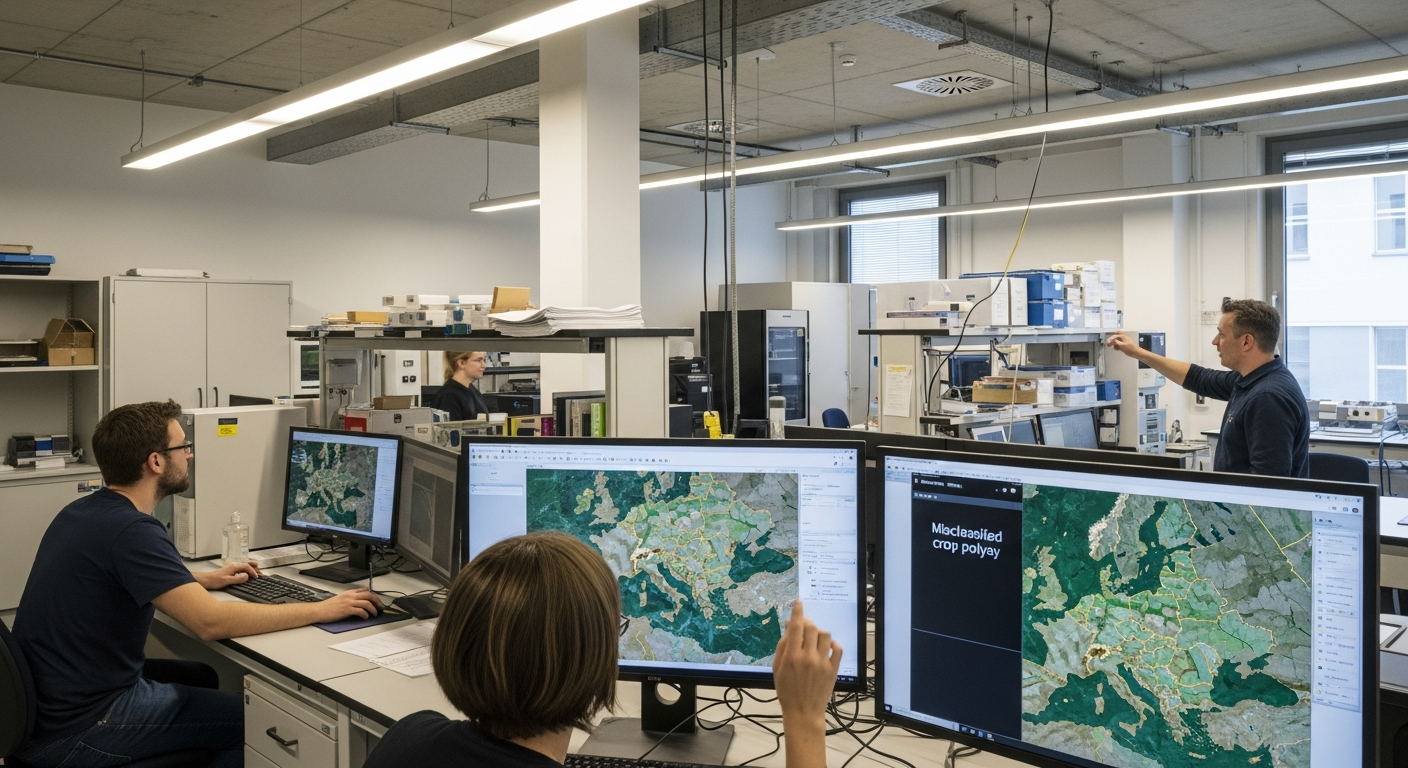
- EU-funded open crop-mapping datasets: The Copernicus Land Monitoring Service and the European Space Agency's Phi-Lab are generating open satellite data that, combined with ground-truth photography, could underpin purpose-built crop-identification models for EU smallholder contexts.
- National agricultural AI programmes: Several EU member states are moving beyond reliance on commercial platforms. France's INRAE research institute is developing AI advisory tools calibrated specifically to French polyculture systems.
- Low-tech AI delivery: Voice-based alerts via SMS and basic messaging platforms, requiring no app download and no smartphone literacy, have proven effective in coastal and rural communities across multiple continents and are readily deployable across EU rural areas.
- Cooperative data pooling: European farming cooperatives, which aggregate data across thousands of smallholdings, represent an underused asset for building training sets that reflect real EU agricultural diversity.
None of these approaches require waiting for Google, Meta, or Microsoft to change their priorities. They require political will, public funding, and a recognition that agricultural AI is critical infrastructure rather than a commercial product in a growth market.
The EU AI Act, which began phased enforcement in 2024, does not yet treat agricultural AI tools as high-risk systems subject to mandatory transparency and accuracy requirements. That classification matters: if an AI model advising a smallholder on pesticide application or harvest timing is wrong, the consequences are immediate and material. Regulators should revisit that categorisation.
The future of agricultural AI in Europe depends on whether governments, research institutions, and farming cooperatives can build the data infrastructure that big tech has not found it profitable to construct. Early progress from EU-funded satellite programmes and national research institutes shows it is possible. The question is whether it can happen fast enough to serve the millions of smallholder farmers across the EU whose livelihoods depend on getting the right advice at the right moment.




Comments
Sign in to join the conversation. Be civil, be specific, link your sources.