AI Devices to Edge Out Smartphones? Not in 2026, and Probably Not for Years
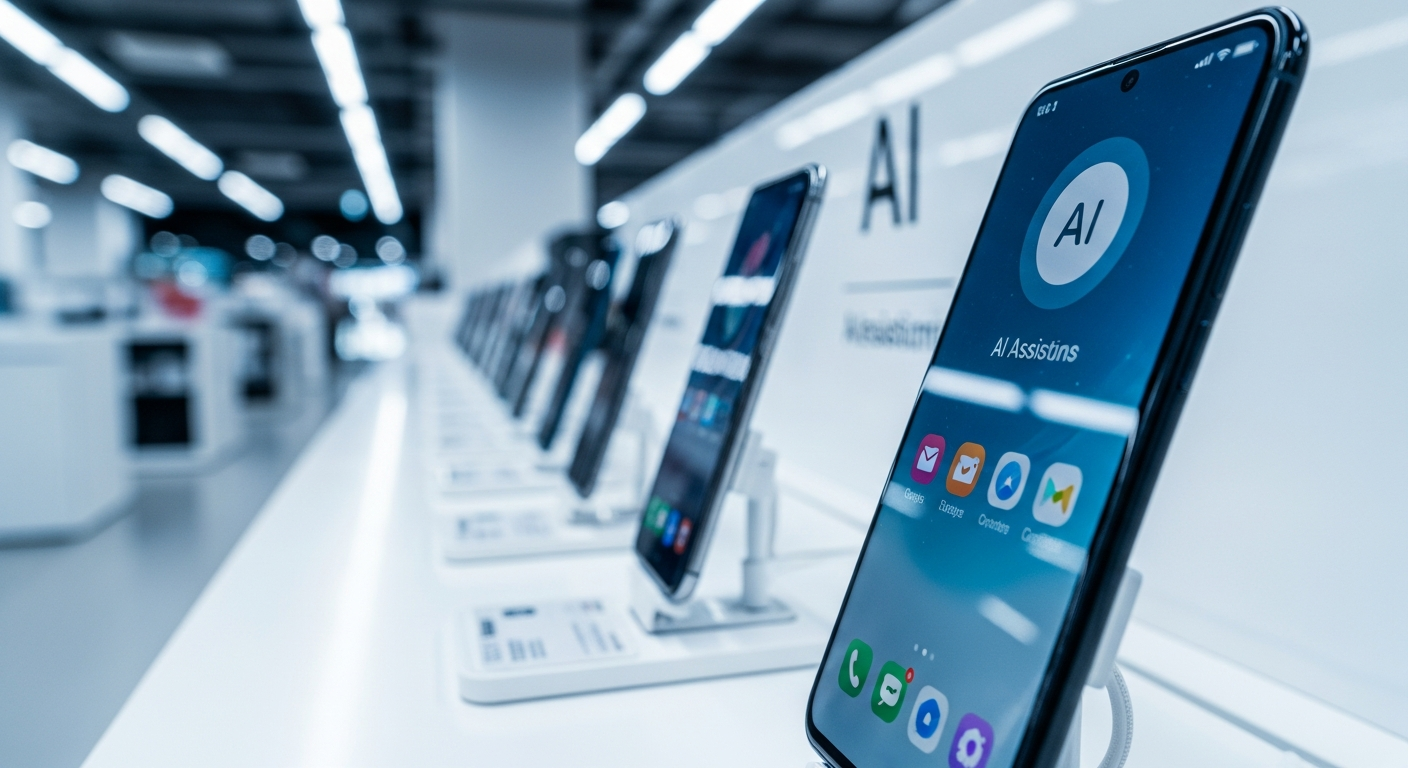
Smartphones hold 47.2% of the global on-device AI market in 2026, defying predictions that wearable pins and smart glasses would render them obsolete. For European consumers and enterprise buyers weighing whether to back specialist AI hardware, the data delivers a clear verdict: upgrade your phone first.
Smartphones are not dying. They are winning. The prediction that ambient AI pins and smart glasses would render the pocket-sized rectangle obsolete by 2026 has collapsed under the weight of actual market data, and European technology buyers should take note. Smartphones account for 47.2 per cent of all on-device AI processing globally this year, nearly half of a category that was supposedly being disrupted beyond recognition.
[[KEY-TAKEAWAYS:Smartphones hold 47.2% of global on-device AI market share in 2026, defying obsolescence predictions|AI-capable phones now represent 43% of all handset shipments, up from 32% in 2025|Specialist devices like AI pins have failed commercially; wearables and glasses remain complementary|European manufacturers and platform providers are accelerating on-device AI integration|Consumers are best served by smartphone upgrades rather than investment in standalone AI hardware]]
Advertisement
The device in your pocket has not surrendered to its challengers. It has absorbed their most useful ideas and left the rest behind. For European consumers, enterprise IT departments, and policymakers watching the hardware landscape, the message is straightforward: the smartphone is the primary AI interface for the foreseeable future, and everything else is an accessory.
The numbers contradict the hype
The data paints a picture that no amount of concept-video excitement can obscure. Consider the headline figures:
Smartphones hold 47.2 per cent of the global on-device AI market in 2026.
AI-capable smartphones represent 43 per cent of all phone shipments in 2026, up from 32 per cent in 2025.
The generative AI smartphone market reached USD 1.2 billion in 2026, a 2,200 per cent increase from 2023.
These are not the numbers of a platform in terminal decline. They are the numbers of a platform consolidating dominance. The features driving adoption are practical rather than theatrical: real-time translation, computational photography, on-device voice assistants, context-aware notifications, and AI-assisted content creation. Each of these delivers tangible daily value, which is more than most specialist AI gadgets can honestly claim.
Across Europe, smartphone AI adoption is tracking this global trajectory closely. IDC's European device research has consistently documented the acceleration of AI-enabled handset shipments across Western and Central European markets, with premium-tier devices from Samsung, Apple, and Google now shipping with dedicated AI silicon as standard.
Why smartphones keep winning
The structural advantages smartphones hold over specialist AI devices are not accidental. They are the product of decades of investment and the compounding effect of near-universal adoption. There are four core reasons the phone continues to outperform its challengers.
Existing ownership and habitual use. Adding AI capability to a device people already carry everywhere requires no behaviour change and no additional hardware spend.
Processing power. Dedicated AI silicon in current flagship handsets delivers computational performance comparable to desktop GPUs from five years ago.
Multi-modal input and output. Cameras, microphones, displays, speakers, and touch input operate together on a single device. Specialist gadgets typically handle a subset of these modalities and must offload the rest to a paired smartphone anyway.
Battery adequacy. Smartphone battery life, while imperfect, is generally sufficient for AI workloads. Smaller wearable devices frequently struggle to sustain AI processing through a working day.
The Rabbit R1 and Humane AI Pin remain the cautionary case studies every product manager in the sector should study. Both launched with considerable marketing ambition and genuine technological interest. Both failed to justify their cost against the AI capabilities already available on a mid-range smartphone. Neither has achieved meaningful commercial traction.
Professor Luc Van den hove, whose work at imec in Leuven on semiconductor integration has informed much of the thinking around edge AI processing, has noted in published commentary that the decisive factor for consumer AI hardware is not novelty but sustained utility delivered within power and form-factor constraints. Smartphones, he has argued, currently satisfy those constraints better than any competing form factor at scale.
European manufacturers and the platform race
European participation in the on-device AI race is concentrated at the component, software platform, and regulatory levels rather than in smartphone hardware itself, where Samsung (South Korea), Apple (United States), and a cluster of Chinese original equipment manufacturers dominate shipment volumes. However, European influence is far from marginal.
Arm Holdings, headquartered in Cambridge, supplies the processor architecture underpinning virtually every smartphone AI chip on the market, from Apple's A-series to Qualcomm's Snapdragon and Samsung's Exynos. ASML in Eindhoven manufactures the extreme ultraviolet lithography machines without which leading-edge AI silicon cannot be fabricated at all. These are not peripheral contributions; they are foundational chokepoints in the global AI hardware supply chain.
On the software and services side, Mistral AI in Paris has positioned its efficient, open-weight language models as well suited to on-device deployment, where memory and compute constraints make smaller, faster models preferable to cloud-scale giants. The firm's approach to model compression and quantisation is directly relevant to the smartphone AI use case, and several European handset distributors are evaluating Mistral's models for on-device assistant applications.
The European AI Act, which entered into force in August 2024, is also beginning to shape on-device AI design decisions. The Act's requirements around transparency, data minimisation, and user rights create compliance incentives that, in practice, favour on-device processing over cloud-dependent architectures. A smartphone that handles sensitive queries locally generates fewer obligations under the Act's provisions than one that streams data to a remote server. This regulatory dynamic is quietly reinforcing the technical case for powerful on-device AI.
Specialist devices find their niche, not their throne
None of this means specialist AI hardware is worthless. Specific categories have found sustainable, if modest, markets:
AI glasses including Meta's Ray-Ban collaboration and emerging European alternatives have attracted users seeking hands-free capture and audio assistance. They work best when tightly integrated with a paired smartphone rather than operating independently.
AI-enabled smartwatches from Apple, Samsung, and Garmin have grown beyond fitness tracking into health monitoring and coaching platforms with genuine clinical relevance.
AI hearing aids from manufacturers including Oticon (Denmark) and GN Audio use on-device processing to deliver real-time audio enhancement that meaningfully improves quality of life for millions of users across Europe.
Automotive AI is emerging as a significant adjacent category, with European automakers including BMW, Mercedes-Benz, and Stellantis integrating sophisticated on-board AI assistants subject to their own regulatory frameworks under both the AI Act and vehicle type-approval rules.
What unites the successful specialist categories is integration. The devices that work are those designed to extend smartphone capability for a specific task, not to replace the phone entirely. Attempting the latter, as Rabbit and Humane demonstrated, is a path to commercial failure.
What European buyers and businesses should expect
For enterprise IT purchasers across the EU and UK, the practical implications are clear. Mobile device management strategies built around smartphones remain the correct investment. Pilot programmes for specialist AI wearables may be warranted for specific roles, such as field engineering, logistics, or clinical settings, but should be scoped narrowly and evaluated against a high bar for productivity gain.
For consumers, a 2024 or later flagship smartphone from any of the major manufacturers provides comprehensive on-device AI capability that covers the vast majority of everyday use cases. Specialist devices are worth considering only where a smartphone genuinely cannot serve the need, not where they simply seem more futuristic.
Ben Wood, chief analyst at CCS Insight in London, has consistently argued in published research that the consumer AI hardware market will follow a hub-and-spoke model for the remainder of this decade, with the smartphone as the hub and specialist devices as optional spokes. The 2026 market data supports that view entirely.
Whether smartphone dominance persists beyond 2028 will depend on whether any specialist form factor achieves a step-change in capability that smartphones structurally cannot match. Augmented reality glasses are the most plausible candidate, but the battery, optics, and social-acceptability challenges remain formidable. Until those are resolved, the smartphone holds the field. European consumers and businesses should plan accordingly.
Updates
published_at reshuffled 2026-04-29 to spread distribution per editorial directive
AI Terms in This Article5 terms
generative AI
AI that creates new content (text, images, music, code) rather than just analyzing existing data.
edge AI
Running AI directly on devices (phones, cameras, sensors) instead of in the cloud.
at scale
Applied broadly, to a large number of users or use cases.
compute
The processing power needed to train and run AI models.
open-weight
Models whose learned parameters are shared, but training code may not be.
Advertisement
Comments
Sign in to join the conversation. Be civil, be specific, link your sources.





Comments
Sign in to join the conversation. Be civil, be specific, link your sources.